
What Is a Topical Map in SEO? Definition, Parts and Example
A topical map is the page-by-page plan for owning a subject in SEO. See what it contains, how it differs from a keyword list and why it matters in AI search.
A topical map is a plan of every page a website needs to be trusted on one subject, arranged as a hierarchy where each page has one parent and one search intent. SEO teams use it to decide what to publish, which keywords each page targets and how the pages link to each other.
A keyword list tells you what people type. A topical map tells you which page answers it. You’ll also see it called a topical content map, a topical authority map or an SEO topical map, and all four names describe the same document.
The map is the decision layer between research and writing. Research says what a subject contains. The map says which of those topics earn their own URL, where each one sits and what links to it. Building one follows its own sequence, set out in the topical map construction steps.
Topical Map Definition Key Takeaways
- A topical map is a plan of every page a site needs to be trusted on one subject, with one parent and one search intent per page.
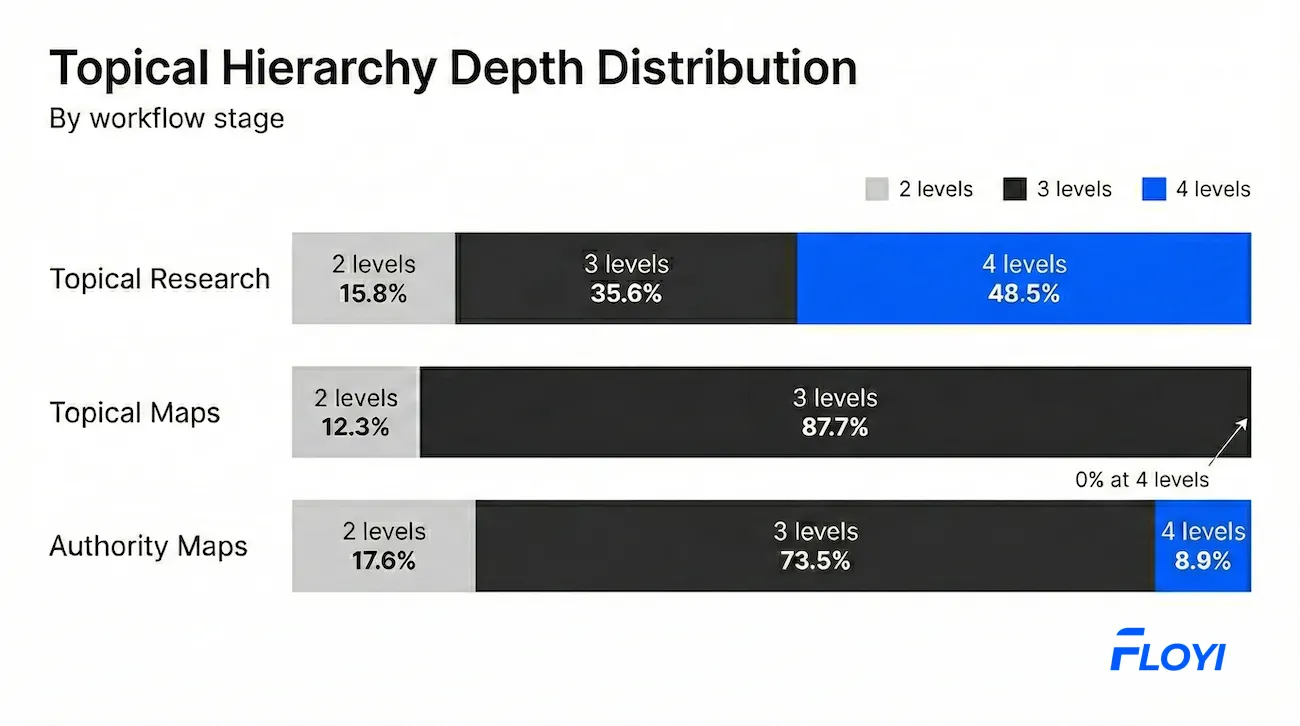
- A map runs up to four levels deep: Pillar, Hub, Branch, and Resource. Across 1,256 brands, 87.7% of maps settled at three levels after SERP validation.
- Every page in the map carries a topic, a primary keyword, an intent, a funnel stage, a parent, a URL slug, and its internal links.
- A keyword list records what people search. A keyword cluster decides which keywords share a page. A topical map arranges those pages into a hierarchy.
- Across 42 topical maps, websites ranking for at least half of a map’s topics were cited in 30.8% of its citing AI Overviews on average, against 0.14% for websites ranking for less than 5% of them.
- A topical map is a plan, not a ranking factor. Google sees the pages and links it produces, never the map itself.
What Is a Topical Map?
A topical map covers one subject, cut down to the topics your audience and your business need. It isn’t everything that could be written about the subject. It’s the set of pages that, together, answer what your buyers ask about it.
Search engines group queries by meaning and intent, so one page per intent does more work than one page per keyword. The map records that decision for every page before anyone writes. Two queries with the same intent share a page, and two with different intents get separate pages, even when the wording is close.
Here’s one Pillar from a map for an ecommerce email and SMS platform whose subject is ecommerce marketing automation:
- Pillar: Email marketing for ecommerce
- Hub: Abandoned cart emails
- Branch: Abandoned cart email timing
- Resource: How many abandoned cart emails to send
- Branch: Abandoned cart email examples
- Branch: Abandoned cart email timing
- Hub: Email list growth for online stores
- Branch: Signup popups for ecommerce sites
- Branch: Welcome discounts for new subscribers
- Hub: Ecommerce email deliverability
- Hub: Abandoned cart emails
Each line is one page. The Pillar targets one broad area of the subject, each Hub owns one facet of it and each Branch narrows a facet to an article-level topic. The Resource answers a question specific enough to crowd the Branch page if it lived there.
The names are page subjects, not keywords. Keywords attach to each page once clustering shows which queries belong together.
What Are the Core Components of a Topical Map?
A topical map has two parts: the levels that give it shape and the fields every page carries.
The Four Levels of a Topical Map
Each level has one job:
- Pillar: a broad area of the subject you want to own. Most maps have several, one for each major area.
- Hub: one major facet of the Pillar, broad enough to hold its own group of pages.
- Branch: a specific aspect inside a Hub, usually an article-level topic.
- Resource: a single page answering one narrow query under a Branch.
The rules for how the four map levels work come down to one test. Every page below the Pillar supports a broader parent, and every parent covers more ground than any one of its children.
Four is the most a map uses, not the target. Across 1,256 brands, 87.7% of maps settled at three levels after SERP validation, and none kept a fourth. Intent checks merge pages that would repeat each other, and that usually removes the fourth level. The study of how deep validated topical maps go breaks the numbers down by stage.
What Every Page in a Topical Map Carries
Each field settles a decision before a writer starts. Here they are for the “Abandoned cart email timing” Branch from the example above:
| Field | What it decides | Example |
|---|---|---|
| Topic name | The page’s subject and its place in the hierarchy | Abandoned cart email timing |
| Primary keyword | The query the page targets, with the variants in its cluster | “when to send abandoned cart emails” |
| Search intent | What the searcher wants from the page | Informational |
| Funnel stage | Where the reader sits in the buying process | TOFU |
| Parent | The broader page it supports and links up to | Abandoned cart emails (Hub) |
| URL slug | The address the page will live at | /blog/abandoned-cart-email-timing/ |
| Internal links and anchors | Which pages it links to, and with what words | Up to its Hub, across to the examples Branch |
The last row is where the map becomes an internal linking plan. Parents link down to their children, children link back up and siblings link across. Nobody has to guess where a new page’s links go.
How Is a Topical Map Different From a Keyword List, Topic Cluster or Content Silo?
A topical map is the only one of these documents that decides which pages should exist and how they connect. The others each answer a narrower question:
| Document | What it answers | Structure | Where it stops |
|---|---|---|---|
| Keyword list | What people search for | A flat list with volume and difficulty | Doesn’t say which keywords share a page |
| Keyword map | Which page targets which keyword | One row per URL, usually for pages that already exist | Doesn’t show what’s missing or how pages relate |
| Topic cluster (pillar-cluster) | Which articles support one pillar page | Two levels: a pillar page and its cluster articles | Every page hangs off one parent as the pillar grows |
| Content silo | How sections of the site stay separate | Folders or categories, with links kept inside each | A structure rule, not a list of pages to write |
| Content calendar | When each piece gets published | Dates, owners and status | Schedules pages without deciding which ones should exist |
| Topical map | Which pages a site needs on a subject and how they link | Up to four levels, with a parent and intent per page | Doesn’t schedule or write the pages |
“Cluster” means two different things here. A keyword cluster is the set of keywords one page targets, decided by whether Google ranks largely the same URLs for them. The method for grouping keywords by shared top-10 results settles that question one page at a time. A topic cluster is a pillar page with its supporting articles.
The map uses both. Keyword clusters set what each page targets, and the map arranges those pages more than two levels deep. A content hub, in the pillar-cluster sense, is one Hub in a topical map with the pages beneath it.
A silo tells you where pages live. A map tells you which pages to build.
Why Do Topical Maps Matter for SEO and AI Search?
For SEO, a topical map shows what’s missing before you write. For AI search, Floyi’s research found that websites ranking across more of a map get cited more often.
The SEO case rests on three effects:
- Gaps show up early: the map lists every page the subject needs, so a missing Hub or Branch is visible before you commission content.
- Each intent gets one page: every query has one home, which keeps two of your pages from competing for the same result.
- The link plan comes with it: parent, child and sibling relationships tell each page what to link to.
For AI search, Floyi’s Topical Authority Report measured how map coverage tracks AI citations across 42 topical maps and 354,955 AI citations. Three findings bear on why a map matters:
- Websites ranking for at least half of a map’s topics were cited in 30.8% of its citing AI Overviews on average, against 0.14% for websites ranking for less than 5% of them.
- Ranked coverage tracked AI citations more closely than Domain Rating on all four AI engines, at 0.51 against 0.09 on AI Overviews.
- 26.8% to 43.7% of AI citations went to websites that didn’t rank for that query but did rank elsewhere in the same map.
These are correlations, and the study doesn’t establish coverage as a cause of AI citations. They do show that citation share rises with ranked coverage across a defined scope. A topical map is how you define that scope.
What Does a Topical Map Look Like?
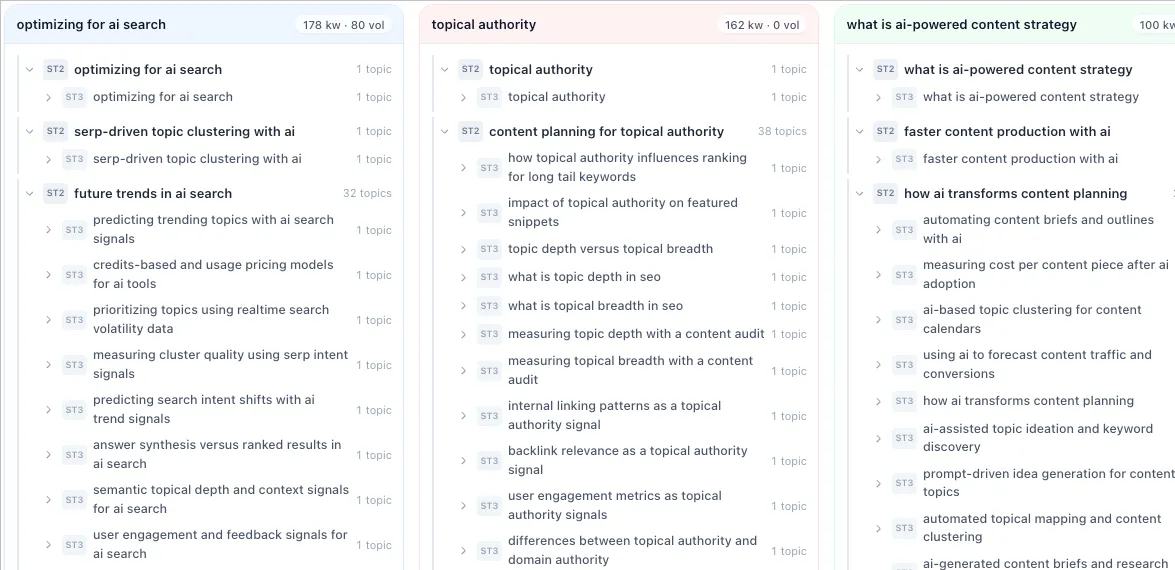
Most topical maps live in a spreadsheet, with one row per page or keyword and the fields above as columns. A tree diagram reads better in a meeting, but the spreadsheet is what writers and editors work from.
In Floyi, the Topical Map shows the same data in three views:
- Spreadsheet: the default editable grid, with column sets for the hierarchy and for content fields such as title, intent, journey stage, and URL slug.
- Silo View: one column per main topic, with its hubs and branches nested beneath. The ST2 and ST3 badges mark the Hub and Branch levels.
- Outline View: a collapsible tree with topic counts, for moving through large maps.
Maps export to XLSX, Google Sheets and Markdown, and the exports carry no Floyi branding, so an agency can hand one to a client as its own deliverable. If you already use Floyi, the Topical Map tool documentation covers each view and the export options.
How Do You Build a Topical Map?
A topical map gets built in a fixed order, because each stage settles a question the next one depends on:
brand and personas -> authority anchor -> topical research -> SERP clustering -> four-level map -> briefs
Brand Foundation and Audience Insights set what the brand stands for and who the content serves. The authority anchor names the one subject the map covers. Topical Research then builds up to four levels of topics, grounded in live Google and YouTube autocomplete.
SERP Clustering decides which keywords share a page. You set the overlap threshold from 20% to 90%, and 40% to 50% is the recommended range. The map arranges the resulting pages into Pillars, Hubs, Branches, and Resources. Each node then becomes one of the executable content briefs a writer works from.
Each stage carries its own decisions, and the eight-step build guide walks through them in order.
How Do You Know a Topical Map Is Working?
A topical map is working when its planned pages ship, rank and get cited. Track three numbers at every review:
- Planned vs. published pages per level: how much of each Pillar, Hub and Branch exists as a live page.
- Search Console impressions and positions per page: whether each published node is gaining ground on its target queries.
- AI mentions and citations per topic: whether AI Overviews, AI Mode, ChatGPT, and Gemini name or cite you on the map’s topics.
Record a baseline before you publish, then compare against it at each review. Targets come before tracking, and defining goals and metrics for topical maps ties each one to a business outcome.
In Floyi, the Topical Authority Scorecard tracks the map as a whole. It scores coverage of published topics, share of voice against competitors and AI presence across AI Overviews, AI Mode, ChatGPT, and Gemini. Topical Authority is a Pro and Scale feature.
Pick one subject your buyers ask about, then lay it out as Pillars, Hubs, Branches, and Resources in a topical map in Floyi before you brief the first page.
Topical Map Definition FAQs
1. Is a Topical Map the Same as Topical Authority?
No. The map is the plan, and topical authority is the result you earn as the planned pages rank and get cited.
In Floyi, the Topical Authority Score measures that result for the topics in a map, across content, market and AI authority.
2. How Many Levels Should a Topical Map Have?
Plan for up to four: Pillar, Hub, Branch, and Resource. In Floyi’s study of 1,256 brands, 48.5% built four levels during research, but intent checks folded most of that depth back to three.
In authority maps, 8.9% of brands kept a fourth level where a narrow area needed pages of its own.
3. Does an Existing Site Need a Topical Map?
Yes. Match your current pages to nodes in the map first, then fill the gaps and merge pages that compete for the same intent.
The free Content Audit tool at floyi.com shows the topic structure your site has today, which is the starting point for planning the one it needs.
4. Is a Topical Map a Google Ranking Factor?
No. Google doesn’t see or score your map. It sees the pages the map produces, the intent each one serves and the links between them, so the map’s value shows up only once those pages are live.
5. Is a Topical Map the Same as a Topographic Map?
No. A topographic map shows terrain and elevation with contour lines. A topical map plans the pages a website needs on one subject.
About the author

Yoyao Hsueh
Yoyao Hsueh is the founder and CEO of Floyi, the topical authority platform, and the founder of Main Heading, an SEO and AI search agency. He is an expert in topical authority and topical mapping. He created Topical Maps Unlocked, a course studied by thousands of SEOs, content strategists and digital marketers, founded TopicalMap.com, a done-for-you topical mapping service for agencies and enterprise teams, and publishes the weekly Digital Surfer newsletter on SEO, content strategy and AI search.
About Floyi
Floyi is a closed loop system for strategic content. It connects brand foundations, audience insights, topical research, maps, briefs, and publishing so every new article builds real topical authority.
See the Floyi workflow