
How to Maintain a Topical Map for SEO as a Living System
Learn how to maintain a topical map for SEO using Search Console, SERP, AI visibility, and content audit signals to decide when to add, merge or retire topics.
SEO topical maps don’t stay accurate just because their hierarchy was sound at launch. Pages go live, queries drift and results pages change. Maintaining a topical map for SEO means reconciling planned topics with live URLs, Search Console data, refreshed SERPs, and AI visibility on a fixed schedule.
A traffic drop alone doesn’t tell you whether a page needs content work, a technical fix or no change at all. Monthly page reconciliation and a quarterly SEO content audit separate seasonality, indexing issues, intent shifts, cannibalization, and genuine gaps. Floyi’s Organic Audit ties page metrics to the queries behind them, and its Visual Map shows performance and AI search presence across the whole hierarchy.
Each decision should be the smallest useful change: improve, add, consolidate, redirect, or retire. Record a baseline and a ship date for every change so the next review can measure it against an equivalent period.
Topical Map Maintenance Key Takeaways
- Keep one authoritative record for every planned and published URL.
- Track map ID, parent ID, URL slug, status, review date, and next action on every row.
- Check new pages weekly, reconcile performance monthly and review structure quarterly.
- Diagnose a traffic decline before changing content, links or page status.
- Check query-to-URL fit before adding a page for new demand.
- Consolidate only pages that serve substantially the same search intent.
- Measure each change against its baseline over an equivalent period.
Set Up a Living Map Record
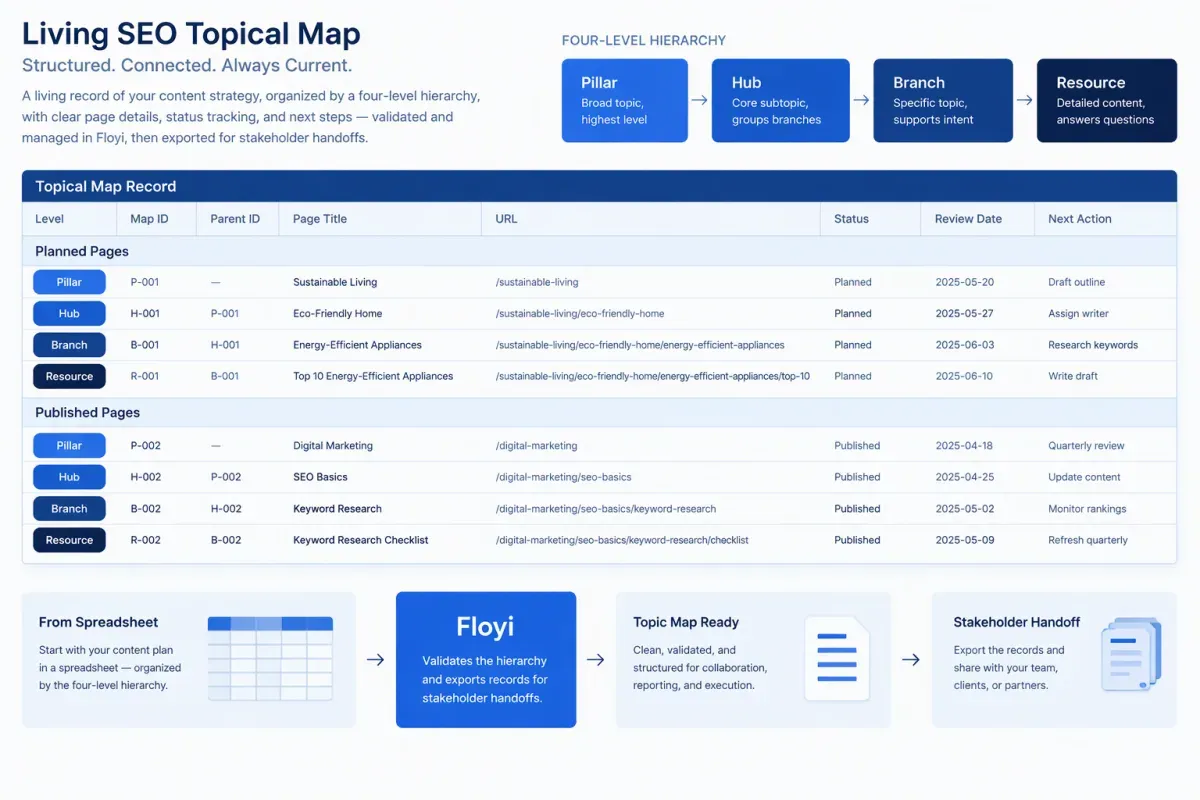
Knowing how to maintain a topical map for SEO starts with one editable record. Every planned or live page gets one row, and every decision about that page lands in that row. That record is what turns a topical map into a living SEO system rather than a one-time deliverable.
A Google Sheets topical map is enough for most sites. Move to a database or a connected content management system when you need filtered views, linked records or workflow visibility. Whatever the format, don’t run parallel trackers. Two sheets that disagree on a page’s purpose, status or URL do more damage than one sheet that’s a week behind.
The eight-step topical map build sets the initial structure. Once you build a topical map, maintenance keeps it accurate after publication. Each row carries a stable map ID, a parent ID and a URL slug, so the record still reads as a structured topical map after sorting or export:
- Pillar: Email Marketing
- Hub: Deliverability
- Branch: Authentication
- Resource: DMARC Setup
- Branch: Authentication
- Hub: Deliverability
The same path as a table row looks like this:
| Map path | Page attributes | Performance record | Next action |
|---|---|---|---|
| Email Marketing > Deliverability > Authentication > DMARC Setup | Informational intent, /email/dmarc-setup/, Needs Update | Dated impressions, clicks, CTR, conversions, and review date | Improve after a results check and a live-site check |
An SEO content map audit starts before a new query becomes a brief. Check the existing rows and live URLs first. That one habit prevents most duplicate pages and is the cheapest way to prevent keyword cannibalization.
Each row should carry four groups of fields:
- Strategy: search intent, content type, buyer-journey stage, one primary keyword, and supporting queries.
- Production: proposed and live URLs, owner, brief or draft location, publish date, and update date.
- Relationships: parent ID and the internal links in and out.
- Review: review date, dated performance fields, a short decision note, and one next action.
If several people edit the record, decide who approves map changes before the first review. That question sits at the center of running one map across a team.
Lifecycle status turns the record into a working queue: Planned, In Progress, Published, Needs Update, Updating, Consolidated, and Redirected. Pair each reviewed row with one action, such as Create, Improve, Merge, Redirect, or No Change. An old URL isn’t the same as a page someone reviewed and deliberately left alone.
Floyi’s Topical Map validates the hierarchy and exports to XLSX, Google Sheets or Markdown for stakeholder handoffs. The Topical Authority Scorecard reports Coverage as the importance-weighted share of mapped topics that have a live page, which gives every review one number to compare.
Schedule Monthly, Quarterly and Event Reviews
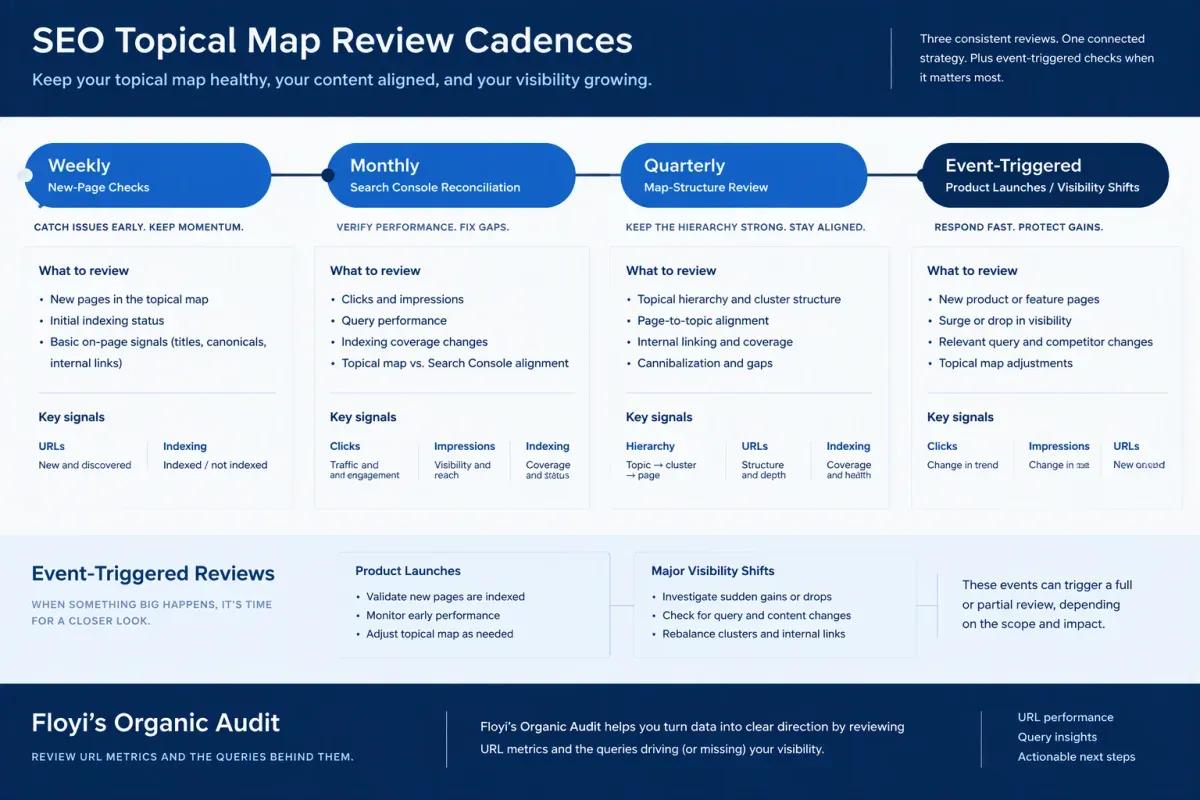
Run SEO topical map maintenance at three speeds rather than as a daily rebuild. Weekly checks catch new pages, a monthly topical map update reconciles live performance and a quarterly SEO content audit handles structure. These are working intervals, not Google requirements, so scale them to your publishing volume. An informational blog that publishes several posts a week can run the full review monthly. A SaaS website with a stable product line can run it quarterly.
-
Check new pages weekly. Compare each new URL with the record. Confirm it’s live, indexed where appropriate, linked from its intended hub, and marked with the right status. Update the URL, link state and publish date the same day, because small gaps get hard to trace after a few release cycles.
-
Reconcile performance monthly. The monthly SEO content audit pulls clicks, impressions, average position, and query detail from Search Console for every live page. Update each row’s metrics and status from it. The By Page view in Floyi’s Organic Audit lists every URL that has search data and expands each row into the queries behind it. When a URL is matched to the wrong topic, fix the match from the page side or the topic side.
-
Review structure quarterly. Check whether pillars, hubs, branches, and resources still match your content strategy and search demand. Compare planned work with what actually shipped. Incomplete coverage, overlapping pages and topic-level trends can each justify a new page, a consolidation or a change in priority. Judge the quarter by the metrics that show a map works, not by single-URL movement.
Falling clicks or impressions are a diagnostic signal, not an automatic reason to rewrite or retire a page. Separate content decay from seasonality, ranking losses, stale information, intent mismatch, and crawl or indexing problems. A seasonal page may need no change at all. A page losing impressions because it dropped out of the index needs a technical fix before any editorial work.
Quarterly reviews should also protect what works. Reorganizing a strong hub before the evidence warrants it can break link paths that already earn traffic. Keep effective pages and links intact, and focus on real overlap, weak coverage or changed user needs.
Pull a review forward after a product launch, a pricing or feature change, an industry-standard update, or a major shift in traffic, visibility or audience questions. Refresh the affected branch of the map first, then decide what each URL needs.
Map Live Signals to Map Actions
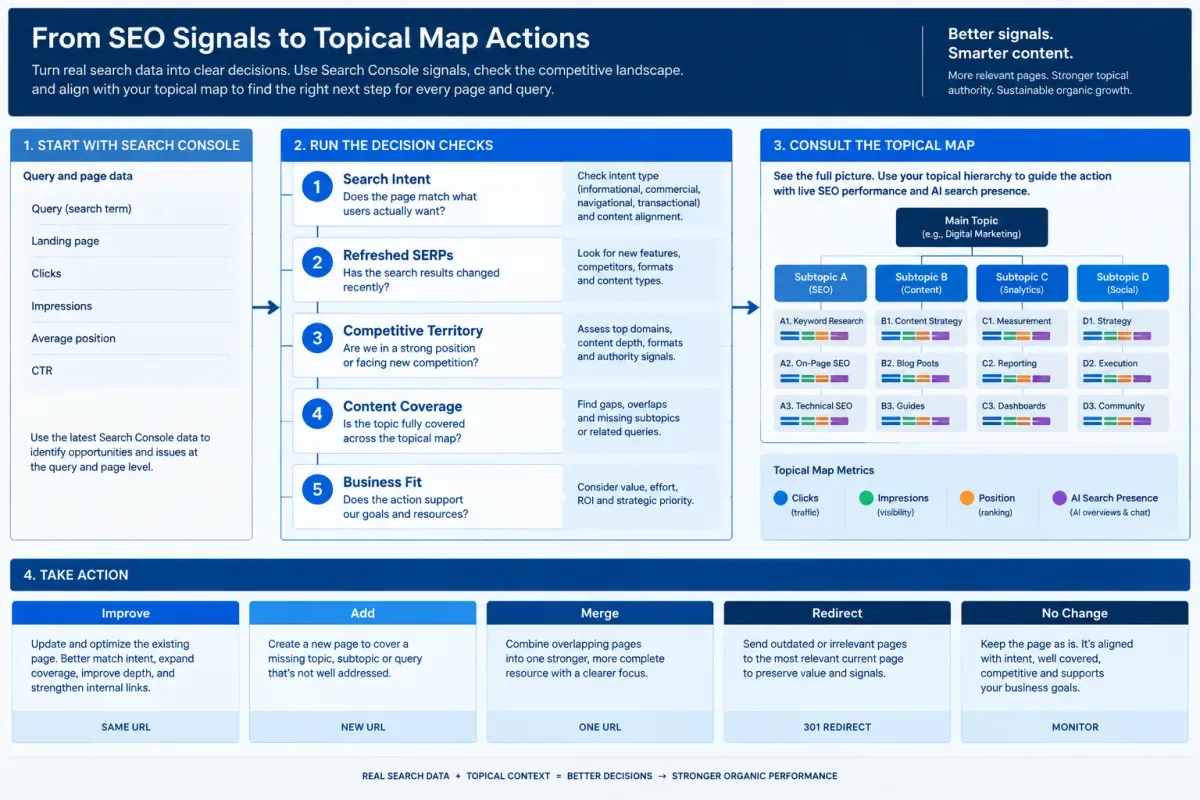
Map changes should follow combined evidence from demand, intent, page performance, and business fit, not one ranking movement. An unmapped query isn’t a publishing assignment until it passes that test.
Start each review with equivalent date ranges and paired query and page exports from Search Console. Look at impressions, clicks, CTR, average position, and indexing status, then add analytics conversion data where you have it. High impressions with weak CTR can mean broad visibility that doesn’t produce qualified visits. A lower-volume query with few clicks can still deserve attention when it converts.
Work through the evidence in this order:
-
Validate the query. Check which URL Google ranks, the intent that page serves and its fit with your audience and offer. An existing page can satisfy demand even when the map has no matching Resource, so an unmapped query isn’t automatically a content gap.
-
Inspect live results. Refresh the results for priority hubs and pillars to track search intent changes before they distort the map. Review the result mix, People Also Ask, related searches, forum threads, competitor changes, and new terminology. Repeated buyer questions can justify a subtopic. A one-off phrase usually can’t. When the results have shifted across a whole hub, re-cluster with fresh SERP data before editing individual pages.
-
Assess competitive territory. In SEO content gap analysis, competitor coverage shows territory to evaluate, not topics you must publish. Score candidates on audience need, business potential, search volume, traffic potential, and ranking difficulty. Drop candidates that score poorly on at least two of brand relevance, business potential, search volume, and traffic potential. Keep realistic lower-volume topics that a newer site can win.
-
Audit coverage and attribution. A content gap audit asks whether each hub answers the audience’s real subtopics, not whether it targets every keyword variant. Declining URLs, outdated facts, missing decision-stage questions, weak internal links, and keyword cannibalization can all change the diagnosis.
Common signals translate into map annotations like this:
| Signal | Likely interpretation | Proposed direction |
|---|---|---|
| Several pages receive the same query set | Architecture or attribution conflict | Investigate overlap before adding coverage |
| A page earns impressions from loosely related searches | Broad reach with weak topical precision | Tighten scope or correct attribution |
| Repeated buyer questions appear in the results | Durable intent shift | Evaluate a new Branch or Resource |
| A competitor covers a relevant low-demand topic | Potential supporting coverage | Keep only when business fit is clear |
Floyi’s Organic Audit attributes your queries to mapped topics, and its By Page view is where misattributed pages and cannibalization show up. The Visual Map colors the hierarchy by position, impressions, clicks, or AI search presence and rings published topics, so weak hubs stand out at a glance.
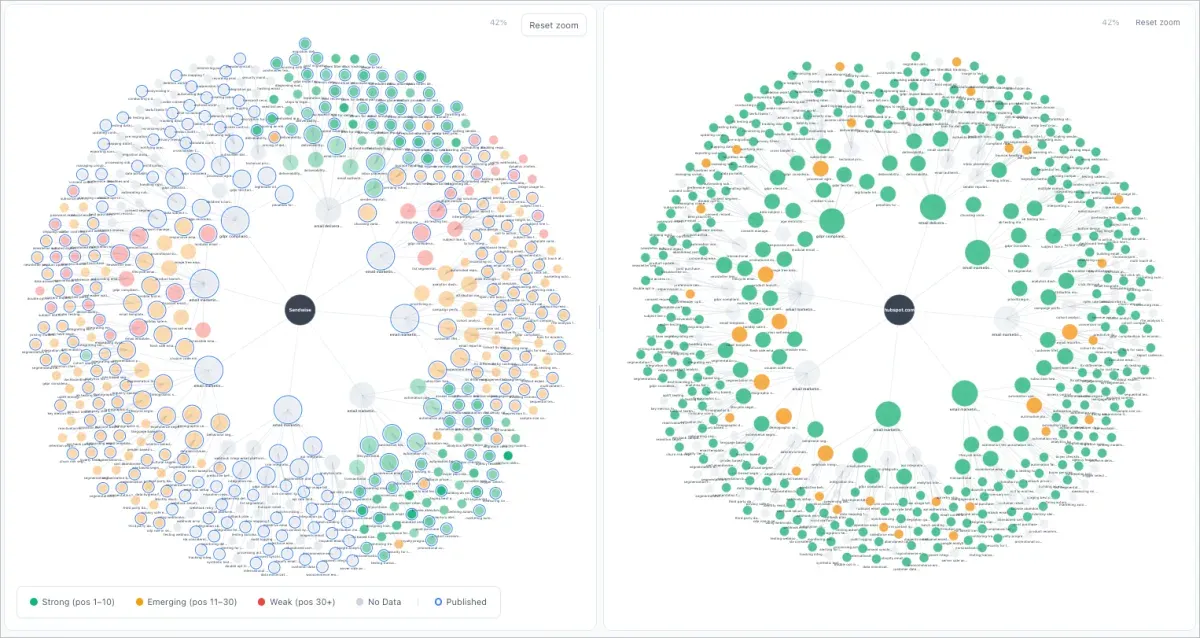
Record the signal, the affected topic or URL, the observed intent, business fit, and the proposed direction before the next review decides anything. Then compare performance against the next equivalent period.
Decide Whether to Add, Merge or Retire
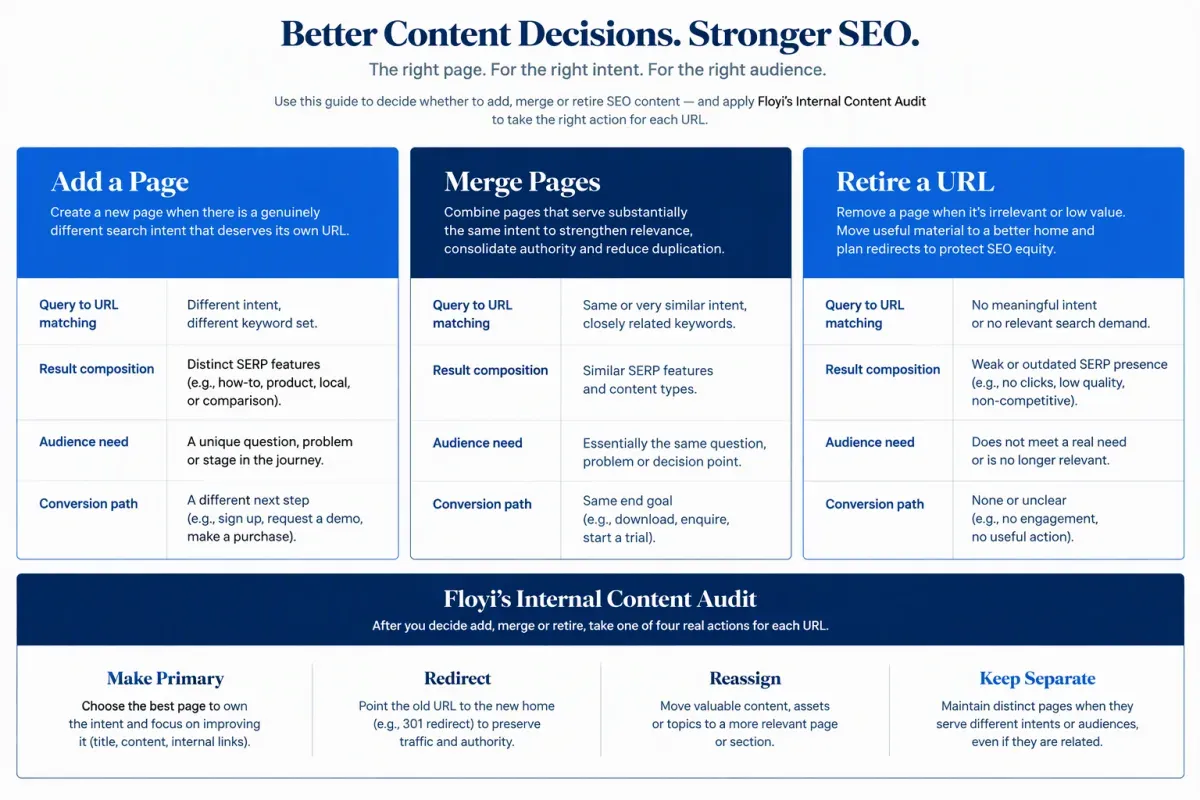
A defensible add, merge or retire decision starts with query-to-URL fit. Map each priority query to its ranking URL and its intended map destination, then pick one action: create, refresh, expand, retarget, internally link, consolidate, redirect, or leave unchanged. A query with no suitable destination can justify a new page. Weak fit usually calls for improving the existing URL before you create a near-duplicate.
Run the same sequence for every candidate:
-
Match demand to the map. Record the target query set, current ranking URL, map role, and intended destination. This exposes pages without a clear role and queries without a credible home.
-
Check search intent and existing page coverage. Review the page’s query mix, on-page scope, rankings, and live results. A URL that already ranks for many related queries may meet that demand without a supporting page.
-
Diagnose weak clicks before adding content. Low CTR on high impressions can mean a weak title, a stale snippet, poor format fit, misaligned intent, or a more direct competitor. A fresh look at the results separates an on-page problem from a changed SERP.
-
Choose the smallest useful change. Expand a page when new material deepens its existing promise. Add a page only when results show a distinct question, format, audience need, or commercial gap that the hub can’t cover without losing focus.
A comparison page and an implementation guide can share most of their terms while serving different buyer stages and conversion paths. That difference is what separates a useful addition from filler.
Keyword cannibalization isn’t two URLs using similar vocabulary. It’s two pages competing to satisfy substantially the same need. Before you call it cannibalization, compare these signals:
- Primary intent and result composition: shared terms alone don’t justify a merger.
- Query mix and ranking behavior: one URL may draw research demand while another supports evaluation.
- Content depth and format: a calculator, a template, a comparison, and an explanatory guide can each earn a separate place.
- Audience and conversion path: different personas or funnel stages can support separate URLs.
- Backlinks, conversions and unique value: the weaker page may hold authority, revenue or material the stronger one lacks.
Floyi’s Internal Content Audit resolves competing pages with four actions: Make Primary, Redirect, Reassign, or Keep Separate.
The consolidation call comes down to that comparison. Merge pages that meet the same intent into the stronger resource. Keep pages with distinct value separate. Retire only irrelevant, low-value URLs with no case for keeping them. Move useful material to the primary page, update internal links and redirect the retired URL.
Record the query set, map role, action, and review date for each verdict, then recheck rankings, clicks and conversions after the change ships.
Reconcile Site Content Against the Ideal Map
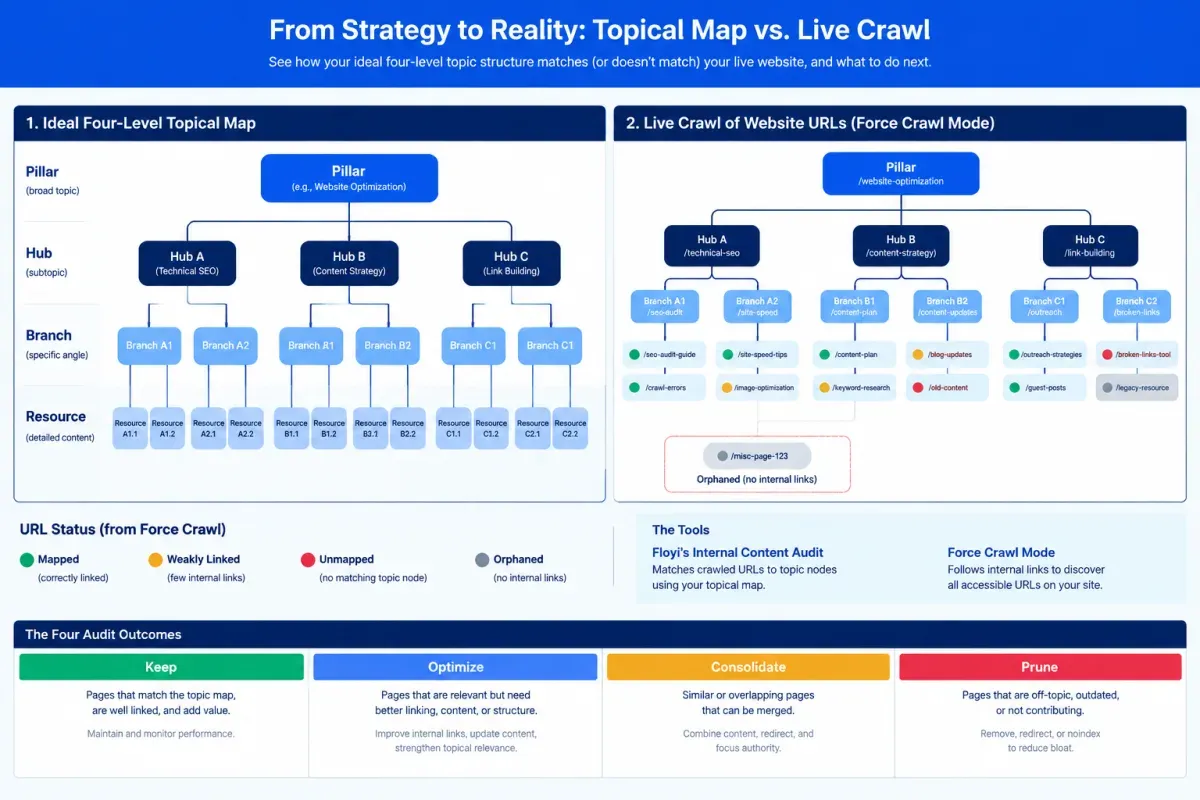
To audit existing content against a topical map, start from the ideal map, not the current URL inventory. Assign every live page to one mapped topic and one primary search intent: informational, commercial, transactional, or navigational. Flag pages that duplicate another URL, mix incompatible intents or don’t belong in the map. Starting from the map keeps legacy content from redefining your topical scope.
Then check that internal linking aligns with the map’s topic clusters:
-
Pillar paths. Each pillar acts as the parent destination for its hubs. Supporting pages link back to it in context, and the pillar links out to its priority supporting pages through navigation and body links.
-
Sibling paths. Link related supporting pages when the next page advances the reader’s task. An informational guide can lead to a commercial comparison when it prepares someone to weigh options, but conversion pages don’t belong in every article.
-
Crawl paths. Every mapped URL needs at least one crawlable, contextual link from a discoverable page. A page reachable only through the XML sitemap isn’t part of the structure yet.
The practical test of SEO content architecture is whether a reader and a crawler can move from a broad pillar to a specific answer without crossing unrelated topics. Anchor text should state the destination’s topic and intent. “Expired dog food” should point to expiration content, not to a page about whether dry dog food causes cancer. A valid link can still send the wrong topical signal when its anchor is vague.
A map diagram can’t show orphan pages. Compare a full crawl against the map, then investigate URLs that are unmapped, weakly linked or found only through the sitemap. Floyi’s Internal Content Audit matches crawled URLs to your topic nodes, and its Force Crawl mode follows links instead of the sitemap when sitemap discovery is incomplete. It sorts each page into one of four outcomes:
- Keep: the page matches its mapped topic and serves a distinct intent.
- Optimize: the page belongs in the map but needs a sharper purpose, tighter focus or better links.
- Consolidate: several pages compete for one topic. Choose a primary page, then redirect or reassign the rest.
- Prune: the page has low value or no valid role in the map.
Search performance can also expose a valid unmapped topic. If a page ranks by accident for a separate topic, add that topic to the map. Give it its own page rather than forcing one page to do two jobs.
Assign Owners, Execute Changes and Measure Outcomes
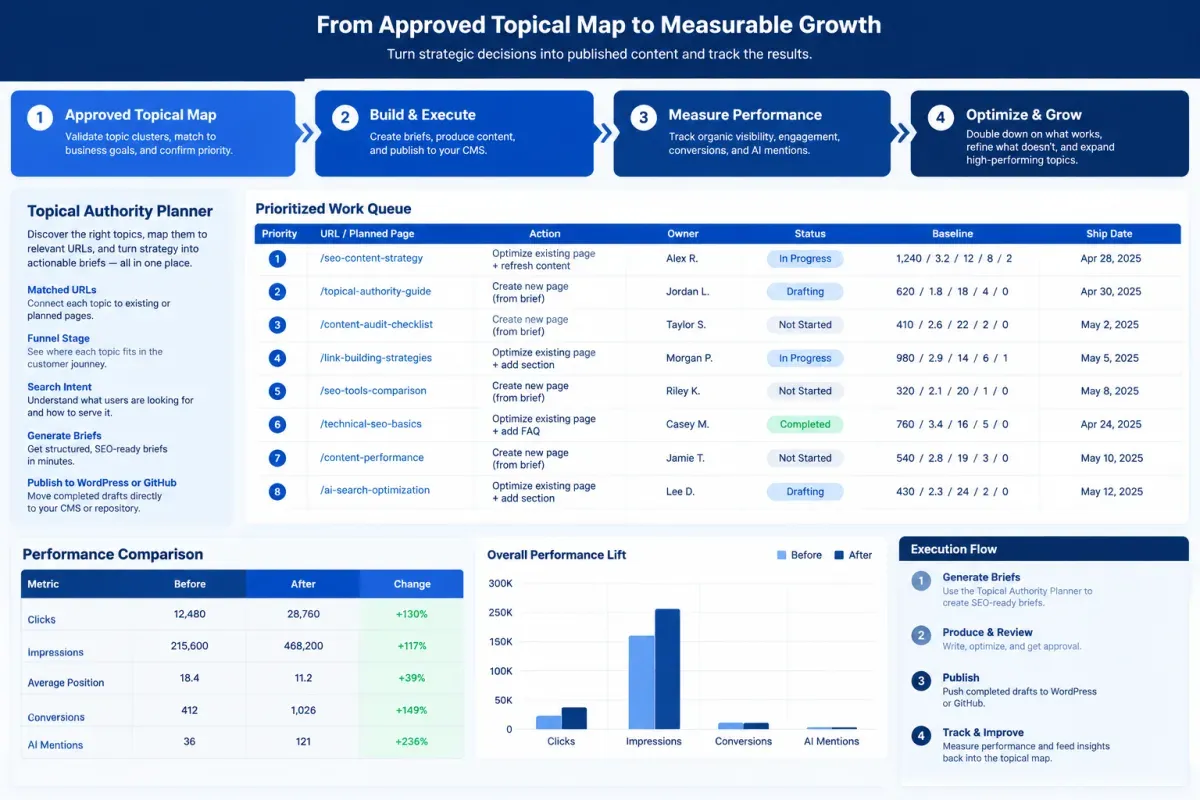
Every approved map decision becomes a work item with the affected URL or planned page, the action, an owner, a status, a baseline, and a ship date. Separate items ready to publish from work that still needs a brief, a redirect, a link repair, or a content decision. That split keeps the map tied to delivery instead of turning into a polished backlog.
A simple SEO prioritization model makes competing changes comparable. Score expected impact, business relevance and implementation effort from 1 to 5, then calculate (impact × relevance) ÷ effort. Treat the result as a way to compare tasks, not as a ranking forecast. Weight revenue-critical buyer journeys above search volume, especially where demand is new or AI search data is thin.
Early capacity usually belongs to four kinds of work:
- Existing traction: improve commercially relevant URLs already earning Search Console clicks or impressions.
- Broken paths: repair internal links, orphan pages and redirects that cut off important pages.
- Material gaps: add a needed page where the map shows missing coverage, not another variation of an existing query.
- Content decay: refresh an outdated page that lost visibility because the topic, product or SERP changed.
Search Console and a spreadsheet are enough to start. Track the action, score, status, baseline, and ship date in the record. A paid keyword tool or site crawler adds depth when diagnosis needs it, so check each vendor’s feature page for what it covers.
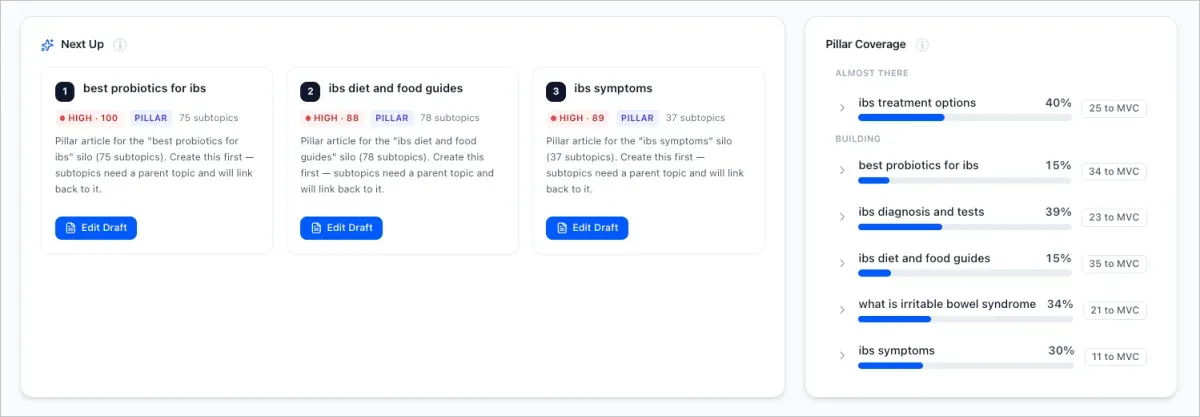
In Floyi, the Topical Authority Planner keeps the queue attached to the map. A topic’s matched URL shows Search Console clicks, impressions, average position, and query count, with impression sparklines after multiple imports. Funnel stage and search intent sit on the same row. From the Planner you can generate briefs and publish completed drafts to WordPress or GitHub, one at a time or in bulk. Check that each topic is matched to the right URL before you report on it, because a wrong match can make a sound decision look ineffective.
Give each change enough time for crawling, indexing and seasonality to settle before you judge it. Compare completed work with its baseline. Review which topics gained or lost ground, and check AI mentions or citations where you track them. Keep changes that strengthen people-first content, investigate weak results before repeating a tactic and feed the findings into the next review queue.
Run your next map review in Floyi to see coverage, rankings and AI search presence on one hierarchy.
How to Maintain a Topical Map FAQs
These questions cover the maintenance decisions that come up between reviews, from defining a living map to tracking how it changes.
1. What Is a Living Topical Map?
A living topical map is a maintained semantic blueprint, not a one-time keyword list. It records the scope a site intends to cover and the audience intent behind each area. It also tracks which pages and internal links exist today. The hierarchy runs from broad pillars to specific subtopics, with keywords attached to each level. Electric cars might narrow to electric-car brands, then Tesla, then Model S, then Model S care.
2. How Often Should You Update a Topical Map?
Review monthly if you publish weekly or work in a fast-moving topic, and quarterly if the site is stable. The deciding factor is how fast the record goes stale. If many rows change status between reviews, the interval is too long. Weekly spot checks on new pages are optional, and none of these intervals is a Google requirement. Move a review forward after a launch or a sharp performance shift.
3. When Should You Split a Topic Cluster?
Split a hub only when refreshed results show distinct intents or audiences that one page can’t serve well. Keyword variants alone don’t justify another URL. If the results for two queries share most of their top-ranking pages, one page should cover both. If they share few, such as an informational guide and a transactional product page, separate pages earn their place.
4. Can Seasonal Trends Change Your Topical Map?
Seasonal demand should trigger a review, not a permanent change. Compare this year’s impressions and query mix with the same period last year. Add a lasting page only when the pattern repeats every season, the existing hub misses the seasonal intent and the topic fits your pillar. A one-time spike from a news event doesn’t belong in the hierarchy.
5. How Do You Track Topical Map Version History?
Keep a dated change log next to the record, with one entry per decision. Each entry names the affected URL, the action, the reason, the owner, and the evidence behind it, such as the query export or results check. Log deliberate holds too. A logged No Change tells the next reviewer the page was checked, not forgotten.
About the author

Yoyao Hsueh
Yoyao Hsueh is the founder and CEO of Floyi, the topical authority platform, and the founder of Main Heading, an SEO and AI search agency. He is an expert in topical authority and topical mapping. He created Topical Maps Unlocked, a course studied by thousands of SEOs, content strategists and digital marketers, founded TopicalMap.com, a done-for-you topical mapping service for agencies and enterprise teams, and publishes the weekly Digital Surfer newsletter on SEO, content strategy and AI search.
About Floyi
Floyi is a closed loop system for strategic content. It connects brand foundations, audience insights, topical research, maps, briefs, and publishing so every new article builds real topical authority.
See the Floyi workflow