
Topical Authority for Local SEO: The Complete Guide
Learn how to build and measure topical authority for local SEO with GBP alignment, local pages, internal links, KPIs, and coverage audits.
Topical authority for local SEO helps agencies and local content teams build pages that win map pack, local organic, and AI-assisted visibility. It works when site content proves relevance, distance fit, and reputation with business signals tied to real services and service areas.
The workflow covers topic research, page mapping, Google Business Profile alignment, LocalBusiness schema, internal linking, and coverage audits. It also shows how to measure progress with TAS, rankings, calls, form fills, and AI surface presence. The result is a set of topical maps, AI-assisted briefs, refresh rules, and reporting cues you can use across locations.
Local search now rewards proof-based pages, so regional content leads need a system that scales without duplicate service plus city templates. Freelance SEOs and franchise content directors care because stronger topical coverage drives qualified calls, cleaner reporting, and better use of budget. A location page that matches GBP fields, LocalBusiness schema, and a city-specific internal link path can beat a broad blog post, and the sections below show the workflow.
Topical Authority for Local SEO Key Takeaways
- Local SEO works best when pages prove relevance, proximity, and reputation.
- Topical authority should map to services, locations, and real customer intent.
- Google Business Profile and site content need matching categories, services, and proof.
- LocalBusiness schema and service schema help search engines classify page purpose.
- Internal links should connect pillar, service, location, and support pages.
- Measure progress with TAS, rankings, GBP engagement, and conversions together.
- Reviews, citations, and local backlinks reinforce trust and topical coverage.
Does Local SEO Still Work In 2026?
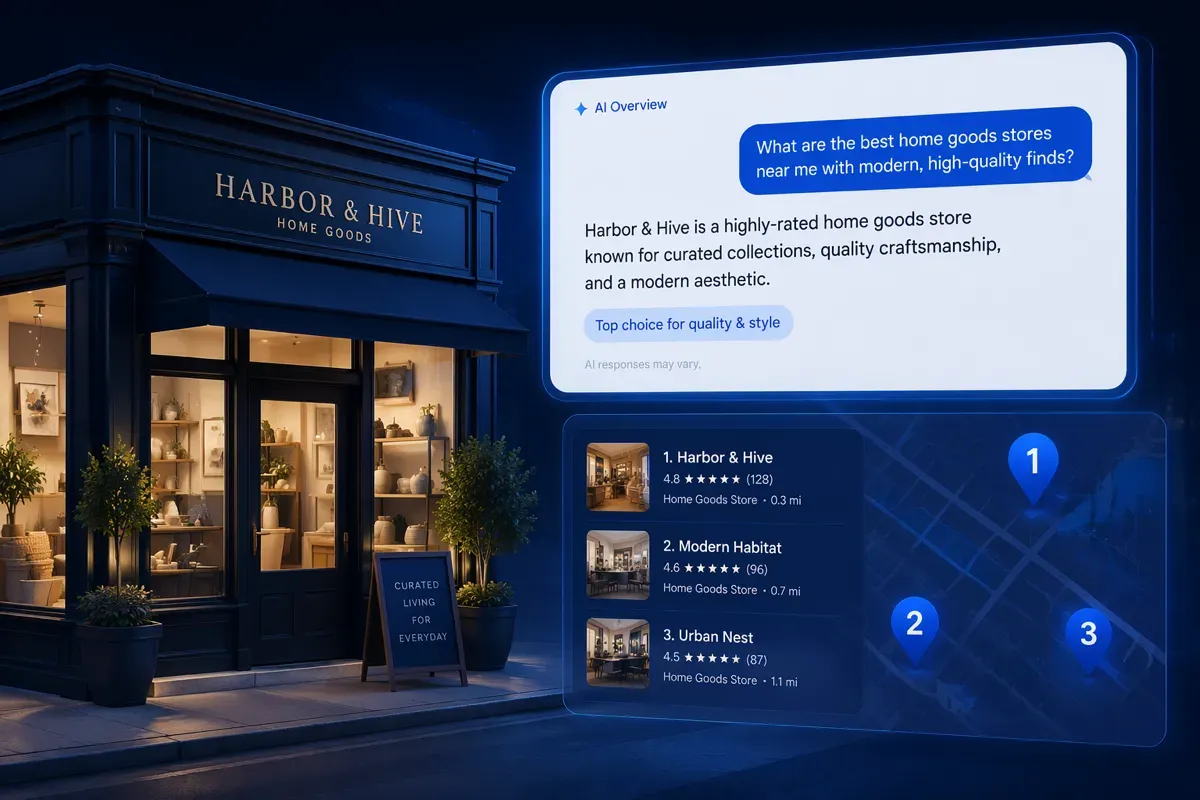
Yes, local SEO still works in 2026, but it works best when you treat it as local search visibility across the map pack, local organic results, and AI-assisted answer surfaces rather than as a path to generic blog traffic. The businesses that keep winning prove local relevance, proximity fit, and reputation with clear business signals. That matters even more now because artificial intelligence (AI) search experiences compress broad informational demand and reward pages grounded in real entities, places, and services.
The biggest shift is the rise of answer engine optimization (AEO), AI Overviews, AI Mode, and chat-style search results. Those formats reduce the payoff for thin educational posts that could fit any market. They also raise the bar for localized content, because search systems need stronger proof that a page belongs to a real business in a real service area.
AI summaries can reduce clicks on some informational queries, while local intent still depends on signals such as business relevance, distance, and reputation (source, source). That means your content has to be entity-rich, specific, and tied to how customers actually buy.
Local ranking signals have not disappeared. They still cluster around three core drivers:
- Relevance: the page matches the service, product, or intent behind the query
- Distance: the business is close enough to serve the searcher well
- Reputation: reviews, citations, links, and brand proof support trust
A complete Google Business Profile, consistent name, address, and phone data, reviews, local citations, backlinks, mobile-friendly pages, fast load times, clear calls to action, and schema markup all reinforce those drivers. None of these signals works alone. Together, they tell search engines that your business is legitimate, reachable, and a strong local fit. Understanding how building topical authority for SEO and AI search works helps explain why coverage depth matters as much as proximity for local results.
The page types that still perform best are tied to real commercial intent. Home pages, service pages, location pages, and service-area pages usually do more for visibility than broad blog posts because they can state the business name, location, offer, and geography with precision. Service + city pages still matter when they answer real demand instead of repeating near-duplicate templates.
A practical comparison looks like this:
| Page type | Best use | What it must prove |
|---|---|---|
| Home page | Brand and primary local trust | Who you are, where you operate, and what you do |
| Service page | Core commercial intent | The service, the outcome, and the service area fit |
| Location page | Physical presence or branch support | Exact location, local proof, and local relevance |
| Service-area page | Coverage beyond a storefront | Geographic reach, service boundaries, and contact path |
| Blog post | Supporting authority | A real local question, service variation, or market need |
A practical local SEO plan usually starts with the pages that convert best, then adds internal links and supporting content that help those pages earn visibility (source, source). Blogs still help, but only when they reinforce a real service line, location, or customer question. A solid planning framework that connects clusters to revenue pages is the right planning layer because it connects topical clusters to revenue pages instead of treating content as isolated traffic bait.
That approach works because topical coverage should map to intent, not volume. Build clusters around service variations, local objections, pricing questions, seasonal concerns, and location modifiers. Then connect those pages back to the core service or location page with a clear internal linking pattern. For teams managing multiple territories, this is where local SEO topical authority becomes measurable instead of vague.
A simple priority order keeps the work grounded:
- Strengthen the pages that already capture leads.
- Add supporting pages for the highest-value service and location combinations.
- Use blogs only when they answer a local question that supports conversion.
- Tie every page to a real business proof point, such as staff, service area, reviews, or location details.
The measurement lens is also different in 2026. If local SEO is working, you should see stronger map pack visibility, better rankings for location-plus-service searches, more qualified calls and form fills, and a more stable presence across Google Business Profile, organic local pages, and branded search. Content depth matters, but only when it reflects business proof and not raw word count.
The clearest signs of progress usually look like this:
- Visibility: more appearances in the map pack for high-intent local queries
- Relevance: better rankings for service-plus-city terms and nearby variations
- Conversion: more calls, direction requests, and forms from local pages
- Consistency: stronger alignment between your website, Google Business Profile, and citations
- Authority: broader coverage of the topics that matter to your service area and customer journey
That is the test for modern local SEO. If your pages help search engines verify who you are, where you work, and why you are the right fit, the channel still drives qualified demand in 2026. If your content is broad, generic, and disconnected from the business, AI-driven search will usually ignore it.
How Do You Build Local Topical Authority?
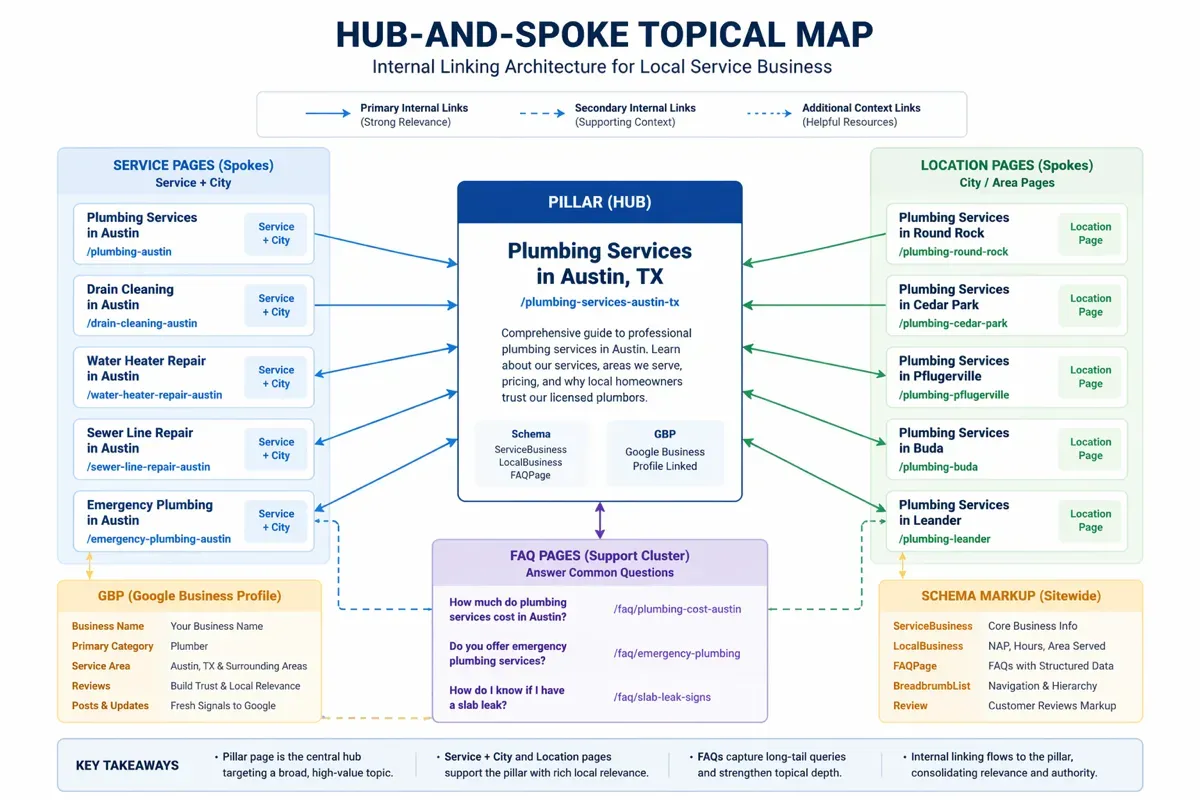
Local topical authority comes from one connected system. We build that system around a topical authority model, then align every page, profile field, schema element, and link so the site sends one clear signal about what the business sells and where it serves.
The first move is scope. Start with a topical map for local SEO that centers on your core service, the city or service-area variations you actually sell, and the questions prospects ask before they convert. From there, assign one page type to each intent so search engines can read the structure cleanly and users can move through it without friction.
A practical page model looks like this:
| Page type | Primary job | Best query shape | Role in the funnel |
|---|---|---|---|
| Pillar pages | Organize the topic and connect the cluster | Broad service topic or category | Mid-funnel education and navigation |
| Service pages | Capture high-intent commercial searches | Service name plus problem or benefit | Bottom-funnel conversion |
| Location pages | Match service-plus-city demand | Service plus city, neighborhood, or service area | Local intent and proximity relevance |
| Supporting content | Answer adjacent questions and objections | Comparisons, how-tos, FAQs, cost, timing | Early education and internal support |
That structure creates topical clusters that map cleanly to buyer intent. It also protects pillar pages from competing with service pages, which is a common source of cannibalization in local SEO topical authority work. Strong content clusters usually start with one primary service line and then expand into adjacent questions instead of trying to cover everything at once.
Your Google Business Profile should follow the same hierarchy as the site. Categories, services, descriptions, photos, and posts need to reinforce the same services and locations that appear on the site. When GBP and the website point to the same local offer, the profile supports the page instead of fighting it.
Use this alignment checklist to keep the profile and site in sync:
- Primary category: Match the main revenue service as closely as possible.
- Secondary categories: Add only services that fit the real offer and the landing pages you have.
- Services field: Mirror the wording and order of the highest-value service pages.
- Description: Reinforce service area, outcomes, and brand positioning without stuffing keywords.
- Photos and posts: Tie visuals and updates to the same locations, service lines, and proof points that appear on the site.
Site architecture does the heavy lifting after that. Service pages should target the highest-intent searches, location pages should handle service-plus-city variations, and pillar pages should connect the cluster without sending mixed signals. That separation helps build topical authority for local sites because each page has a distinct job and a distinct search purpose. The principles behind organizing silos to reinforce topical signals apply directly to local SEO when you treat each service line as its own silo.
Structured data gives search engines a clearer read on the entity and the geography. Use LocalBusiness schema sitewide where it fits the business model, then layer Service schema on service pages and FAQ schema where the page copy already answers common questions. The goal is to make the page model easier for search engines to classify and trust.
Internal linking for topical relevance should be deliberate, not random. Link from the pillar page to the main service pages and city pages, then link back from those pages to the pillar so the cluster stays connected. Descriptive anchors work best when they name the topic and the location, because they help Google connect the entity, the service, and the geography in one graph.
A simple linking pattern keeps the system stable:
- Start at the pillar page: Link out to the main service pages and the highest-value location pages.
- Support the service pages: Link to the pillar, related FAQs, and the most relevant location page.
- Support the location pages: Link to the service page, local proof points, and nearby supporting content.
- Use supporting content as reinforcement: Link back to the pillar and the most relevant commercial page.
- Review anchor text: Keep phrases specific, natural, and tied to the page intent.
Content depth alone will not hold the rankings. Relevant citations and backlinks from local chambers, associations, suppliers, partners, and industry publications help validate the business in the real world. Those signals support the entity, the service area, and the trust story that search engines use when comparing local results.
A 90-day rollout can keep the work manageable when the plan is split into scope, publishing, and expansion phases. Month 1 can define scope and map the topic structure. Month 2 can publish the first cluster, tighten internal links, and align profile fields. Month 3 can expand into adjacent questions and refine the pages from performance data. Floyi’s Topical Maps Builder let you build the local topic structure visually and assign page types before writing starts, so the rollout stays organized from day one.
- Month 1: Define scope, inventory current pages, record baseline rankings and conversions, and map the local topic structure around one service line.
- Month 2: Publish the first cluster, tighten internal links, align GBP fields, and add the right schema to the main page types.
- Month 3: Expand into adjacent questions, fill content gaps, earn a few relevant local mentions, and refine pages based on rank movement and conversion data.
That cadence turns strategy into a working system. When you connect page intent, GBP alignment, schema, links, and citations, you build local SEO topical authority that can scale with less guesswork and stronger local visibility.
How Do You Measure Local Topical Authority?
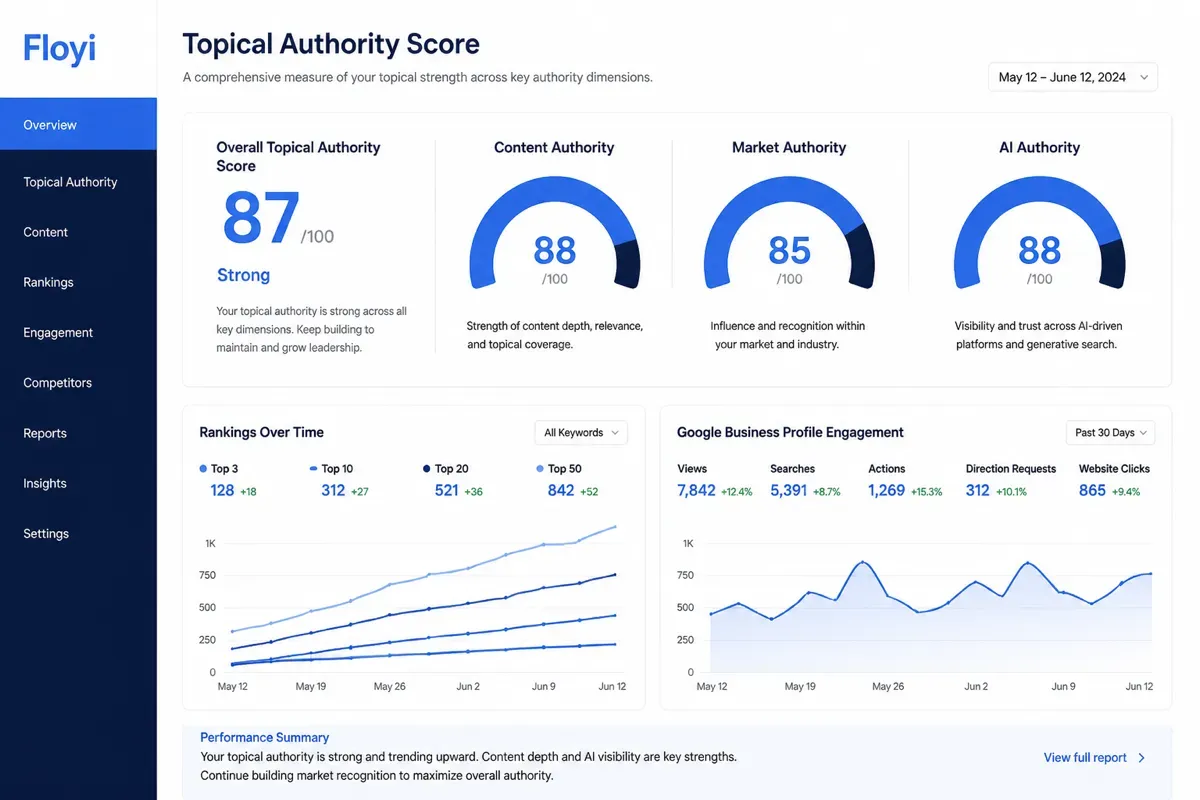
A practical scorecard gives topical authority for local sites a number you can defend in a meeting. The cleanest model is a Topical Authority Score, or TAS, built from three parts: Content Authority, Market Authority, and AI Authority. Content Authority measures how fully the topic set is covered. Market Authority shows how much local demand and ranking value you own. AI Authority tracks visibility across AI surfaces, which matters more as AEO and the LLM impact on organic traffic shape discovery.
A framework for measuring authority with repeatable inputs works best when the scorecard stays tied to the same topical map that drives briefs and audits. The scorecard should stay tied to the same topical map that drives briefs and audits so strategy and reporting do not drift apart. That gives you one frame for planning, one for performance review, and one for deciding what to build next.
| TAS component | What it measures | What good looks like |
|---|---|---|
| Content Authority | Planned versus published coverage across local topics | Most priority topics have live pages, and those pages match search intent |
| Market Authority | Local ranking share, visibility, and demand ownership | Core pages win meaningful visibility in the target market and cluster |
| AI Authority | Presence, citation, and mention rates in AI answers | The brand appears in relevant AI surfaces with clear attribution |
The local topical coverage score should not reward volume by itself. It needs to compare planned topic assets with published pages, weight each asset by business importance, and only rise when shipped pages also perform. A harmonic-mean approach keeps the score honest because weak execution drags the result down instead of letting more pages hide poor rankings. That turns the metric into an operating signal instead of a vanity count.
A page-type inventory gives the scorecard its audit backbone. For each business model, map the page types that must exist before you judge authority, then score each type for presence, freshness, and role in the topical map. In practice, that inventory usually includes these page types:
- Service pages: core commercial pages that turn demand into leads or sales
- Location pages: pages tied to specific cities, neighborhoods, or branches
- Service-area pages: pages that target a broader geography without a storefront
- Supporting informational content: articles, FAQs, and guides that build content clusters around money pages
- GBP-aligned landing pages: pages that reinforce the offer, locality, and proof shown in Google Business Profile
- Conversion pages: contact, booking, quote, and other action pages that move interest into pipeline
That inventory shows where the topical map is strong and where it is thin. It also helps content strategists decide whether their content clusters and topical clusters are aligned or whether the site is publishing pages without covering the full local entity set.
Internal-link thresholds make authority measurable instead of implied. Priority pages should receive enough contextual links from related supporting pages to signal importance, and core local pages should point back to the pillar or hub often enough to reinforce the same entity and intent cluster. A page is under-linked when it has too few relevant inbound links from its cluster. It is over-linked when repeated links add no topical value. It is orphaned when nothing in the site architecture points to it with context.
Benchmarks make the framework defensible across strategy, content, SEO, and analytics. The scorecard should track visibility and conversion together so teams do not optimize one at the expense of the other. The most useful KPIs are these:
- Local ranking visibility by cluster: how visible each topic group is in the target market
- Share of ranking value versus competitors: how much of the meaningful local SERP footprint you own
- Branded and non-branded organic clicks to priority pages: how discovery and demand shift over time
- GBP-to-site engagement: how often local profile interactions lead to site visits and deeper engagement
- Conversion rate from local landing pages: how well local intent turns into leads or revenue
- AI Presence Score: how often the brand is mentioned versus cited across AI Overviews, AI Mode, and ChatGPT Search where applicable
Those metrics help you separate visibility gains from true demand capture. If ranking value rises but conversions stay flat, the issue may be page intent, proof, or offer clarity. If branded clicks rise while non-branded clicks stall, the site may be too dependent on existing awareness. If AI visibility changes while organic traffic softens, the LLM impact on organic traffic deserves its own review instead of a blended narrative. Topical Authority scoring for local pages tracks Content Authority, Market Authority, and AI Authority together so local teams can see all three dimensions in one view.
The best teams operationalize the framework through one shared topical map. Strategy defines the cluster. Content turns it into briefs and pages. SEO checks internal links and page roles. Analytics watches TAS, coverage gaps, and KPI movement on a recurring cycle.
A simple cadence looks like this:
- Review coverage gaps: compare planned assets with live pages and mark missing page types.
- Inspect link deficits: check whether key local pages receive enough contextual support from sibling pages.
- Read KPI movement: look at cluster visibility, GBP engagement, clicks, and conversion trends together.
- Choose the next move: expand adjacent clusters, consolidate weak pages, or reinforce pages that already own local demand.
That rhythm keeps your local program focused on measurable progress instead of content churn. It also gives every team the same source of truth when you decide what to publish next and what to improve first.
What KPIs Should You Track?
A useful scorecard blends visibility and execution, because rankings alone do not prove authority. In local SEO, the strongest reports tie local search performance to a Topical Authority Score (TAS), then split TAS into Content Authority, Market Authority, and AI Authority so you can see whether shipped coverage, competitive share, and AI mentions or citations are moving together. That keeps keyword research for local businesses tied to revenue instead of isolated traffic gains.
| KPI area | What to track | How to read it |
|---|---|---|
| Rankings and visibility | Priority keyword positions, average position by cluster, map-pack placement, share of ranking value across the site | A few high-value terms rising matters more than small gains on low-intent queries, especially when service areas and page types differ |
| GBP performance | Profile views, website clicks, calls, direction requests, review volume, review velocity, average rating, landing-page alignment | Strong engagement plus matched service and location pages usually signals better local relevance and trust |
| Conversions | Form fills, phone calls, booked appointments, quote requests by page type and location | If rankings rise but conversions stay flat, the likely issue is intent mismatch or weak page-to-offer alignment |
| Coverage and content depth | Topical coverage score, coverage breadth, published vs. missing clusters, service pages, location pages, supporting articles | Gaps show where pillar pages and supporting content still need to be built |
| Internal linking | Links into money pages, links from relevant cluster pages, isolated pages with no pathway | More internal-link depth to service and location pages should support discoverability and ranking stability |
| Local authority signals | Local backlinks, referring local domains, industry and community links, regional citations | Quality beats volume, so a small set of relevant local links can outweigh broad but weak link gains |
The most useful progress report connects these metrics instead of treating them as separate dashboards. Strong GBP engagement, tighter internal links, and better topical coverage usually reinforce the same service and location pages. When rankings improve without conversion lift, the report should point to page intent, CTA quality, or service-page alignment rather than assuming the topic map is too small.
Track overlap as well as growth. Cannibalization signals show when two pages compete for the same query, while rising internal-link depth shows whether the site is helping users and crawlers find the right path. That also makes it easier to see whether authority is expanding in a controlled way or leaking through duplication, thin local content, or weak structure.
What Goes In A Coverage Audit?
A local topical coverage audit starts with a full page inventory. Page count alone does not show whether a site covers a market well. Record every home page, service page, city or location page, blog or guide, about and contact page, plus FAQs and resource content.
A simple inventory table keeps the review consistent:
| Field | What to record |
|---|---|
| URL | Exact page address |
| Page type | Home, service, city, blog, about, contact, FAQ, or resource |
| Primary intent | Attract, convert, or support |
| Target service | Main offer or service line |
| Target city or area | City, neighborhood, or service radius |
| Local role | Core page, supporting page, or gap |
That inventory becomes the base layer for a topical map for local SEO. From there, you can map each service page to the city or location pages that matter most. This is where gaps, thin coverage, and overbuilt combinations become visible. A strong audit also shows when a service needs its own page, when a city page needs more service detail, and when near-duplicate pages dilute authority. The full scoring methodology for authority audits covers the approach you can adapt for local markets.
The mapping review should make these patterns easy to spot:
- Missing combinations: a service has no matching location page, or a city page lacks service depth
- Thin coverage: the page exists but does not fully support the target intent
- Overbuilt coverage: too many similar pages target the same service and location pair
- Shallow hierarchy: local pages sit too far from supporting content
- Redundant clusters: pages repeat the same message with only a city name change
Schema checks come next, and they should be tied to the inventory instead of reviewed in isolation. LocalBusiness schema, service markup where it fits, and location-specific fields help search engines interpret the entity, service area, and page purpose. The real test is whether schema values match the on-page copy. A valid schema file still misses the mark if the structured data says one thing and the page says another.
Google Business Profile alignment is another required layer. Compare the profile’s business name, address, phone number, primary category, secondary categories, services, service areas, photos, and posts against the core location and service pages. Inconsistent signals weaken local authority even when each asset looks complete on its own.
Reviews matter as topical proof, not just reputation proof. Review audits should track volume, recency, sentiment patterns, and whether customers mention specific services, neighborhoods, or outcomes. That gap analysis is especially useful when a site claims expertise in high-value services but the review profile does not yet back it up.
The review and proof layer should also capture these signals:
- Service language: words that mirror target offers
- Local language: neighborhoods, cities, and service areas
- Outcome language: results, speed, quality, or trust cues
- Coverage gaps: important services that never appear in reviews
Internal linking for topical relevance is where the audit shows whether priority local pages are actually supported. Contextual links from related pages matter more than navigation alone. Orphan pages, weakly supported pages, and broken clusters should all be documented, along with anchor text that reinforces the service, city, or entity relationship you want search engines to understand.
The final layer is off-site authority. Review local backlinks from regional newspapers, magazines, chambers, local partners, and niche community sites, since those links often carry strong local value. Compare those signals with local citations across local directories to catch inconsistent names, addresses, phone numbers, and service descriptions. A solid checklist shows where authority is earned, where it is reinforced, and where it leaks across the local ecosystem.
A reproducible coverage audit can run in this order:
- Build the full page inventory.
- Map service and city combinations.
- Check schema against page content.
- Compare GBP details with site signals.
- Review reviews for topical proof.
- Audit internal linking for topical relevance.
- Check local backlinks and local citations against local directories.
- Mark gaps, overlaps, and priority fixes.
That sequence gives you a repeatable audit for one location or a multi-market network.
About the author

Yoyao Hsueh
Yoyao Hsueh is the founder and CEO of Floyi, the topical authority platform, and the founder of Main Heading, an SEO and AI search agency. He created Topical Maps Unlocked, a course studied by thousands of SEOs, content strategists and digital marketers, founded TopicalMap.com, a done-for-you topical mapping service for agencies and enterprise teams, and publishes the weekly Digital Surfer newsletter on SEO, content strategy and AI search.
About Floyi
Floyi is a closed loop system for strategic content. It connects brand foundations, audience insights, topical research, maps, briefs, and publishing so every new article builds real topical authority.
See the Floyi workflow