Whole Map vs One Topic
Floyi vs MarketMuse
Set the strategy once for the brand, then let every topic inherit it through the content brief and article draft.
Last verified: September 2026
See all Floyi comparisonsIs Floyi or MarketMuse Better for You?
Both products do content strategy, so the real question is scope. Floyi sets it once for the brand: topical research grounded in live Google Web and YouTube autocomplete, checked against what ChatGPT, Google Gemini and Google AI Mode recommend, then clustered by the URLs that actually rank together into one four-level map that every content brief, article draft, and authority score hangs off.
MarketMuse works topic by topic on the inventory you already have, with a topic model and recommendations for each one. If you have a large existing library to grade, that's a real strength. If you're still defining the territory, the map has to come first.
Choose Floyi When
- You want the strategy set once at the brand level, not rebuilt for every topic.
- You want content briefs that read the AI responses as well as the SERP, grounded in your own documents.
- You want a whole-page quality judgment and an authority score, not just a coverage number.
Choose MarketMuse When
- You want inventory analysis that grades a large library you have already published.
- You want SERP Heatmap and Site Heatmap for competitive coverage at page and site level.
- You want a free tier for occasional topic and SERP research.
Floyi vs MarketMuse: Key Differences
Floyi sets the strategy once for the whole brand and runs it end to end: research, clustering, a four-level map, the content brief, the article draft, publishing, and the score that comes back. Every topic inherits that strategy along with its internal links and authority priorities. MarketMuse builds its strategy one topic at a time, on top of the content inventory you already published.
| Capability | Floyi | MarketMuse |
|---|---|---|
| Content strategy | Every topic sits at one of four levels, Pillar, Hub, Branch, or Resource, in an information architecture built from what actually ranks. Each one knows its level, its parent and its siblings, and that is what tells a content brief which pages to link to and what your score is measured across. | Site inventory, tracked topics and strategy documents analyze the library you already have. The strategy arrives topic by topic, with a topic model and recommendations for each one, and never resolves into a four-level architecture with parent and sibling relationships. |
| Topic research | Generate topics and keywords from your Brand Foundation, buyer personas and core topic, grounded in live Google Web and YouTube autocomplete. AI Search Gaps then asks ChatGPT, Google Gemini and Google AI Mode what they recommend for your buyer personas and adds the topics your research is missing to the hierarchy, each with a suggested level and parent topic. | Topic Navigator and SERP X-Ray build topic models from search results and the inventory you already have. The research starts from a topic or an existing page rather than from your brand and buyer personas. |
| Brand and audience | Brand Foundation holds positioning, USP, competitors, brand voice analyzed from your own writing samples, visual style, and Content Guide rules for terminology and compliance. Buyer personas add roles, pain points and objections. It's set once and inherited by research, maps, content briefs, article drafts, and images. | There's no brand foundation and no persona layer. Planning is driven by topic intelligence and competitive coverage, so nothing carries your positioning, voice or buyer objections into the research or the content brief. |
| SERP clustering | SERP-overlap clustering turns a keyword list into intent groups built from the URLs that actually rank together, then feeds those groups into the topical map. Each keyword carries search volume, CPC and competition, but the grouping comes from shared ranking URLs rather than from volume. | Topic models group related terms from search results. The grouping isn't built on which URLs actually rank together, so it doesn't resolve competing intents into separate pages. |
| Competitor comparison | The Competitor Matrix shows you, topic by topic across the whole map, which competitors rank, at what positions, the exact URLs they rank with, whether one holds several positions on the same topic, and their AI search status for AI Overviews, AI Mode, Gemini, and ChatGPT. The Topical Authority Scorecard adds a share of voice leaderboard, domain rankings and 7-day to 1-year trends across up to 10 tracked competitor domains, with exports for client reporting. Silo Analysis adds SERP and AI competitive heatmaps and a per-silo competitor leaderboard, and Content Audit puts your map side by side with a competitor's in the same shape, or recolors one map by who wins each topic. | SERP Heatmap and Site Heatmap compare coverage at page and site level. They read the search results rather than a map you defined, so there's no per-topic matrix of competitor positions and URLs, no share of voice leaderboard across tracked domains, and no AI search status beside each competitor. |
| Internal links and anchor text | The map defines parent, sibling and subtopic relations, so every content brief carries internal-link targets with anchor text options. Write your own anchors or generate suggestions, and the Research tab tracks which links the article already uses. | Content briefs include internal-link guidance for the single page you are briefing. Nothing derives those links from a topical hierarchy, so a content brief can't know its parent or sibling topics. |
| Site architecture | Site Architecture plans service, location, industry, feature, integration, and category pages across four site types with more than 40 page types. It generates the URL hierarchy, service and location matrices and LocalBusiness schema, then exports to Excel, CSV or Google Sheets. | There's no site architecture planning. Inventory and heatmaps only read the pages you already have. |
| Knowledge Base | Upload your own documents, up to 2,000 on the Scale plan, organized into categories. Scope exactly which ones a content brief may draw on: all documents, a category, specific files, or none. Floyi grounds original angles in that evidence. When an angle needs proof you haven't supplied, the content brief flags a Blocked Opportunity and asks you for the data. Floyi won't invent the number. | There's no document library to upload. The research is built only from your published inventory and the search results. |
| Content brief depth | Content briefs define the audience and the page goal, then read the top SERP competitors and the AI responses in full. They carry consensus claims with a source count on each, key entities, an information gain pass against your Knowledge Base that surfaces original angles, and internal-link targets with anchor options. Content type detection picks one of 24 dedicated outline templates, so your writer gets a real structure built for that format rather than a list of H2s. Blocked Opportunities flag the angles that still need your evidence. | Detailed content briefs and internal-link guidance support writers with topic coverage and structure, and the pricing page lists nine content brief types on the Strategy plan. The research reads the search results, not the AI responses, and there's no information gain pass grounded in documents you upload. |
| Optimization | The live content score updates from 0 to 100 as you write, checking weighted topic and entity coverage, natural term usage, heading structure, AI chunkability, and reading ease. Behind it, the Term Coverage Heatmap is a matrix of term and entity frequency per source, across 6 top-ranking SERP competitors and 3 AI engines: Google AI Overview, AI Mode, and ChatGPT. You can see the terms each engine used to build its answer, not just the ones your competitors used. | Optimize scores term coverage against a topic model and compares your page with the top 20 ranking pages. What MarketMuse calls topics covers the same ground Floyi calls terms and entities. The difference is the sources: the benchmark reads search results only, so no AI engine response is in it. |
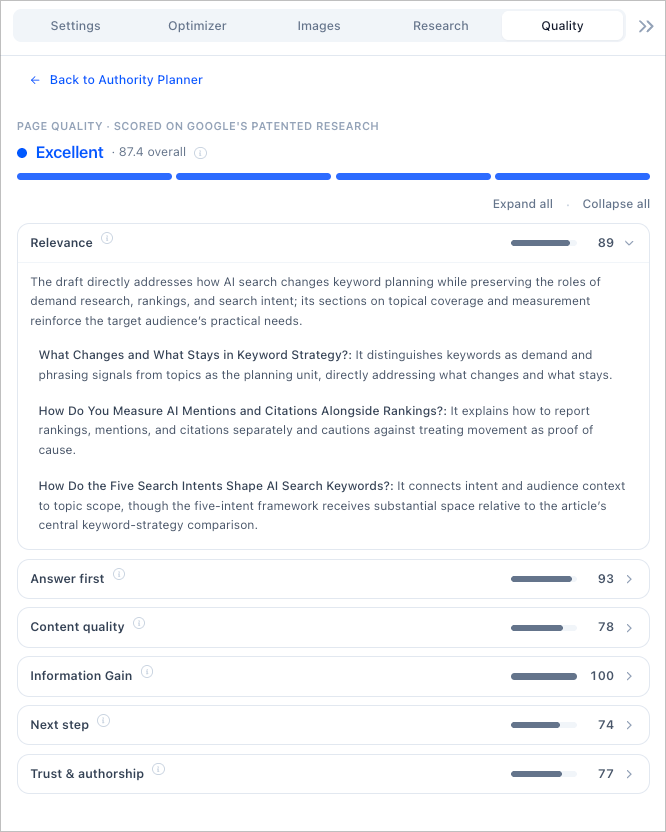
| Quality review | Use the Page Quality Scorecard to review relevance, content quality, information gain, next step, and trust and authorship. It cites passages from your article draft and checks whether you delivered the original contribution set out in the content brief. | Content scores and topic models benchmark term coverage. There's no whole-page quality judgment that cites the passages it is judging. |
| Drafting | Every decision in the content brief carries into the draft: the audience, the brand rules, the consensus claims, the original angle, and the internal-link targets. Writer and Editor agents write against the outline template for that content type, then Fact Checker, Web Research, Conversion Coach and Evidence Integrator passes run over the result before you check coverage and page quality in the Content Editor. | MarketMuse describes AI content with a person reviewing every step, and exports your writing to Word or Google Docs. Its First Draft product, which used to generate a draft directly, was retired in 2022, so nothing here writes the draft for you. |
| Schema markup and AI images | Auto-generates JSON-LD for Article, FAQ, HowTo, LocalBusiness, Organization, and BreadcrumbList with no AI credits. Entity schema connects the entities in your article to Wikipedia, Wikidata and Google Knowledge Graph identifiers. Brand-aligned AI images generate in the editor with suggested placements. | There's no schema generation and no in-editor image generation. Optimize exports your writing to Word or Google Docs and leaves the rest to your CMS. |
| Content Audit and Organic Audit | Content Audit scans your live site against your topical map and tells you which pages to keep, improve, merge or delete, including the ones competing with each other and the topics you never covered. Organic Audit connects Google Search Console to the same map so you can see which topics earn clicks and which pages need a refresh. | Site inventory and Site Heatmap only read the library you already have. There's no map you defined up front to score them against, and no Search Console view mapped onto one. |
| AI search visibility | AIRS Analyzer runs an on-demand analysis of any query across nine AI engines and two SERPs, with a Brand and Entity Landscape showing who the answers name and AI citations counted separately from organic rankings. AI Authority tracks the same map over time across AI Overviews, AI Mode, Gemini, and ChatGPT. | There's no AI answer tracking. The measurement is organic only: content scores, topic models, and SERP and Site Heatmaps. |
| Authority feedback | The Topical Authority Scorecard tracks Content, Market and AI Authority on your map, with Top 10 and Top 20 rankings, a share of voice leaderboard, up to 10 tracked competitor domains, and 7-day to 1-year trends. Silo Analysis marks each topic area Leading, Contested or Trailing, and the Authority Planner turns that into what to work on next. | Inventory and tracked-topic insights point at pages worth writing or refreshing. There's no authority score, no share of voice against tracked competitors, no Leading, Contested or Trailing classification, and no AI visibility in the measurement. |
What the Map Does That a Topic Model Can't
Review the Map, Then Open the Work
A topic model can tell you a page is thin. It can't tell you which parent topic that page belongs under, which siblings it should link to, or what the brand already promised elsewhere. The map holds those relationships, so every content brief starts with them instead of rediscovering them.
Use Your Evidence to Shape the Content Brief
Floyi combines competitive coverage with brand knowledge and persona intent. The content brief identifies both expected coverage and the evidence-backed contribution your page can add.
Review the Article Draft Against the Content Brief
The scorecard quotes the passage it is judging. If the content brief asked for a claim only your data supports and the article draft never makes it, information gain is marked down with the paragraph that should have carried it. That is the check most teams do from memory in a Google Doc.
Turn the Next Topic Into a Content Brief and Article Draft
Use content analysis to choose the work, then keep the audience, evidence and topical relationships attached during production.
A Practical Workflow
Start from the map rather than the page. Pick a topic that is under-covered, scope the Knowledge Base documents for that buyer, and generate the content brief with the audience, the consensus claims and the internal-link targets already attached.
Generate the content brief and article draft, then review optimization and page quality before publishing. Return to the topical map to choose the next priority.
Floyi vs MarketMuse: Common Questions
Can You Compare Floyi and MarketMuse on Price?
Not directly. Floyi publishes its plans and credit allowances on the pricing page, so you can work out the cost of a content brief and an article draft before you talk to anyone. Siteimprove acquired MarketMuse in 2024, and its Free, Optimize, Research, and Strategy plans are quoted through a demo rather than published as prices. Its free tier is limited to 10 queries a month.
How Is Floyi's Content Strategy Different From MarketMuse's?
Floyi sets the strategy once at the brand level, and every topic in the map inherits the audience, positioning and internal-link plan from it. MarketMuse genuinely does content strategy too, through inventory, tracked topics, heatmaps and strategy documents, but it delivers that strategy one topic at a time on top of the content you already published. The question is whether you are grading a library or defining the territory.
How Does the Page Quality Scorecard Differ From MarketMuse's Optimize Score?
Optimize asks whether your terms match the topic model built from the top 20 ranking pages. The Page Quality Scorecard asks whether the finished page was worth publishing at all, across relevance, content quality, information gain, next step, and trust and authorship, citing the passage behind each judgment. An article can hit its coverage target and still repeat what the top 20 results already said.
Does Floyi Analyze Existing Content?
Yes. Content Audit scans your live site against your topical map, classifies pages as Keep, Optimize, Consolidate, or Prune, and surfaces cannibalization and coverage gaps. Its Organic Audit connects Google Search Console to the same map, so you can see which topics earn organic traffic and which pages need a refresh. Topical Audit does the same structural read on a competitor's site.
What Happens After the Article Draft Is Written?
Floyi publishes it. WordPress or GitHub, single or in bulk, with SEO metadata and optional JSON-LD, and WordPress status syncs back so your coverage records update themselves. MarketMuse exports your writing to Word or Google Docs and hands the rest to your CMS, so the published page never reports back into the analysis that chose it.
Docs for This Workflow
Sources for These MarketMuse Capabilities
Every MarketMuse capability on this page was checked against its own documentation and product pages in September 2026. Features and plan limits change, so confirm the current details with the vendor.
- MarketMuse: current capabilities by plan
- MarketMuse: Optimize
- Siteimprove completes acquisition of MarketMuse
- MarketMuse: First Draft retirement
The Rest of the Closed Loop
Most tools have a brand kit, applied as an input at the moment something gets written. In Floyi, Brand Foundation and the Knowledge Base are the source everything else reads from, so topical research, the map, content briefs, article drafts, images, and the authority score all work from the same positioning, personas, rules, and evidence. That's the loop, and it's the part a feature-by-feature table can't show.
One Brand Foundation
Positioning, voice, Content Guide rules, and buyer personas are set once, then inherited by research, maps, content briefs, article drafts, and images without being restated.
Workspaces and Teams
A separate brand workspace per client, with role-based access and a shared credit pool across the team.
Knowledge Base
Up to 2,000 documents on the Scale plan, organized by category and scoped per content brief, so original angles are grounded in your evidence instead of invented.
Local and Multi-Location
Content briefs and article drafts built for service pages, location pages and service-area landing pages, with NAP consistency and local schema.
Developer API and MCP Server
A REST API across the whole pipeline, plus an MCP server so an AI assistant drives the real Floyi rather than a copy of it.
Client-Ready Exports
Authority scores, coverage data, maps, content briefs, and article drafts export to XLSX, DOCX, CSV, PDF, and Google Docs.
The Floyi Tools in This Comparison
Each one sits behind a row in the table above, from topical mapping through publishing.
Topical Maps
Turn SERP clusters into a four-level topical map that doubles as your content plan.
Briefs & Drafts
Turn any topic into a SERP-grounded content brief and a writer-ready article draft.
Content Plans
Turn your topical map into a ranked publishing queue, with an owner for each topic.
Topical Authority
Track your Topical Authority Score, coverage, and presence in AI Overviews, AI Mode, Gemini, and ChatGPT.
Content Editor & Optimizer
Real-time content scoring, page quality review, competitor benchmarking, and term coverage.
AI Writing Assistant
Edit inline with SEO entity guidance, grammar fixes, and rewrite suggestions.
Topical Audit
Reverse-engineer any website's topical structure and find its authority gaps.
Site Architecture
Plan hundreds of pages at once, with a clean URL hierarchy for every page type.
Compare Floyi With Other Tools
See how Floyi compares with other SEO, content optimization and AI search platforms.
Floyi vs Surfer SEO
Turn a four-level topical map into content briefs, article drafts and a score that picks the next topic.
Read comparison →Floyi vs Frase
Plan by topical map, not page by page, then carry the brand and the evidence into every content brief.
Read comparison →Floyi vs Keyword Insights
Turn keyword clusters into a four-level map, content briefs, article drafts and a score that picks the next topic.
Read comparison →Floyi vs Ahrefs
Turn keyword and backlink findings into a topical map, content briefs and article drafts.
Read comparison →Turn Content Gaps Into Publishing Priorities
Choose the topic from your topical map, build the content brief and article draft and review the finished page before publishing.