
When to Hire Topical Mapping Services: A Decision Guide
Not sure when to hire topical mapping services? Compare a spreadsheet, a platform and a hired service by skill, scale, deadline, and budget, then choose.
You’ve got a topical map on the to-do list and three ways to get it. Build it in a spreadsheet, run it in a platform or hire someone to deliver it. Hire a service when your team lacks the strategy skill or the capacity, and the site has a diagnosed gap that a finished map would close. If you can audit the site and judge scope in-house, a spreadsheet or platform usually does the job.
A quick search won’t settle it, because every provider promises a “map” and the word covers very different things. One deliverable is a flat keyword dump. Another is a four-level Pillar > Hub > Branch > Resource hierarchy with intent labels, URL slugs and an internal linking plan. A deliverables checklist and a red-flag list show how to tell the two kinds of output apart.
The cost of guessing wrong is a locked PDF nobody can edit, or a map that goes stale the week after handoff.
Topical Mapping Services Key Takeaways
- Three paths exist: a spreadsheet you build, a platform you operate or a hired service.
- Every path should produce the same four-level Pillar > Hub > Branch > Resource hierarchy.
- Score each path on skill, scale, deadline, budget, and upkeep, then pick the path that solves your tightest constraint.
- Audit the site first, because a service closes skill or capacity gaps, not undiagnosed content problems.
- A strong deliverable includes intent labels, URL slugs, an internal linking plan, and page-level keep, merge or retire verdicts.
- Walk away from guaranteed rankings, keyword-count boasts, locked PDFs, and result claims without named sites or time periods.
- A hybrid works well: a specialist builds version one, and your team maintains the map.
What Are Your Three Paths to a Topical Map?
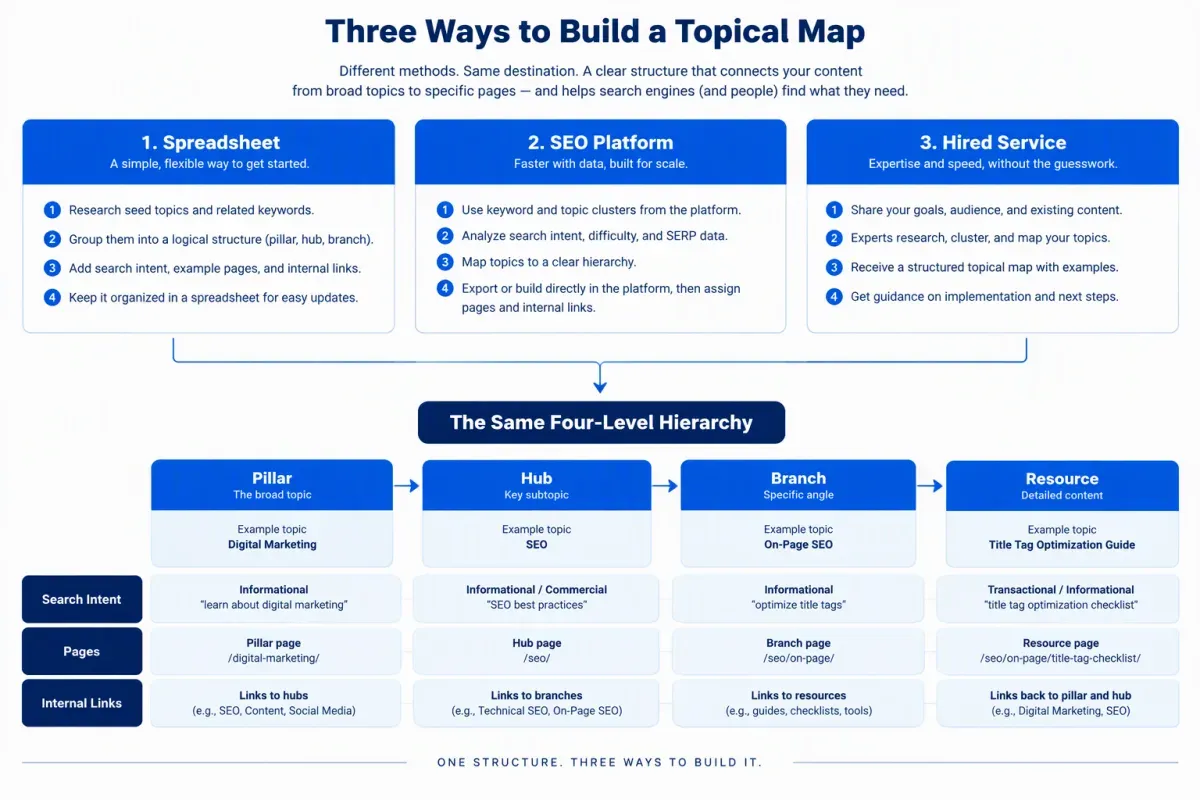
There are three paths to a topical map: a spreadsheet you build, a platform you operate or a hired service. All three must produce the same artifact. That’s a connected hierarchy of topics, search intents, pages, and internal links, with URL structure, running up to four levels deep (Pillar > Hub > Branch > Resource).
A keyword list and a map aren’t the same thing. A list holds isolated terms with no scope and no order. A map shows which topics are broader or narrower, which page owns each search intent and how pages connect. Picture a site about electric cars with every topic on one flat level. Nobody can tell parent from child, and neither can a crawler.
That hierarchy is what makes the map useful for topical authority. Coverage organized around a defined scope helps search engines read a site as expert in a subject rather than a scatter of pages chasing isolated keywords. The map also drives the internal links between related pages.
If you build a topical map yourself, it lives in a spreadsheet, often paired with a mind map, and you do every step. Platforms that build topical maps generate and maintain the hierarchy in software, though a skilled operator still steers them. A hired service delivers a finished map built by an outside SEO strategist or agency.
Each path builds the same hierarchy. What changes is who does the work, how fast it gets done and who keeps the map current.
How Do the Three Paths Compare on Skill, Scale, Deadline, and Budget?
The three paths differ on who does the work. A spreadsheet needs in-house skill and time, a platform needs a skilled operator and a service needs budget and a clear scope. No path wins every row, so score all three on the same five factors.
| Factor | Spreadsheet | Platform | Hired service |
|---|---|---|---|
| Team skill | Wins when a strategist can research intent and structure hubs by hand | Wins when a skilled operator can judge scope and review output | Wins when nobody in-house can do the strategy |
| Scale (sites and maps per year) | Wins for one small site and one map | Wins for several sites, brands or clients | Wins for a single first build |
| Deadline | Wins when there is no deadline | Wins for steady publishing | Wins for a fixed deadline with no strategist |
| Budget | Wins when staff hours are easier to find than budget | Wins when one subscription and its usage cover several maps | Wins when a fixed fee, retainer or hourly rate fits a one-off budget |
| Upkeep | Wins when someone in-house will maintain the file | Wins when the map must stay connected to briefs and publishing | Wins when your team will own the delivered file |
A spreadsheet demands hands-on keyword research and intent work. A platform lowers the manual work but still needs an operator who can judge scope. A consultant or full-service provider fits when that skill isn’t on your team.
On scale, a platform pays off because you reuse and update one map across several sites, brands or clients. If you run client work, compare topical mapping tools for agencies on how each one keeps client context, approvals and reporting separate.
Pricing models differ in predictability. A service usually charges a fixed fee per map, a retainer or an hourly rate, while platform usage and staff hours can grow over time. The full cost model for mapping tools breaks those lines down.
A map is a living plan, so a one-off deliverable frays without an owner. A platform keeps the map connected to briefs and publishing. It doesn’t replace keyword research depth from Ahrefs or Semrush, backlink analysis or technical audits, so keep those tools on any path.
When Does Each Path Fit Your Team?
Deciding when to hire topical mapping services starts with a diagnosis of the site. Check for thin coverage, overlapping pages and weak internal linking first, because a service closes a skill or capacity gap, not an undiagnosed content problem. A content audit or content gap analysis tells you which problem you actually have.
- New or small site with a skilled strategist: The spreadsheet path fits, since there’s no legacy content to reconcile. Building a topical map in Google Sheets costs you time, not a vendor fee.
- Stalled rankings or a large content library: Plateaued traffic can point to shallow coverage, topic gaps, isolated intents, or weak linking. Start with an audit that sorts every page into keep, optimize, consolidate, or prune and surfaces cannibalization. A platform suits recurring audits, while a service suits a one-time cleanup.
- Competitive or YMYL niches: Finance, health, legal, SaaS, and e-commerce reward thorough, trustworthy coverage of overlooked subtopics and intent angles. If the gap analysis exceeds in-house skill, hire a specialist to build the map and let your team maintain it. Confirm the handoff before you sign.
- Pivots and rebrands: A changed offering needs a new roadmap that tells search engines what the site is about now. Audit existing pages first, because they may contradict the new topical scope.
If your team can run the audit and act on it, you may not need to outsource at all. If it can’t, a service is a fair purchase.
What Should a Good Service Deliverable Include?
A good deliverable includes eight things: a four-level hierarchy, validated groupings, intent labels, build-ready detail, verdicts on existing pages, a publishing order, editable files, and a handoff. It’s a decision document your team can build from, not a keyword list. Hold any service to this checklist before you sign:
- Four-level hierarchy: Pillar > Hub > Branch > Resource, so every page has a clear parent and role.
- Validated groupings: Keywords grouped by overlap in live search results, not word similarity. Two keywords that sound alike can trigger different results pages.
- Intent labels: A search intent on every topic, plus clear calls on which queries share one page and which need separate pages.
- Build-ready detail: A URL slug for each page, and an internal linking plan that names source pages, target pages and anchor text.
- Existing-page verdicts: A keep, optimize, merge, or retire call for each current page, plus the gaps that need new pages.
- Publishing order: A prioritized content roadmap ranked by business relevance and audience need, with competition informing the sequence.
- Ownership: Editable files you own, such as a spreadsheet, never a locked PDF.
- Handoff session: A live walkthrough of the logic, so your team can maintain the map after the engagement ends.
Entity analysis with extraction tools and competitor review can strengthen a map, but the reasoning should still show in the rows.
Test it: ask a teammate to draft a content brief from one row. If they can’t tell the page’s intent, URL, parent, and links, the map isn’t finished.
Compare every quote against this checklist rather than against price. A cheaper quote that skips half these items leaves you to build the missing half yourself.
What Red Flags Should You Watch for in a Service?
Most red flags show up in two places: the sample deliverable and the sales promises. Check both before you sign anything.
Red flags in a sample deliverable:
- A keyword dump with no hierarchy: A flat list of terms is research, not a map. You need parent and child relationships to build from.
- No validation against live search results: Without it, grouping is guesswork about which queries deserve their own page.
- No search intent labels: Writers can’t tell a guide from a comparison page without them.
- A locked or PDF-only file: If your team can’t edit it, the map goes stale on delivery day.
- No check against existing pages: New pages end up competing with current ones, which creates cannibalization.
- No plan for updates: Someone has to own the map after handoff.
Ask how the provider researches competitors and live results, validates clusters and decides whether queries need separate pages. Those decisions matter more than the number of keywords delivered.
Warning signs in the sales pitch:
- Guaranteed rankings: A topical map is a planning tool. Results also depend on content quality, competition, technical SEO, and execution.
- Keyword counts presented as quality: Volume says nothing about whether the grouping is sound.
- Headline results with no context: A claim without a named site, time period or baseline can’t be checked.
Before signing, ask for the evidence behind every result claim, and walk away if it doesn’t arrive.
What Questions Should You Ask Before Signing?
Ask about research method, scope, entities and intent, deliverables, pricing, and evidence. Those six areas test how a provider thinks, not how many keywords it can deliver. Whether you’re talking to an agency or a freelancer, these questions separate real analysis from a repackaged keyword export:
- Research method: How do you analyze live search results and competitors, and how do you decide that two queries belong on one page? Can you walk me through one worked page-split example?
- Scope: How do you set topical scope for each hub, handle gaps and cannibalization against existing pages and decide when to stop adding topics?
- Entities and intent: How do you analyze entities and search intent, and how do those findings shape the plan?
- What you receive: Can I see a sample deliverable, the prioritization logic, a timeline by stage, the revision scope, and the file format? Who owns the files, and are a handoff session and an update plan included?
- Pricing: Is the fee fixed per map or hourly, what topic count and depth does it cover and what do revisions and updates cost?
- Evidence: For any result you cite, which site was it, over what time frame, from what starting point, and what else changed?
Vague answers are a warning sign. Score every provider on these questions before you compare prices.
Should a Service Build and Your Team Maintain?
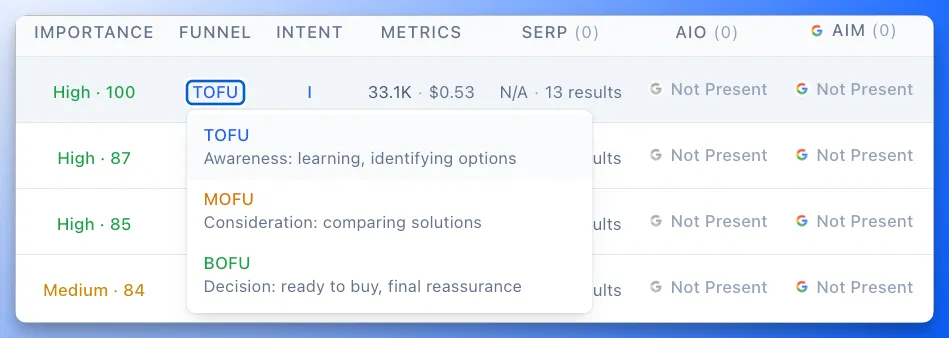
In a hybrid model, a specialist builds version one of the map (research, keyword grouping and hierarchy), and your team owns everything that repeats after delivery. It suits teams that can produce content but lack the time or specialist skill for the front-loaded work. Writers also get one roadmap for what to create, how deeply to cover each subtopic and how pages interlink, so publishing stops producing redundant articles.
Maintenance keeps the map alive. Your team turns the map into briefs, publishes on a schedule and runs reviews that decide what to add, merge or retire. Skip that loop and the deliverable decays into a static spreadsheet.
A usable handoff makes maintenance possible. Require these elements:
- A validated hierarchy with URL slugs
- Intent labels on every topic
- An internal linking plan
- An editable format you can import into your own tool
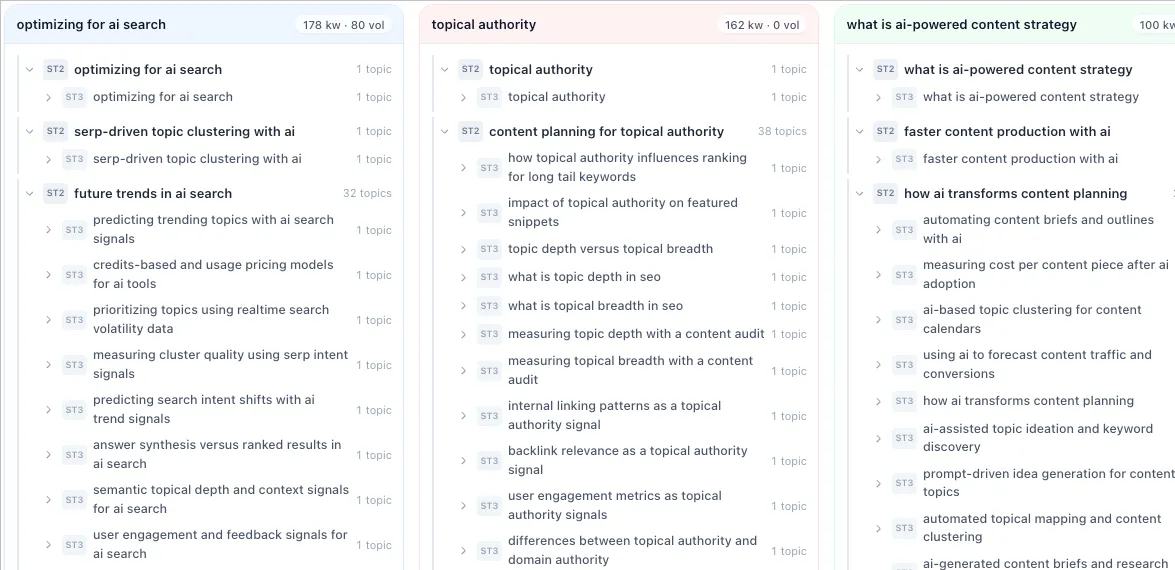
If you maintain the map in Floyi, the topical map is the blueprint the rest of the workflow runs on. The Authority Planner turns it into a prioritized plan with brief generation and WordPress or GitHub publishing. The Topical Authority Scorecard tracks topics gained and lost between refreshes, so each review has evidence behind it.
Before signing with any specialist, confirm the file arrives in a format your team can import and edit.
Which Path Should You Choose Next?
Pick the path that solves your tightest constraint:
- Spreadsheet: Fits strong in-house skill, one small site and no deadline.
- Platform: Fits several sites, brands or clients, or steady publishing, because the map has to feed briefs and drafts.
- Service: Fits low in-house skill and a hard deadline. You buy the build and keep the review in your hands.
- Hybrid: Buy the first build when you lack time, then take over maintenance to keep long-term control.
A map is a planning tool, not a ranking guarantee. Rankings and AI visibility still depend on content quality, competition, technical SEO, and execution.
For teams choosing to build in-house, map it yourself in Floyi. Floyi Topical Maps build a four-level, SERP-validated map with URL slugs, page intent, internal linking guidance, and anchor text recommendations.
Topical Mapping Services FAQs
These FAQs answer the questions strategists ask most when weighing topical mapping services against a spreadsheet or a platform. They cover who each path fits, how to judge deliverables and what to plan for around budget, timing and upkeep.
1. Should You Hire Before or After Publishing?
For a new site, domain, content hub, product line, or niche category, map before you publish at scale. A map built up front fixes the architecture and roadmap, so you plan categories, content depth and internal links from day one and avoid random articles and costly overhauls.
For an established site, build the map first with existing pages set aside so they don’t bias the topical scope. Then audit published pages against it, checking intent and cannibalization to find gaps, overlaps and pages to update, consolidate or retire. If you hire, sign the service before you publish at scale on a new site, or before you start the audit on an established one.
2. Can a Topical Map Fix Stalled Rankings?
A topical map can help explain a plateau, but it won’t lift rankings by itself. It works as a diagnostic and planning tool that shows where the cause may sit: thin coverage, missing subtopics, isolated intents, or weak internal links between related pages. Check for cannibalization too, since overlapping pages often compete with each other.
Rankings move only when you act on the findings by adding pages, consolidating overlaps and fixing links. Content quality, competition, technical SEO, and execution still decide the result.
3. How Long Does a Topical Map Take?
Turnaround depends on three things: site size, how much existing content must be reconciled with the new structure and how complex the niche is. A small site in a simple niche moves quickly, while a large site with overlapping pages takes longer. A DIY build also costs real staff time.
Before signing, get the scope and timeline in writing. Confirm what the quoted window covers (discovery, research, structure, delivery, and handoff), whether existing content is audited and what happens if the niche proves larger than expected.
4. Do You Need a Map for a New Site?
Yes. A new site, domain, content hub, product line, or niche category benefits from a map built before large-scale publishing. It settles site architecture and the content roadmap early and prevents disjointed pages and costly restructuring. The research process matches an existing site’s, minus legacy content to reconcile.
The exception is a very small site with only a few target pages. One primary keyword per page in a spreadsheet works, and a template or full service adds little. Once you plan to expand into related subtopics, build the map before publishing.
About the author

Yoyao Hsueh
Yoyao Hsueh is the founder and CEO of Floyi, the topical authority platform, and the founder of Main Heading, an SEO and AI search agency. He is an expert in topical authority and topical mapping. He created Topical Maps Unlocked, a course studied by thousands of SEOs, content strategists and digital marketers, founded TopicalMap.com, a done-for-you topical mapping service for agencies and enterprise teams, and publishes the weekly Digital Surfer newsletter on SEO, content strategy and AI search.
About Floyi
Floyi is a closed loop system for strategic content. It connects brand foundations, audience insights, topical research, maps, briefs, and publishing so every new article builds real topical authority.
See the Floyi workflow