
Best Topical Mapping Tools for Agencies: 7 Compared
Compare 7 topical mapping tools on client workspaces, seats, cost per client, client-ready exports, and brief hand-off. Pricing checked in October 2026.
Seven tools claim to map topics for agencies. The ones that hold up across a full client roster keep each client in a separate workspace and carry map structure into briefs. Pick by client count first, then check seats, exports and brief handoff. Floyi fits agencies that put per-client brand workspaces and map-to-brief carry-through first. Search Atlas and Frase Enterprise add the client portals Floyi doesn’t offer.
Plan tables won’t settle this on their own. Surfer SEO lists paid tiers from $49 to $299 a month as of October 2026, MarketMuse publishes user and brief limits but no dollar amounts and Keyword Insights caps clients through workspaces. Those numbers only mean something against the client sites you’d actually run. A keyword cluster still isn’t a topical map.
This comparison judges every tool on six agency criteria, with cost per client beside them. A four-step pilot on one client account then replaces vendor claims with your own results. A sizing section matches tools to solo, 3 to 10-person and 10 to 30-person agencies.
Topical Mapping Tools Key Takeaways
- Keyword clustering and topical mapping are different jobs, so no tool’s clusters count as a map.
- Score each tool on six criteria, from client workspaces to map-to-brief carryover.
- Cost per client equals plan price divided by realistic client sites, plus extra seats.
- Workspace, project or site limits set client count more than the headline price does.
- Floyi offers per-client brand workspaces, map-to-brief carry-through and unbranded exports, but no client portal.
- Topical Map AI (Enterprise and Agency), Search Atlas (Pro and Agency) and Frase Enterprise list white-label outputs.
- Pilot every shortlisted tool on one client with identical inputs, then score hierarchy, intent, gaps, and cannibalization.
How Do Six Agency Criteria Score These Tools?
Keyword clustering vs topical mapping is the first gate every tool passes through. Clustering groups queries that share search results. An SEO topical map defines the subject hierarchy, each page’s role and intent, coverage gaps, and how pages support one another. Floyi structures it in four levels: Pillar > Hub > Branch > Resource. No tool’s keyword clusters count as a topical map here. If you want the general field rather than agency fit, start with topical map software compared.
A strong result on each of the six agency criteria means:
- Per-client brand workspaces: Each client’s brand context stays separate.
- Seats and team roles: Strategists, writers and reviewers get access without per-seat surprises.
- Cost per client: The plan price spreads across your real client count.
- Client-ready exports and reporting: Deliverables reach clients without manual rebuilding, white-label included where you need it.
- Repeatable process: The same steps run for every client.
- Map-to-brief carry-through: Hierarchy, intent and page roles flow into each brief.
| Tool | 1. Client workspaces | 2. Seats | 3. Entry price | 4. Client-ready exports | 5. Repeatable process | 6. Map-to-brief |
|---|---|---|---|---|---|---|
| Floyi | Brand workspace per client | 1 to 15 by plan | Free, Pro $99 | Unbranded exports, no client portal | Same pipeline per workspace, bulk briefs | Briefs inherit map position |
| Surfer SEO | 1, 5 or unlimited brand workspaces | 1 to 10 by plan | $49 | Verify in a pilot | Verify in a pilot | Verify in a pilot |
| MarketMuse | Verify in a pilot | 1 to 5 users | No public prices | Verify in a pilot | Verify in a pilot | Verify in a pilot |
| Topical Map AI | Verify in a pilot | 3 or 5 on top plans | $56 | White-label on Enterprise and Agency | Verify in a pilot | Briefs built in, verify in a pilot |
| Frase | 1 to 10 sites by plan | 1 to 5, extra $29 | $39 yearly | White-label on Enterprise | Verify in a pilot | Verify in a pilot |
| Keyword Insights | 5 or 10 workspaces | 1 or 3 | $58 | Verify in a pilot | Verify in a pilot | Content Briefs at 100 credits each |
| Search Atlas | 1 to 10 projects | 1 to 10 | $99 | White-label from Pro | Verify in a pilot | Verify in a pilot |
“Verify in a pilot” marks anything the vendor doesn’t publish on its pricing page. Prices are list prices as of October 2026. Several vendors, Floyi included, discount annual billing.
Cost per client is the monthly plan price divided by the client sites you’d realistically run on it, plus extra seats. Workspace, project or site limits set that client count, not the headline price. Credits, add-on seats and onboarding time add more, which the true cost of topical mapping tools breaks down.
Weighting shifts with your agency. Ten local clients lean on cost per client, while SaaS, B2B or ecommerce accounts lean on map structure and briefs. Clients who expect agency-branded deliverables push criterion 4 to the top.
We make Floyi and say so here. Every tool faces the same six criteria, and where a vendor publishes no figure, we say so instead of estimating.
Which Topical Mapping Tools Fit Agencies Best?
The best topical mapping tools for agencies fall into four groups, and the right group depends on how your agency delivers work. The table above holds the criteria, and the profiles below say who each tool fits.
- Fast cluster generator: Topical Map AI.
- All-in-one suites: Search Atlas and Surfer SEO.
- Planning, clustering or brief tools: MarketMuse, Keyword Insights and Frase.
- Map-to-brief platform: Floyi.
Generators suit fast first-pass structures and pitch material. Suites suit agencies that want mapping, writing and publishing under one login, and that will pay for the seats and projects that requires.
Many agencies run two agency SEO tools side by side. A keyword research suite such as Ahrefs or Semrush supplies demand data, and a mapping or briefing tool handles structure. No single platform leads on research depth, backlinks, technical audits, mapping, and briefs at once.
Four factors decide the shortlist:
- Workspace or project limits: Check them against your client count.
- Seats: Match them to your team size.
- Export formats: Confirm they match what clients sign off on, and check each tool’s approach to visualizing and exporting topical maps before a client meeting depends on it.
- Brief handoff: Verify the map flows into briefs without re-keying.
Some agencies skip the purchase and outsource the mapping, so settle when to hire topical mapping services before you compare plans.
1. Floyi: Client Workspaces With Map-to-Brief Carry-Through
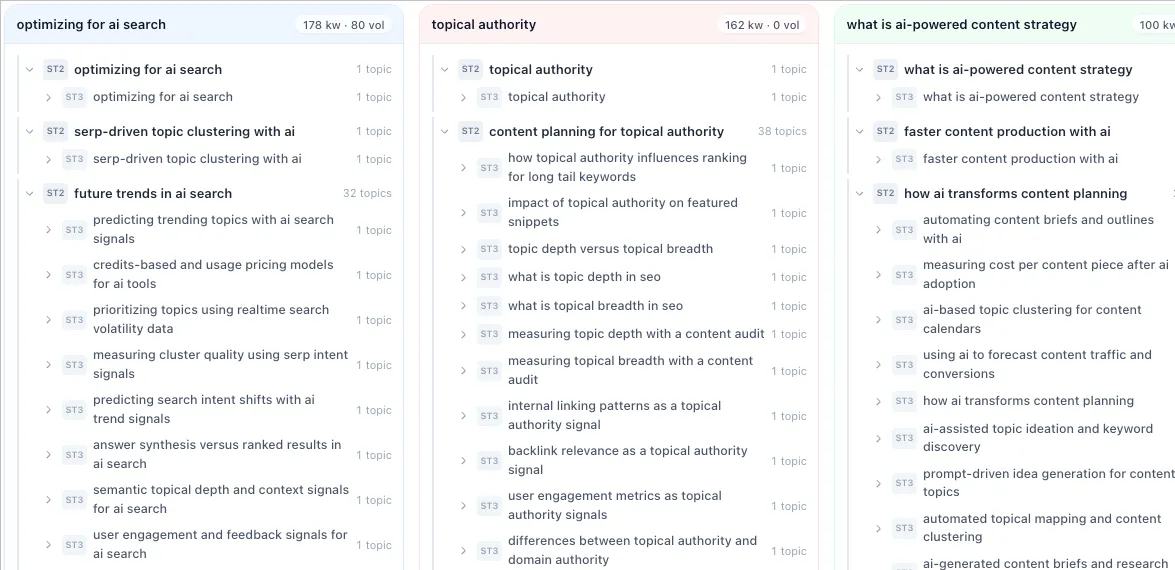
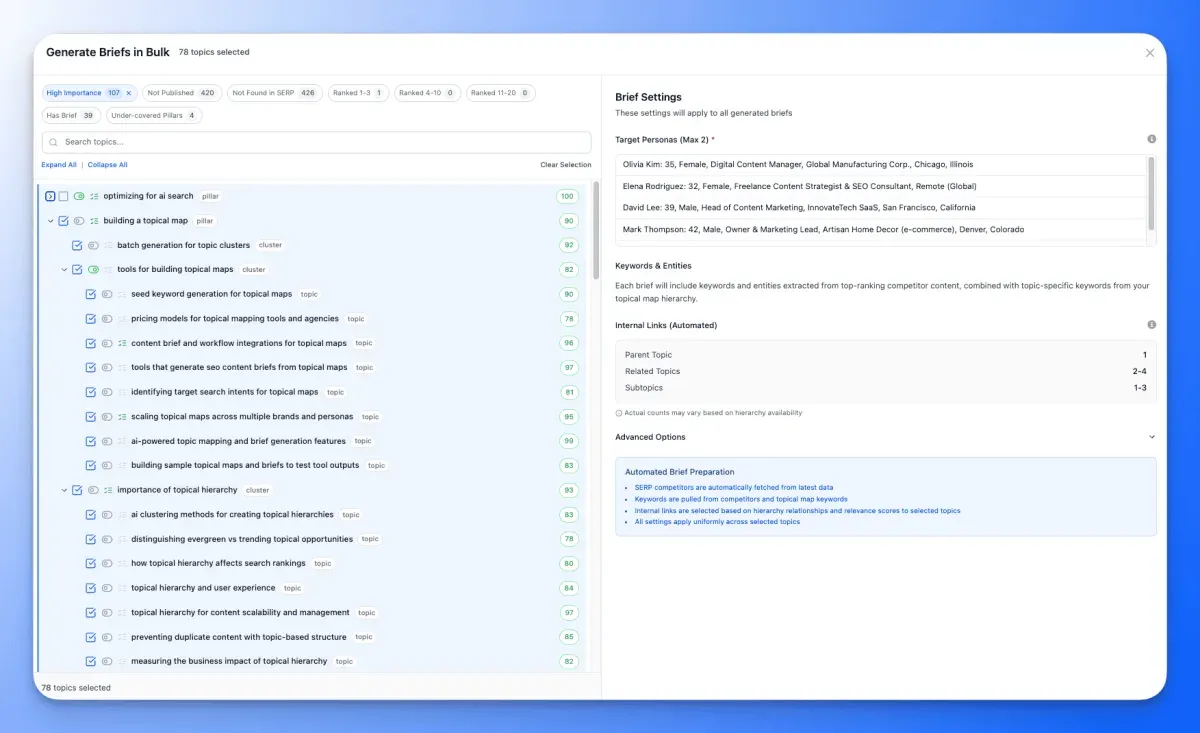
Floyi suits agencies that want each client’s context and map to carry straight into briefs. Floyi is the topical authority platform, and we make it, so weigh this profile with that interest in mind.
Each client gets a separate brand workspace in one account. That workspace holds the client’s Brand Foundation, personas, Content Guide, and Knowledge Base, so every brief and draft starts from the right client’s context.
Floyi maps run four levels (Pillar > Hub > Branch > Resource) and are validated against SERP data. Each topic carries a URL slug, page intent and anchor text guidance. Briefs and drafts inherit the map position and internal-link plan, and bulk brief generation lets one strategist run the same topical map workflow within each client workspace. For client reviews, the map opens in Spreadsheet, Silo View or Outline View.
Pricing and seats as of October 2026:
- Free: 500 credits and 1 seat.
- Pro: $99/month, or $82.50/month billed annually, with 15,000 credits and 3 seats (up to 5). Extra seats cost $15/month, and the plan includes the Developer API and the MCP server.
- Scale: $299/month, or $249.17/month billed annually, with 50,000 credits and 8 seats (up to 15). Extra seats cost $10/month, and the Developer API and MCP server are included here too.
Teams get role-based access and shared credit pools. Maps export to XLSX, Google Sheets and Markdown, and drafts export to DOCX, HTML, Markdown, TXT, and Google Docs.
Floyi has no client portal. Its exports carry no Floyi branding, so agencies can add their own branding to any export. Floyi also isn’t the pick for keyword research depth or backlink analysis (Ahrefs, Semrush) or technical audits (Screaming Frog, Semrush).
2. Surfer SEO: Content Optimization With a Topical Map Feature
Surfer SEO is a content optimization platform that scores drafts against the competition in real time, and it adds a Topical Map feature for finding topics and content angles. It suits agencies whose retainers center on writing and optimizing client pages.
Surfer’s pricing on surferseo.com in October 2026, billed annually:
| Plan | Price | Seats |
|---|---|---|
| Discovery | $49/month | 1 |
| Standard | $99/month | 3 |
| Pro | $182/month | 5 |
| Peace of Mind | $299/month | 10 |
| Enterprise | Custom | Custom |
Topical Map comes with every paid tier. For cost per client, check how many client sites each tier really covers, then confirm the seat count covers your writers and editors.
Real-time on-page scoring while you write is Surfer’s strength, and Floyi doesn’t match it there. The agency question is different: how far does a topic travel from the map into a brief and a draft? Check whether the output is keyword groupings or a multi-level hierarchy. Run both tools on one client during your pilot and compare what each hands your writers.
Surfer fits agencies whose bottleneck is optimizing drafts, and teams already working in its editor that want topic ideas in the same tool.
3. MarketMuse: Coverage Analysis for Large Client Sites
MarketMuse fits agencies on long retainers for large client sites, where coverage analysis matters more than speed. It’s a content planning platform built around topic modeling, content inventory analysis, competitor content gaps, content briefs, and Content Strategy Documents.
Plan limits as listed on marketmuse.com in October 2026:
- Free: 1 user and 10 queries per month.
- Optimize: 1 user and 5 briefs per month.
- Research: 3 users and 10 briefs per month.
- Strategy: 5 users and 20 briefs per month.
The pricing page doesn’t list dollar amounts and routes buyers to a demo. You won’t have a monthly figure for cost per client until you’ve talked to sales.
The agency trade-off is seats. Because users per plan are capped, your cost per client depends on how many strategists need access, not just how many briefs you produce. On the demo call, ask how client workspaces work and which export formats are available for deliverables.
MarketMuse is strong for content audits and SEO content planning on large sites, and agencies usually pair it with a keyword research suite upstream. Its output is coverage plans and briefs rather than a topical map, so plan a separate step if clients expect a hierarchy they can approve.
4. Topical Map AI: Fast Cluster Generation With White-Label Exports
Topical Map AI fits agencies that need many fast first-pass structures for pitches and audits. It generates keyword cluster maps from a single seed, about 800 to 1,100 keywords per map per the vendor, across four map types and 20+ languages. Content briefs are built in, and the vendor says you can generate one for any topic inside the map.
Pricing as listed on topicalmap.ai in October 2026:
| Plan | Price | Maps | Notable inclusions |
|---|---|---|---|
| Basic | $56/month | 25 | CSV and Google Docs export |
| Pro | $104/month | 46 | Batches of 5, CSV, Excel and PDF |
| Enterprise | $179/month | 80 | 3 team seats, white-label exports, REST API at 100 requests/day |
| Agency | $374/month | 139 | Bulk generation of 20, white-label exports, 5 team seats, REST API at 200 requests/day |
Annual billing saves 17%, and all paid plans include commercial use rights.
The agency strength is real. Per the vendor FAQ, “Enterprise and Agency plans can white-label exports for client deliverables,” so you can hand clients work under your own branding. For teams delivering polished pitch work at volume, that’s a legitimate edge.
Two checks decide whether it fits:
- See whether the clusters give you a multi-level hierarchy with page roles and intent, or a flat list of groups.
- Time how much rework one cluster’s built-in brief needs before your writers can use it without guessing.
For high-volume pitch and audit work, it earns a place on your shortlist.
5. Frase: Briefs and Publishing for Small Teams
Frase suits freelancers and small agencies whose main need is fast briefs and first drafts. It covers briefs, drafting with an AI agent, site audits, and publishing to WordPress, Webflow, Sanity, or Wix.
Pricing as listed on frase.io in October 2026:
| Plan | Yearly billing | Monthly billing | Seats | Sites |
|---|---|---|---|---|
| Starter | $39/month | $49 | 1 | 1 |
| Professional | $103/month | $129 | 3 | 5 |
| Scale | $239/month | $299 | 5 | Up to 10 domains |
| Enterprise | Custom | Custom | Custom | Custom |
Scale adds client-ready reports. Enterprise adds white-label reports and a branded client portal. Extra seats cost $29/month.
Site limits set your cost per client here. Professional at $103/month yearly across 5 sites works out very differently from Starter at one site. White-label portals sit on the custom Enterprise tier, so small shops shouldn’t plan around them.
The tool centers on briefs and drafts, not a multi-level topic hierarchy. Test how it plans a full client topic area before you commit. It fits solo consultants and small shops with a few client sites and a brief-first workflow.
6. Keyword Insights: SERP Clustering for Existing Keyword Lists
Keyword Insights fits agencies that start from raw keyword exports or work across thousands of terms. It groups keywords by SERP similarity, so overlapping Google results signal terms that belong on one page and diverging results signal separate URLs. That makes it page-level planning, not map-building from scratch.
After clustering, intent classification and cannibalization checks help you catch two terms competing for one URL before a client brief gets written. For accounts with sprawling keyword lists, that’s a real strength.
Pricing as listed on keywordinsights.ai in October 2026:
- Basic: $58/month, with 10,000 credits, 1 seat and 5 workspaces.
- Professional: $99/month, with 20,000 credits, 3 seats, 10 workspaces, and team sharing.
- Enterprise: Custom pricing.
- Trial: 7 days for $1.
Workspaces give you a direct ceiling on client count: five on Basic and ten on Professional.
Keyword Insights is built for clustering, so agencies usually organize the clusters into pillars and pages themselves. As of October 2026, its pricing page also lists “Content Briefs: 100 credits/brief” and a Writing Assistant on every plan. Clusters are an input to a topical map, not the map itself. Before you buy, confirm that your mapping and brief tools accept a clustered export.
7. Search Atlas: All-in-One Suite With Client Portals
Search Atlas suits agencies that want client portals and branded reporting under one login. It’s a broad SEO suite with mapping built inside it. Per its topical maps page, one seed keyword produces topic clusters and content gaps, and selected topics move into Content Genius article workflows and on to CMS publishing.
Pricing as listed on searchatlas.com in October 2026:
| Plan | Price | Seats | Projects | Agency features |
|---|---|---|---|---|
| Starter | $99/month | 1 | 1 | None listed |
| Growth | $199/month | 3 | 2 | None listed |
| Pro | $399/month | 5 | 4 | White-label dashboards and reporting |
| Agency | $999+/month | 10 | 10 | Client portals and branded dashboards |
Projects cap what you can run, so they set your cost per client. The Agency plan starts at $999+/month for 10 projects, so treat any result there as a floor. Confirm which plan includes topical maps before you budget.
Client portals are a real agency strength, and Floyi doesn’t offer one. Run one client through the map and check whether its structure carries into briefs before you commit.
A suite fits agencies consolidating tools under one login with branded client reporting. A dedicated mapping platform fits teams that put hierarchy depth and brief carry-through first.
How Do You Pilot a Tool on One Client Account?
Pilot each shortlisted tool on one representative client in four steps before you scale: baseline, identical inputs, output checks, and scored results. That sequence gives you evidence you can defend to a partner or a client.
Start with a baseline of the client’s current site. The free Content Audit tool at floyi.com returns a Coverage Map of up to 100 pages with no account, no credit card and no credits. It allows one audit per email, and the result link stays live for 30 days. It shows the structure the site has, not the structure it needs.
Next, pick a niche typical of your retainers, then gather its seed topics and competitors. Feed identical inputs to every shortlisted tool so the outputs compare fairly.
Inspect each output with four checks:
- Hierarchy: Is there a clear pillar, hub and branch structure with page roles and URL slugs?
- Intent: Does each topic carry search intent mapping you can verify against live results?
- Gaps: Does the map expose what your baseline missed?
- Cannibalization: Do any topics compete for the same page?
Compare the results against your manual workflow to see what each tool adds or skips.
Then record three results as pass, partial or fail, with notes:
- Map-to-brief handoff: Do structure, intent and URLs reach briefs without re-entry?
- Team usability: How many rework loops pass before client approval?
- Cost per client: Recalculate it with the client sites and seats the pilot showed you need.
Leave any field blank until you’ve measured it.
Which Tool Fits Your Agency Size?
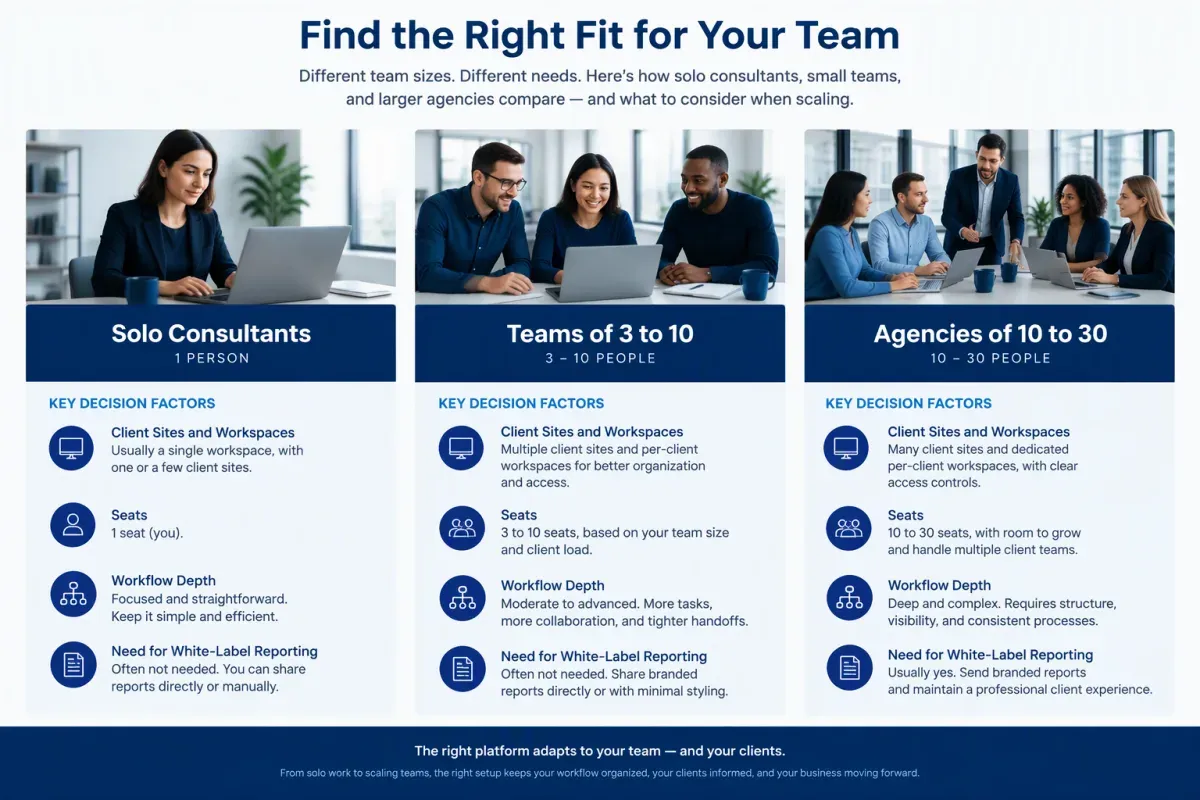
Solo consultants should start on entry tiers, 3 to 10-person agencies should decide on seats and client separation, and 10 to 30-person agencies should weigh workflow depth against branded reporting.
For solo consultants, entry options include Floyi Free (1 seat), Frase Starter (1 seat, 1 site), Surfer Discovery (1 seat), and Topical Map AI Basic (25 maps). Treat these starting prices as entry points, not equivalent tiers. Check the site, workspace or project limit first.
For 3 to 10-person agencies, seats and per-client separation decide it. The options:
- Floyi Pro: 3 seats (up to 5) and per-client brand workspaces.
- Keyword Insights Professional: 3 seats and 10 workspaces.
- Surfer Standard: 3 seats.
- Frase Professional: 3 seats and 5 sites.
For 10 to 30-person agencies, Floyi Scale (8 seats and 50,000 credits a month) suits teams that want the map to carry into briefs and drafts. Scale caps at 15 seats, so check that cap against your headcount. Search Atlas (Pro or Agency), Topical Map AI (Enterprise or Agency) and Frase Enterprise suit agencies whose clients expect built-in white-label reporting or client portals. Recalculate cost per client at your real client count.
Choose by client count, client types, team size, and required outputs such as white-label reporting, API access or CMS publishing. Your agency content strategy may still need research, mapping and briefing in more than one tool.
If per-client workspaces and map-to-brief carry-through top your list, map your first client in Floyi.
Topical Mapping Tools for Agencies FAQs
These FAQs cover what agency leaders ask most when comparing mapping tools: free options, client work, cancellation, the skills a team needs, and map refreshes.
1. Are Free Topical Map Tools Worth Using?
Free generators work for a first-pass structure, but agencies hit their limits fast: thin validation, shallow hierarchy and weak export formats. Check all three before anything reaches a client.
The free Content Audit tool at floyi.com is useful for pilots. It maps how an existing client site’s content groups into topics, covers up to 100 pages and needs no account. Use it as a baseline, since it shows the structure the site has, not the structure it needs.
2. Can You Use Topical Maps For Client Work?
Yes. Topical maps for client SEO campaigns need a tool with four things: a separate workspace per client, team roles, exports clients can approve, and a path to briefs.
Several tools offer white-label output. Topical Map AI (Enterprise and Agency), Search Atlas (Pro and Agency) and Frase Enterprise all list it. Floyi exports carry no Floyi branding, so you can add your own. Floyi also keeps each client in its own brand workspace, and the map feeds briefs and drafts directly.
3. What Happens To Maps If You Cancel?
Before you cancel any mapping subscription, verify three things. Check whether maps stay viewable after the plan lapses, which export formats still work, and whether commercial-use rights cover deliverables you’ve already sent. Topical Map AI, for example, lists commercial use rights on all paid plans and white-label exports on its Enterprise and Agency plans, so confirm which plan produced your exports.
Export every client map, brief and report in a portable format before the billing date. Floyi exports are client-presentable and carry no Floyi branding. This comparison reflects October 2026, so confirm each vendor’s current terms before you act.
4. Do Topical Mapping Tools Need SEO Experience?
Mapping tools speed up clustering and map creation, but they don’t replace judgment. Grouping similar queries is only one step. A topical map also sets hierarchy, coverage gaps and each page’s role and intent. A person has to validate those.
Before a map goes to a client, check intent per page and page roles in the topical map. Then test the hierarchy against the client’s business model and look for topics that would compete with each other. Floyi’s Content Audit flags cannibalization and coverage gaps against the map, but a person decides what to merge, split or cut. A junior strategist can run the tool, while a senior SEO should sign off on hierarchy and topical scope.
5. Can You Regenerate A Topical Map?
Yes. Many tools let you regenerate or extend a map as search results and a client’s content change. Treat a refresh as a scheduled task on each retainer rather than a rebuild from scratch.
Before a regenerated map replaces the approved plan, compare the client’s live URLs against the existing map and mark which pages are published, in progress or drafted. That check keeps the new version from duplicating or overwriting work the client already signed off on.
About the author

Yoyao Hsueh
Yoyao Hsueh is the founder and CEO of Floyi, the topical authority platform, and the founder of Main Heading, an SEO and AI search agency. He is an expert in topical authority and topical mapping. He created Topical Maps Unlocked, a course studied by thousands of SEOs, content strategists and digital marketers, founded TopicalMap.com, a done-for-you topical mapping service for agencies and enterprise teams, and publishes the weekly Digital Surfer newsletter on SEO, content strategy and AI search.
About Floyi
Floyi is a closed loop system for strategic content. It connects brand foundations, audience insights, topical research, maps, briefs, and publishing so every new article builds real topical authority.
See the Floyi workflow