Entity Extraction Tools for Topical Map Research, Compared
Compare NLP APIs, open-source libraries, knowledge graph lookups, and SEO entity tools for topical map research, then turn the entities into a four-level map.
You’ve pulled a stack of competitor pages and need a tool that turns them into entities you can plan around. The right pick depends on three things: how many pages you process, how much code your team can write and whether you need typed entities or only related subtopics. Cloud NLP APIs, knowledge graph lookups, SEO entity tools, and open-source libraries each answer a different version of that need.
A quick search won’t sort them out, because the tools do different jobs under the same label. The Google Natural Language API returns typed entities with salience scores, while the Knowledge Graph Search API only confirms identity and doesn’t return relationships between entities. Ahrefs and Semrush surface related subtopics from ranking pages, and spaCy runs free but leaves entity linking to you. The comparison table sets what each tool takes in, what it returns, setup effort, and cost model side by side.
What comes out of any of them is a candidate list, not a page list. Treating every extracted entity as a topic is how maps swell with pages nobody needs.
Entity Extraction Key Takeaways
- Entity extraction proposes candidate entities and works as a gap-finder, not a replacement for manual research.
- Pull entities from several sources, and review any entity found in only one source.
- Pick tools by page volume, team technical skill and whether you need typed entities.
- The Google Natural Language API returns typed entities with salience, but you must scrape and send the text.
- The Google Knowledge Graph Search API checks identity only and doesn’t return relationships between entities.
- Wikidata supplies parent, child and sibling relationships, but it demands query skills and is thin on niche topics.
- SERP analysis decides whether an entity gets its own page, a section or no coverage.
What Does Entity Extraction Add To Topical Map Research?
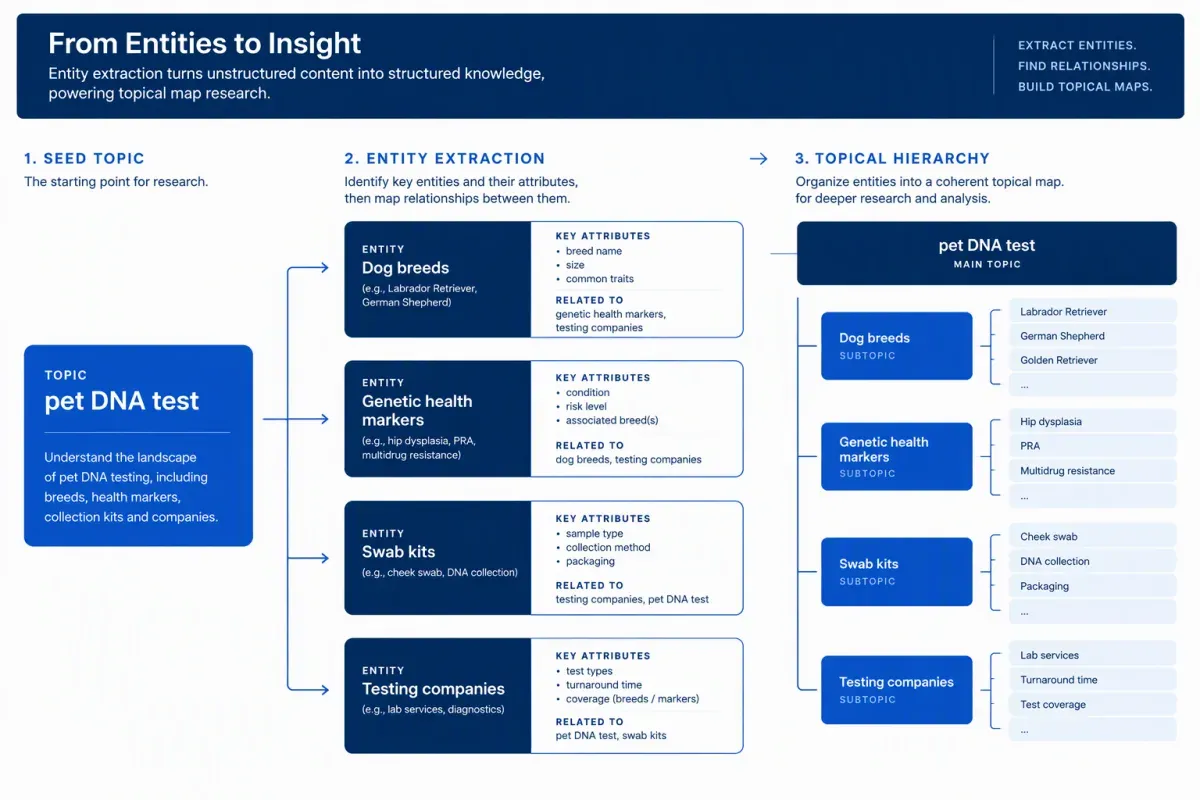
Keyword research shows what people type into search, while entity extraction shows the people, products, places, and concepts a topic is made of. Take the seed “pet DNA test.” Extraction breaks it into entities like dog breeds, genetic health markers, swab kits, and testing companies. Each entity carries attributes (accuracy, sample type, turnaround time) and relationships (a breed links to health risks, a kit links to a lab). Those relationships sort into a hierarchy, which is the backbone of an entity-based topical map.
That matters for a topical map for SEO because an entity list surfaces subtopics and real-world objects a keyword list misses. Entity-based SEO starts here: breeds, labs and organizations become a coverage check against the map you’re already planning.
Treat extraction as a gap-finder, not your primary method. Tools miss entities and mislabel others, so manual research stays the baseline, and extraction catches what you skipped. Extraction tools don’t build the map itself either. That job falls to dedicated topical map platforms compared by workflow and depth, and extraction only feeds them candidates.
Don’t read the output as a keyword list. Some entities that look strong on paper have no place in the results. Keyword data shows demand, and SERP analysis shows which entities earn their own page, which get a section inside a larger page and which never appear. Let the search results make that call before anything lands on the map.
Where Should You Extract Entities From?
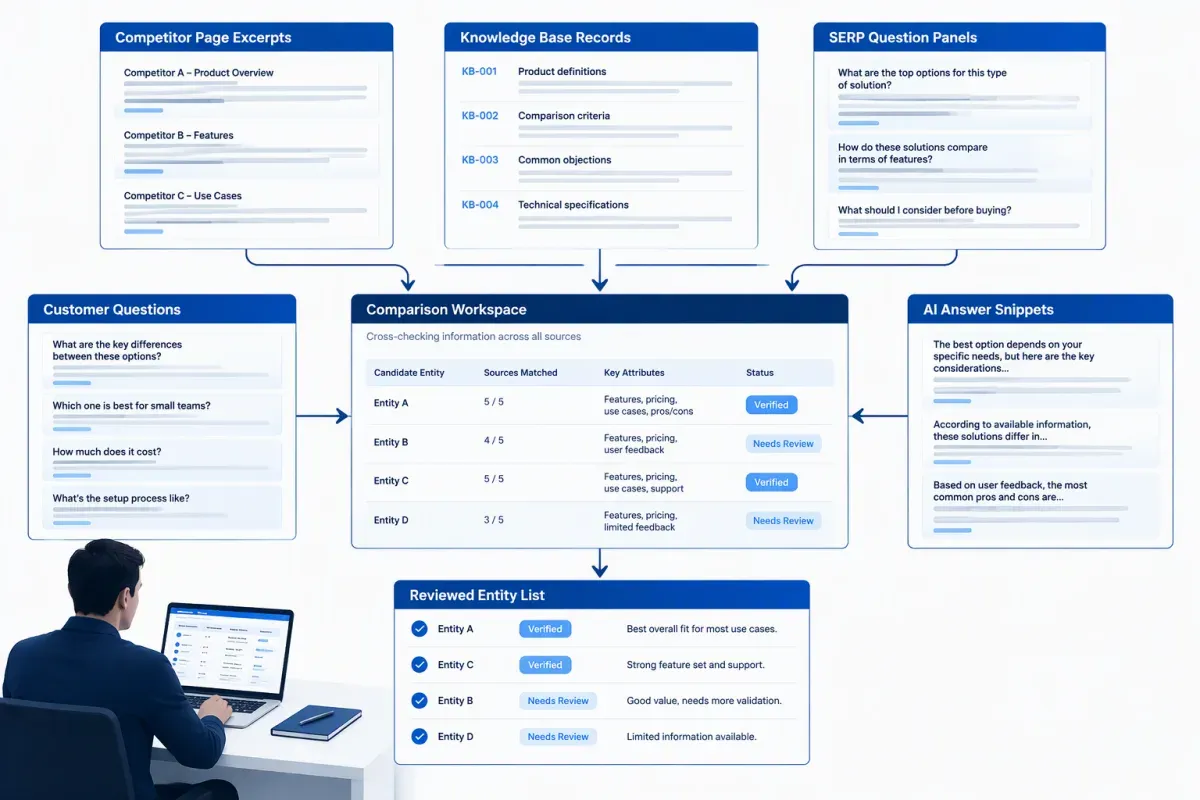
No single input gives complete entity coverage, so pull from several sources and compare what each one surfaces. Start with the pages ranking for your core topic and its main subtopics, and capture titles, headings and main text. That set shows what Google already rewards. Grouping those queries first with one of the SERP clustering tools compared keeps the page set tied to real intents.
Competitor content analysis turns that set into an entity gap analysis. Extract entities from competitor pages, compare the results against your outline and flag entities they cover that you miss as candidate content gaps. Competitor sitemap analysis adds a cheap extra input, since cleaned URL slugs often name products or concepts outright.
Other sources fill different holes:
- Knowledge bases: Wikipedia and Wikidata show canonical entities and how they relate.
- SERP features: Headings, People Also Ask and related searches show how searchers frame the topic.
- Customer questions: These surface entities publishers skip.
- AI answers: The brands, products and concepts that ChatGPT, Gemini and Google AI Mode name show what the engines treat as part of the topic.
Budget-minded teams can run this whole comparison with free tools for topical mapping and a spreadsheet.
Ranking pages repeat each other, encyclopedic sources miss commercial intent and customer questions are noisy. An entity found in only one source needs review before it enters the map. One found in several is a strong candidate.
Which Entity Extraction Tools Fit Topical Map Research?
The right entity extraction tools depend on three things: how many pages you process, how technical your team is and whether you need typed entities or just related topics. Four categories cover most needs:
- Cloud NLP APIs: The Google Natural Language API.
- Knowledge graph lookups: The Google Knowledge Graph Search API and Wikidata.
- SEO entity and topic tools: InLinks, Ahrefs, Semrush, and Floyi.
- Open-source NLP libraries: spaCy.
Volume comes first. A few competitor pages can be pasted into a free demo or checked by hand. Hundreds of pages call for an entity extraction API or library fed by a small scraper, because these tools analyze only the text you supply.
Technical capacity comes next. Developer routes (API calls, Wikidata queries, a Python script) give you control and per-entity data, but they cost coding time. Platform routes trade that control for faster setup. If you’re comparing agency-focused topical map tools, this trade-off usually decides the shortlist.
Output type is the last split. APIs and libraries do named entity extraction and return typed entities. SEO research tools mostly support subtopic discovery, surfacing related phrasing from ranking pages.
Pick one primary extraction route and one validation source, such as Wikidata or a manual check of Wikipedia. The table and tool entries below show how each option fits.
Compare The Tool Options In One Table
Only two of these tools return typed entities from raw text on their own, and the table shows where the rest fit:
| Tool | What you feed it | What it returns | Setup effort | Cost model | Best fit |
|---|---|---|---|---|---|
| Google Natural Language API (extractor) | Page text, scripted from URLs | Typed entities, sentiment and categories. Salience, Wikipedia URL and Knowledge Graph ID come from v1 analyzeEntities (v2 drops salience) | Moderate, needs code | Usage-based API | Agencies running repeat audits |
| Google Knowledge Graph Search API (lookup) | An entity name | Identity match, no relationships between entities | Low | API key, check Google’s terms | Checking a handful of entities |
| Wikidata, SPARQL queries (lookup) | A structured query | Relationships and hierarchy | High, needs query skills | Free | Technical leads |
| InLinks (platform) | Pages or URLs | Entities inside a wider SEO workflow | Low | Subscription | Teams wanting one workflow |
| Ahrefs (related topics) | A keyword | Related subtopics from top-ranking pages | Low | Subscription | Quick topic gaps |
| Semrush (related topics) | A keyword | Related subtopics and phrasing patterns | Low | Subscription | Quick topic gaps |
| spaCy (extractor) | Raw text | Typed entities, no hierarchy | Moderate, needs Python | Open-source and free | Custom pipelines |
| Floyi (platform) | A target query, your page or your research | Optimizer entities, AIRS entity analysis, AI Search Gaps topics | Low | Credits on Free, Pro and Scale plans | Teams tying gaps to a map |
Prices change, so check each vendor’s pricing page.
The Natural Language API and spaCy are the two extractors. Ahrefs and Semrush work from ranking results instead. InLinks and Floyi sit between the groups, finding entities inside a wider SEO workflow. Low page volume pairs well with manual review, while repeatable agency audits call for a scripted run or a platform subscription.
1. Google Natural Language API: Cloud NLP For Competitor Text
The Google Natural Language API fits teams that want to run competitor text through an NLP engine and get structured entity data back. It’s a developer tool, not a map builder, so the output is research material rather than a finished structure.
It returns named entities, entity types (person, organization, location, consumer good, event, and others) and a salience score showing how central each entity is to the text. Where available, it adds a Wikipedia URL and a Knowledge Graph ID. Salience, the Wikipedia URL and the Knowledge Graph ID come from the v1 analyzeEntities method, and v2 of the API drops salience. It can also return sentiment and content categories.
Because it’s an API, you can send the text of many competitor pages, store salience-ranked entities in a sheet and compare patterns across a SERP. Salience measures centrality within one text only, so compare scores across several pages before you act on them.
The trade-off is setup. The service analyzes only the text you send, so you need to scrape pages first and run a Google Cloud project with credentials. Pricing is usage-based, so check Google Cloud’s pricing page for rates. For a one-off check, pasting page text into a free demo is faster.
2. Google Knowledge Graph API: Quick Entity Identity Lookups
The Knowledge Graph Search API is an identity lookup, not an extractor. You send it a candidate name, and it returns matching entities with a name, schema.org types, a short description, an ID, and a result score.
That makes it useful for entity disambiguation. A bare “Moscow” usually resolves to the Russian capital, but the page you’re mapping might cover Moscow, Idaho. A lookup shows which sense Google treats as dominant, so you know whether the term needs a qualifier before it earns a place in the map.
The limits matter. Per Google’s own documentation, the API returns individual matching entities, not graphs of connected entities, and Google points to Wikidata for interconnected data. Google also says it’s migrating the API to Cloud Enterprise Knowledge Graph, so new projects should check that product first.
Treat it as a quick first-pass validator after extraction. When you need relationships between entities, add a Wikidata lookup, which supplies the connections this API leaves out.
3. Wikidata SPARQL: Free Relationship And Hierarchy Queries
Wikidata is a free, structured knowledge base that you query with SPARQL rather than a tool that reads text. It extracts nothing from competitor pages. Its job starts after extraction: confirming what each candidate entity is, retrieving its canonical Q-identifier and separating look-alike names. There’s no license fee, but you pay in query-writing time.
Identity validation is the first practical use. Take a term from an API run or another extractor and match it to its Wikidata item. The item’s type settles whether “Tesco” is a supermarket or something else, and its URI gives you a stable way to track that entity across tools and competitor pages.
Four properties matter most for hierarchy research:
- Subclass of (P279): Points to broader parent classes.
- Part of (P361): Shows which larger whole contains the entity.
- Has part (P527): Lists the components beneath it.
- Facet of (P1269): Links an entity to the wider topic it examines from one angle.
Querying them returns parent, child and sibling relationships. Those can seed a hierarchical topical map and reveal candidate structure before you commit to page topics.
The limits are real. SPARQL demands technical skill, and coverage is thin for niche or new topics, so pair it with a text extractor.
4. InLinks: SEO Entity Platform With Entity Gap Analysis
InLinks is the SEO-oriented entity platform in this comparison. It extracts entities from content, connects them through topical relationships and aligns entities with Knowledge Graph concepts, all without your team writing extraction code. InLinks’ own topic-map article describes two uses:
- Existing coverage: A site topic view of the topics your site already covers.
- Target-topic research: A SERP entity view built by running its NLP over the top results in your chosen market, with the entities grouped into categories and subtopics.
The outputs are practical. Content gaps show up where your site’s entities fall short of what competing pages cover. Entity linking then supports internal links built on concepts rather than only exact-match anchors. For teams that want extraction and implementation in one place, that pairing is a real strength.
The trade-off is access. InLinks works through its own platform, not as a general-purpose API for arbitrary text, so it won’t replace a cloud service if you need to process custom corpora. Its groupings still need validation, and they aren’t a four-level topical map. For pricing, check the vendor’s pricing page.
Choose InLinks if you’d rather review extracted entities than build the pipeline that produces them.
5. Ahrefs: Parent Topics And Content Helper Terms
Ahrefs fits strategists who want SERP-informed topic grouping and related-term discovery, not named-entity extraction. It doesn’t return entity types, salience scores or Knowledge Graph IDs, so treat its output as a topic and phrase list to vet as entity candidates.
Two kinds of output do the work:
- Parent Topic: It uses the query sending the most traffic to the #1-ranking page as the keyword’s broader topic. That helps when you sort macro-topics into subcategories at the upper levels of a map.
- Content suggestions: Its content tools suggest related subtopics and phrasing for a target keyword. Check each term against Wikidata or a Knowledge Graph lookup before you treat it as an entity worth a page.
Ahrefs is built around keyword research and backlink data, so it pairs well with an entity workflow if those are your daily inputs. Because it groups what already ranks, it shows less about entities your competitors haven’t covered yet. For pricing, check the vendor’s pricing page.
6. Semrush: Topic Research And Pillar Grouping
Semrush’s Topic Research widens subtopic coverage. It starts from a seed topic and returns subtopic cards with popular headlines, questions and related searches. That makes it a solid engine for semantic keyword research when you’re planning pillar and supporting pages. It isn’t documented as an entity extractor, so treat the output as SERP-derived topic ideas.
Those ideas sort under a pillar and its supporting pages, which gives you a reasonable starting outline. Semrush also offers keyword research data, which helps with demand checks.
Grouping has a limit, though. A list of candidate subtopics doesn’t confirm that a term is a real entity, resolve which entity it refers to or verify how entities relate. Cross-check each one against a knowledge source such as Wikidata before you commit it as a page.
Semrush fits teams already working in it who want SERP-grounded discovery. It sits closest to the Ahrefs parent-topic approach covered above, and it supplements the extraction and validation steps in this comparison rather than replacing them.
7. spaCy: Open-Source Extraction You Run Yourself
spaCy is a free, open-source Python library, and it’s the obvious pick among open-source NLP libraries when you want extraction without per-call fees. Its named entity recognition labels spans with types such as PERSON, ORG and GPE (countries, cities, states), per the library’s documentation.
For map research, the payoff is bulk processing. Run it over scraped competitor text, export entity counts per page to a sheet and compare across the SERP, since nothing meters the volume.
Entity linking is where expectations need adjusting. The library can resolve an entity to a unique ID in a knowledge base, but you build that knowledge base and train the linker yourself. Most teams skip that step and pair the output with Wikidata lookups instead.
Limits to weigh before committing:
- Python skills: Setup and scripting fall on you.
- General-purpose labels: Niche or industry-specific entities can slip past without custom training.
- No salience score: Unlike the Natural Language API, it offers none, so frequency across pages becomes your proxy.
It fits technical SEOs and in-house teams with a developer on hand. If your team wants a no-code route, look elsewhere.
8. Floyi: Entities From Competitors And AI Answers
Floyi isn’t a general-purpose entity extraction API or NLP library, so you can’t send it arbitrary text and get typed entities back. Its entity work lives inside three features:
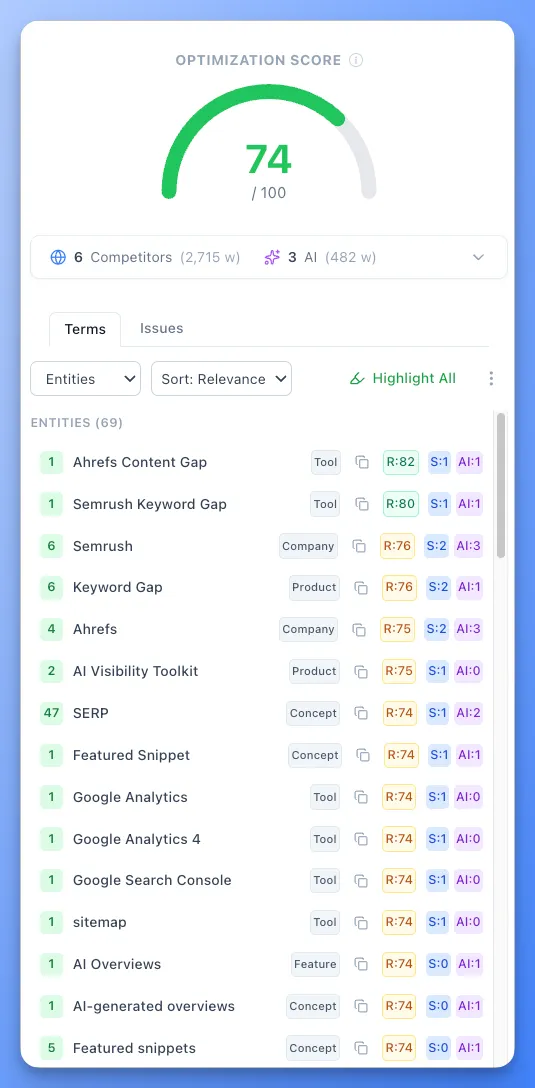
- Content Optimizer: Benchmarks a page against top SERP competitors and AI sources, then lists Terms and Entities separately. You can sort each list by whether an item appears in SERP competitors or AI sources, which makes it a practical route to competitor entity gap analysis.
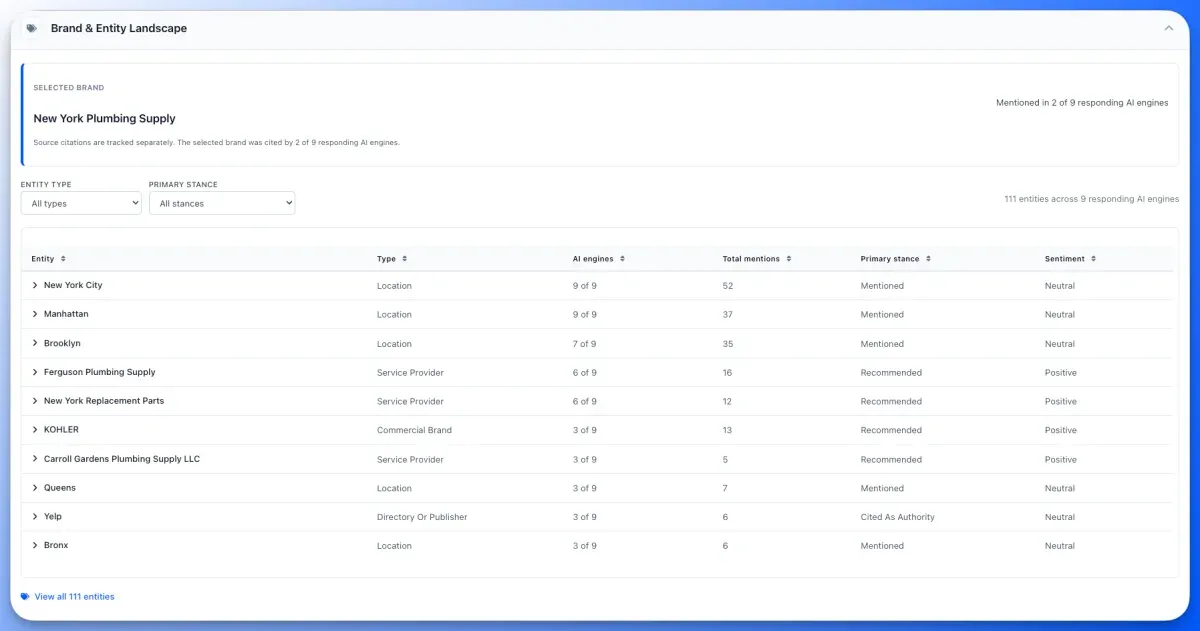
- AIRS Analyzer, Brand & Entity Landscape: Extracts every entity the AI answers name for a query, including brands, companies, products, people, and publishers. It ranks them by how many responding engines named each one and records each engine’s stance and sentiment with an evidence quote.
- Topical Research, AI Search Gaps: Queries ChatGPT, Google Gemini and Google AI Mode as your buyer personas and extracts topics from their responses. It then matches them against your research to surface gap topics.
Floyi fits teams that want entity and topic gaps tied to a topical map, briefs and AI answer visibility. It doesn’t fit if you need raw typed-entity output at scale from your own text. For that job, use a cloud API or spaCy.
What Are The Limits Of Entity Extraction?
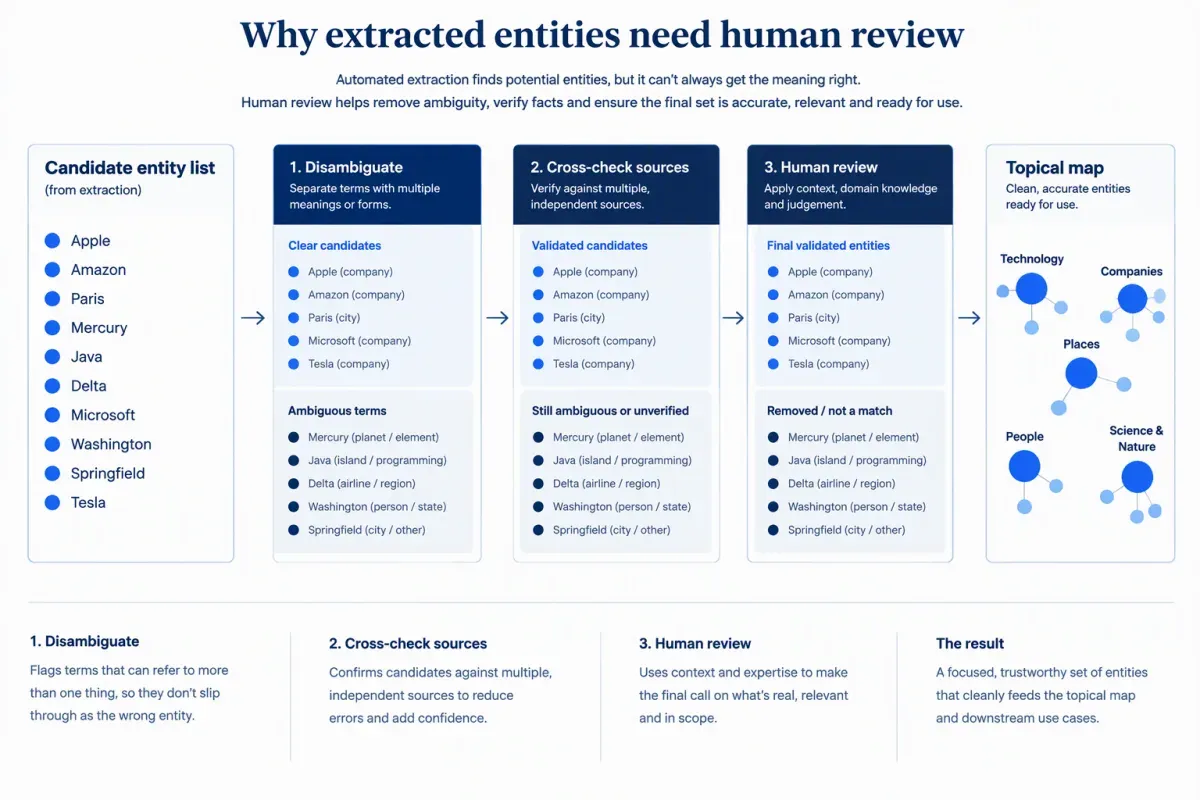
Entity extraction doesn’t decide what your map covers, and treating the output as a finished topic list is a common way these projects go wrong.
Ambiguity comes first. The same string can point to different things, so a confident label may not match your topical scope. An extractor can tag “Moscow” with high confidence, yet a page about Moscow, Idaho and a page about Moscow, Russia serve different audiences. Run a disambiguation check on every candidate before it earns a place on the map.
Source bias is next, because output reflects what you feed in. Competitor text over-represents what incumbents already cover, while Wikidata tends to under-represent niche or brand-new concepts. Whether you use a cloud API, an open-source library or an LLM prompt in ChatGPT or Claude, the same rule holds. Agreement across several sources is stronger evidence than a high score from one.
Scores need careful reading too. Salience and similar metrics show how prominent an entity is in the text analyzed. They don’t show ranking value, page priority or likely traffic.
Human review closes the gap. A strategist should prune noise, merge synonyms and rerun extraction whenever the SERPs for core topics shift. A map built once and never revisited drifts away from the results it was meant to match.
How Do You Turn An Entity List Into A Topical Map?
An extracted entity list is a pile of candidates. It isn’t a map, and it isn’t a list of article ideas. Turning it into a map takes six steps, and each one removes noise before the next begins:
- Collect: Gather the ranking pages for each core query, plus a reference page such as Wikipedia.
- Extract: Run those pages through one extractor from the comparison.
- Normalize: Merge variants and clear out junk.
- Validate: Confirm what each entity is and how it relates to others.
- Decide: Choose between a dedicated page and a mention.
- Structure: Place the survivors into a four-level hierarchy.
For the first two steps, pick either the Natural Language API or spaCy and stick with it across all pages so the output stays comparable. Record each entity, its type and its salience score where the tool returns one. This raw material will be messy.
Normalizing handles the mess. Merge synonyms and spelling variants, then drop duplicates and generic words like “tips” that no one would build a page around. Keep a sheet with the canonical name, aliases, source pages, and Wikidata ID for each entity. That sheet is your SEO entity mapping record.
Validation means checking rather than guessing. Use Wikidata or a Knowledge Graph lookup to confirm identity and parent-child links. Then flag entities that several competitors cover and you don’t. Those are your coverage gaps, and you decide what counts as “several” based on how crowded the niche is.
Search intent analysis settles the choice between a page and a mention. If two related entities return largely the same ranking URLs, one page can cover both. If the results differ, each may deserve its own page. If neither pattern holds, cover the entity as a mention inside a parent page.
To structure the survivors, sort them into Pillar > Hub > Branch > Resource. Your brand’s topical scope and buyer personas act as the final filter, removing entities that are accurate but don’t fit what the brand should be known for.
Floyi doesn’t replace the extraction step for raw text. Its Topical Maps are multi-level hierarchies validated against SERP data, with URL slugs, page intent and internal linking guidance attached. The Organizer lets you reorder, rename and combine topics when validation disagrees with a first draft.
Once your page decisions are made, map your validated entities in Floyi and turn them into a four-level map.
Entity Extraction Tools FAQs
These answers cover the questions practitioners ask most when choosing entity extraction tools, from salience and Wikidata to AI answers and page counts.
1. Do You Need Entity Extraction Before Writing?
No, extraction isn’t a required gate before you write. It works as a research aid that can surface entities your manual research missed or gaps against winning pages. Manual research usually catches most entities, and every extraction tool has limits, so the output supplements that work.
SERP evidence, reader intent and relevance decide what enters the map. Filter each candidate against your topical scope and drop low-intent or redundant items rather than publishing pages for theoretical completeness.
2. How Do Salience Scores Guide Topical Maps?
Entity salience from the Google Natural Language API shows how prominent an entity is within the text you analyzed. It separates what a competitor page centers on from what it only mentions in passing. Salience, the Wikipedia URL and the Knowledge Graph ID come from the v1 analyzeEntities method, and v2 of the API drops salience.
Salience measures prominence in one text, not ranking value or page priority. Entities that score high across several competitor pages are strong candidates. A one-off high score needs checking against relevance to your map, source coverage and a human read of intent.
3. Does Wikidata Influence SEO Performance?
Wikidata is a research and validation source, not a ranking lever, so using it doesn’t improve SEO performance on its own. Its value starts after initial extraction. A lookup confirms what each candidate entity is, returns its canonical identifier and separates similar names before anything enters your topical map.
SPARQL queries can also follow the hierarchy properties listed in the Wikidata entry above to return parent, child and sibling results. Treat those results as candidate subtopics, then check them against SERPs and competitor pages.
4. Can AI Answers Be A Source For Entity Research?
Yes, AI answers work as one input for entity research. The entities that ChatGPT, Gemini and Google AI Mode name show what those engines treat as part of a topic. That includes brands, products, people, and concepts that ranking pages may skip. Treat each one like any other candidate: confirm its identity, check SERP evidence and drop anything outside your topical scope.
Engines differ, so an entity several of them name is a stronger candidate than one named once. Covering an entity doesn’t guarantee inclusion in AI answers.
5. How Many Competitor Pages Should You Extract From?
There’s no fixed number. Start with the pages ranking for each core query, then keep adding pages until new ones stop surfacing entities your list doesn’t already have. That stopping rule keeps competitor entity analysis from turning into busywork.
A few pages per query suit a manual or demo check. An API or library script pays off when you cover every hub of a large map. Keep the source URLs in your sheet so you can rerun the extraction when the SERPs shift.
About the author

Yoyao Hsueh
Yoyao Hsueh is the founder and CEO of Floyi, the topical authority platform, and the founder of Main Heading, an SEO and AI search agency. He is an expert in topical authority and topical mapping. He created Topical Maps Unlocked, a course studied by thousands of SEOs, content strategists and digital marketers, founded TopicalMap.com, a done-for-you topical mapping service for agencies and enterprise teams, and publishes the weekly Digital Surfer newsletter on SEO, content strategy and AI search.
About Floyi
Floyi is a closed loop system for strategic content. It connects brand foundations, audience insights, topical research, maps, briefs, and publishing so every new article builds real topical authority.
See the Floyi workflow