Best Topical Authority Tools: 9 Compared for SEO Teams
The best topical authority tools depend on your bottleneck. 9 compared on clustering, content gaps, briefs and publishing, and where each one stops.
The best topical authority tool depends on which part of your workflow is broken. Feature count is the wrong axis. Ahrefs and Semrush are strongest for research and content gap analysis. Surfer SEO and Clearscope are strongest for briefs and on-page optimization. MarketMuse goes deepest on coverage scoring. Floyi is the only tool here that carries a topic from research through clustering, map, brief, draft, publish, and measurement without a handoff.
This comparison covers Floyi, Surfer SEO, Ahrefs, Semrush, MarketMuse, Clearscope, Search Atlas, RankDots, and SEO PowerSuite, scored on five jobs: topical mapping, content gap analysis, brief generation, semantic optimization, and publishing handoff. You’ll also see where each one stops. What a tool won’t do tells you more than what it advertises.
For agencies, in-house teams, content strategists, and freelance SEOs, the bottleneck usually isn’t research. It’s the handoff. The map lives in one tool, the brief in another, the draft in a doc, and the publish step in a CMS nobody wants to open. Every hop is a chance for the plan to drift from what actually gets published.
Topical Authority Tools Key Takeaways
- Topical authority tools turn keyword research into structured content plans.
- Floyi connects research, clustering, briefs, and publishing in one workflow.
- Surfer SEO is strongest for content briefs and on-page optimization.
- Ahrefs excels at content gap analysis and competitor comparison.
- Semrush is useful for topic discovery and early-stage clustering.
- MarketMuse focuses on depth scoring and full-topic coverage.
- Clearscope, Search Atlas, RankDots, and SEO PowerSuite suit narrower or budget-conscious needs.
Which Tools Rank Highest For Topical Authority?
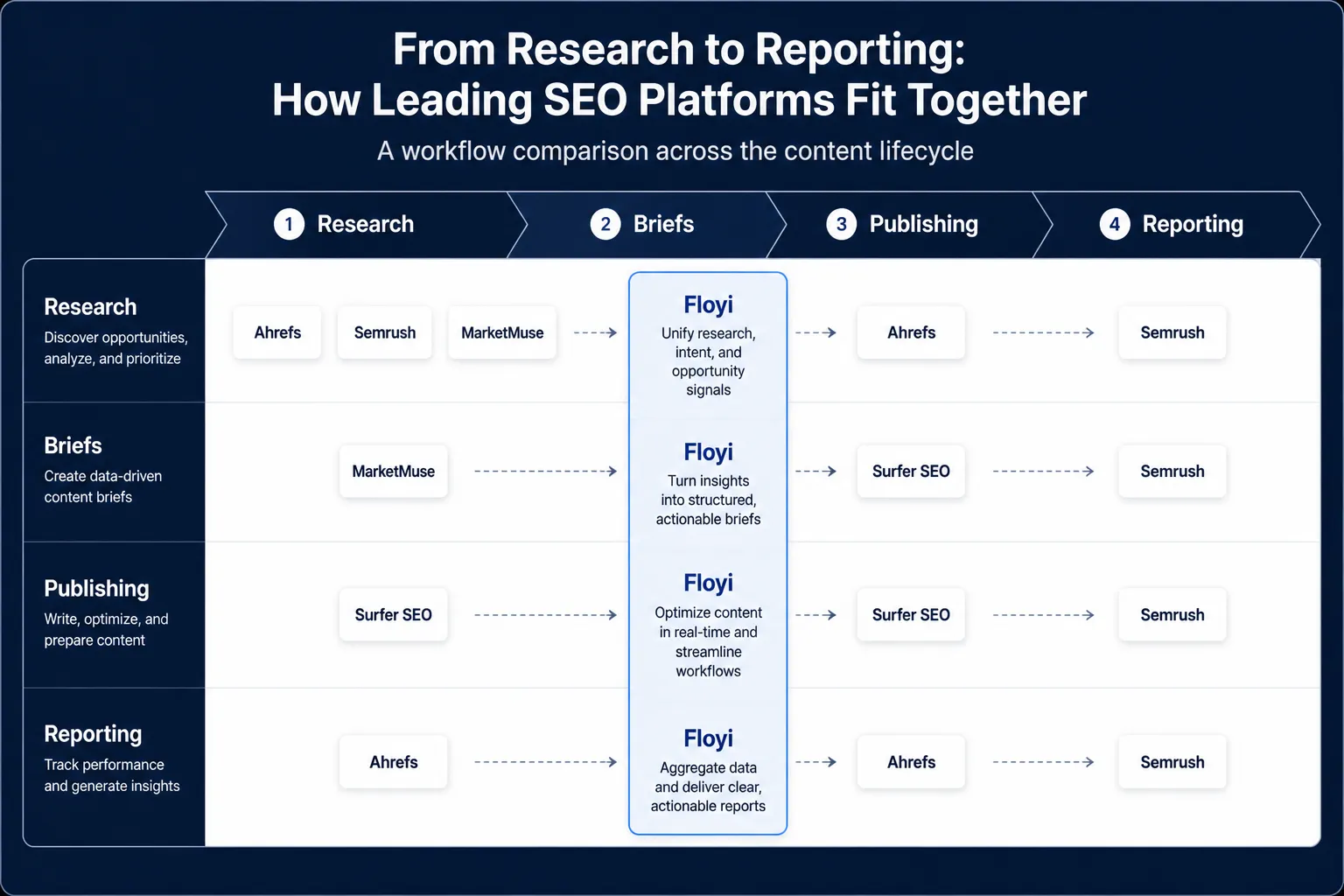
The market breaks into four practical lanes, and your shortlist should follow the workflow bottleneck, not the logo. If you need help with research, briefs, publishing, or reporting, that usually matters more than category labels. The goal is always the same: planning clusters before tooling so authority compounds across your site.
Floyi is positioned as a top choice for teams seeking a single end-to-end topical authority workflow that integrates research, mapping, briefing, and publishing. Authority Planner, Topical Audit, SERP Insights, PAA Explorer, briefs, and drafts connect brand and audience inputs to topical maps, internal linking, and export-ready reporting tied to Google Search Console (GSC) and AI search.
Here’s the fastest way to compare the leading topical authority tools:
| Tool | Best fit | Where it stands out | What it tracks after publish |
|---|---|---|---|
| Floyi | End-to-end planning and production | Topical maps, briefs, drafts, reporting | Keyword positions, share of voice, map coverage, page quality, and AI citations |
| Surfer SEO | Briefs and on-page optimization | Term guidance, readability, editor integrations | Page-level optimization scores, rechecked on edit |
| Ahrefs | Research and gap analysis | Backlinks, content-gap analysis, competitive insights | Keyword positions and share of voice |
| Semrush | Broader all-in-one SEO suite | Semantic topic discovery, site-structure visualization | Keyword positions and site visibility |
| MarketMuse | Depth and authority scoring | Coverage depth over broad platform breadth | Content inventory and topic depth scores |
| Clearscope | Content optimization | Cleaner on-page guidance for writers | Content grades plus Content Inventory performance with GSC connected |
| Search Atlas | Mapping and optimization | Lighter planning plus optimization support | Keyword Rank Tracker with daily, device and location-level positions |
| RankDots and SEO PowerSuite | Simpler semantic support | Narrower use cases without a full system | Rank tracking at cluster level in RankDots, 500+ engines in SEO PowerSuite |
Surfer SEO ranks near the top for teams whose primary bottleneck is converting keyword plans into publishable drafts due to its strong content brief and on-page optimization features. Ahrefs is widely recognized as a leading research and content gap analysis tool, particularly for identifying competitor winning areas and building authority maps.
Semrush fits teams that want a wider SEO platform with semantic discovery and structure views. MarketMuse is often the preferred choice when authority scoring and coverage depth are prioritized over broad platform features, as it focuses on topic models and content depth.
For smaller teams without a need for a full research-to-publish system, tools like Clearscope, Search Atlas, RankDots, and SEO PowerSuite can provide sufficient semantic support and optimization. The cleanest shortlist is usually one end-to-end platform, one research tool, and one optimization tool.
Floyi — End-To-End Research To Publish Workflow
Floyi is the only closed-loop topical authority system in this comparison, taking you from brand and audience inputs to research, clustering, topical maps, briefs, drafts, and publishing without breaking the workflow.
Topical Research starts with live Google and YouTube autocomplete data, so your seed ideas come from real search behavior instead of guesswork. Floyi then builds a canonical hierarchy across Pillar, Hub, Branch, and Resource pages, which keeps you from getting stuck with flat keyword lists that never become an execution plan. Topical Clustering turns those raw ideas into SERP-aware intent groups, lets you tune clustering tightness, and helps prevent overlap before pages are written. That fits how artificial intelligence (AI) search results reward semantic clustering and clean keyword clusters, not duplicated pages.
Floyi’s Topical Map turns that research into a validated page architecture. You get URL slug generation, page-level intent, content placeholders, and multiple working views, including Spreadsheet, Silo View, and Outline View. Writers and strategists can see exactly what to publish next, and the briefing loop keeps the plan grounded in real inputs.
| Stage | What Floyi gives you |
|---|---|
| Research | Live autocomplete signals and hierarchy planning |
| Structure | Validated topical maps and semantic clustering |
| Briefing | Content briefs with brand, audience, and competitor context |
| Linking | Internal linking guidance and transparent research references |
| Publishing | Excel, CSV, Google Sheets, cluster export CSV, and WordPress integration |
The content briefs inherit your brand foundation, audience insight, scoped Knowledge Base documents, competitor and reference URLs, internal linking intent, and custom instructions. Inside the editor, the research tab shows internal link suggestions, research-agent queries, and top SERP competitors, so the logic stays visible instead of hidden. Export options and WordPress-ready execution also let you move the plan into downstream AI writing tools or CMS production without rebuilding it elsewhere. For agencies and in-house teams, that closed loop means fewer handoff errors, faster publishing, and one system for research, structure, briefing, linking, and delivery.
Surfer SEO — Strong For Content Briefs
Surfer SEO is a strong fit when your goal is turning SEO research into usable content briefs. It studies the pages already ranking for a query, then turns that SERP pattern into guidance writers can act on quickly. That usually means targets for word count, image count, headings, and other page-level benchmarks that help editors shape a draft with less guesswork.
It also goes beyond exact-match keywords. Surfer’s semantic and NLP-driven recommendations surface related entities, missing concepts, and adjacent terms so your brief reflects the language search engines expect in depth content. For agencies and in-house teams, that makes content briefs feel more like a working draft guide than a spreadsheet.
That strength shows up most clearly in day-to-day editing:
- Brief structure: Page-level metrics give writers a practical outline before drafting begins.
- Term coverage: NLP suggestions help you catch semantic gaps that simple keyword lists miss.
- Drafting workflow: Readability scoring and editor integrations make it easier to apply guidance inside the writing process.
- Optimization focus: Surfer helps you improve one page at a time with tight on-page direction.
Surfer also pairs well with Keyword Insights when you want cluster-level planning upstream, then page-level execution inside the brief. The tradeoff is scope. Surfer is excellent for brief quality and content optimization, but it’s narrower than end-to-end topical authority platforms because its core strength is optimizing a single page, not managing the full research-to-publish system.
Ahrefs — Best For Content Gap Research
Ahrefs is strongest when you need to see where competitors are winning that you are not, then turn that into an authority map built on real search coverage instead of guesswork.
Competing Domains gives you a fast comparison set for authority mapping. You can spot which rivals overlap with your topical footprint and which domains deserve a closer look. That makes it easier to separate true competitors from noise in the SERP and sharpen your competitive insights.
The Content Gap report turns content gap analysis into a practical planning tool. It shows missing subtopics and page opportunities by comparing your rankings with competitor coverage, so you can identify content gaps, expand weak sections, or build new supporting assets. Parent-topic discovery adds another planning layer. It moves you from single keywords to broader themes and shows how a competitor’s coverage is organized at the cluster level.
Ahrefs does not offer native cluster analysis, but its backlink data adds an authority layer many gap tools miss. Combined with competing-domain signals, it helps you judge which sites have deeper topical authority, not just more pages. That makes Ahrefs a strong fit when you want AI search content maps that expose thin coverage and point your next build toward the pages that matter most.
Semrush — Broad Topic Research Suite
Semrush works best as a discovery layer when you need to move from one seed topic to a wider set of angles fast. You enter a topic, and it expands into a visual mind map of subcategories, common questions, and popular headlines. That makes it useful when you want quick ideation before you build a formal topical map.
The visual layout helps you spot the shape of a topic at a glance. Broad themes stay separate from supporting articles. Question clusters stand out fast. That makes it easier to see where a pillar page needs adjacent coverage and where smaller articles should handle supporting intent.
For SEO teams, the cleanest workflow usually looks like this:
- Discover: Use Semrush Topic Research to collect raw topic ideas, headlines, and questions.
- Cluster: Move those ideas into a clustering tool so overlapping intents get grouped together.
- Brief: Pass each cluster into a semantic optimization or brief tool so required entities and subtopics are covered.
- Prioritize: Use Keyword Insights to sort the strongest opportunities from the loose ideas.
That sequence keeps Semrush in its strongest lane. It is excellent for question mining and early-stage planning. It is not a final execution tool. If you want visual exploration and research depth in one place, Semrush gives you a broad starting point for topical authority planning before you hand the work off to clustering and brief creation.
MarketMuse — Deep Authority Scoring
MarketMuse is built around topical authority, not just keyword volume. That matters when you need to judge how fully your site covers a subject and where authority is still thin. Its topic matrix audit compares your current content inventory against the topic set you need to own, so the plan shifts from chasing keywords to spotting where coverage breaks down.
The deeper value comes from how it surfaces content gaps. By reading competing SERPs and the semantic shape of a topic, the platform can point to missing subtopics, related concepts, and supporting pages that one-page optimization would miss. That makes it a stronger fit when you’re building a content cluster instead of fixing a single URL in isolation.
Enterprise teams also get more from the personalized difficulty score. It acts as a relative authority score that reflects how hard a topic may be to win based on your site’s existing strength, so not every opportunity gets treated as equal. Topic depth scoring then helps you sort quick wins from heavier lifts.
That distinction matters most at scale:
| Priority | What it tells you |
|---|---|
| Quick wins | Topics where current authority can earn traction faster |
| High-value bets | Themes that take more effort but can lift the whole domain |
| Content gaps | Areas where supporting depth is too thin to compete |
| Portfolio choices | Subjects worth funding because they improve overall authority |
For large sites, MarketMuse stands out because it gives you comprehensive gap visibility and domain-wide scoring. It is strongest when you need strategic coverage decisions, not just optimization for a single page.
Clearscope & Search Atlas — Content Optimization And Maps
Clearscope and Search Atlas solve different stages of the same SEO workflow. Clearscope is the page-level editor’s tool. It works best when you already have a draft or live URL and need stronger semantic coverage, tighter entity alignment, and clearer on-page guidance before publish.
Search Atlas sits earlier in the process. Its topical map generator turns one seed keyword into keyword clusters, long-tail ideas, and AI-generated article titles, so you can plan what to build next with more structure.
| Tool | Best use | Core strength | Best fit |
|---|---|---|---|
| Clearscope | Improve an existing page | Entity scoring, term suggestions, readability, editor integrations | Enterprise editorial teams focused on quality control |
| Search Atlas | Plan and expand coverage | Topical maps, cluster export CSV, article titles, bulk production support | Teams that want a structured content architecture |
The difference shows up in execution. Clearscope helps you close semantic gaps by surfacing the concepts authoritative pages already cover. That makes it a better fit for teams polishing one page at a time.
Search Atlas is the map-making counterpart. You can export the cluster export CSV, approve the structure, and move into production with much less manual sorting. Its bulk workflow is built for teams that want the planning layer and the writing layer to connect cleanly.
Compared with TopicalMaps.AI, Clearscope is about refinement, while Search Atlas is about scale. If your team needs quality control, Clearscope fits better. If your team wants exportable topical maps plus rapid downstream output from AI writing tools, Search Atlas is the sharper choice.
RankDots & SEO PowerSuite — Budget-Friendly Semantic Tools
RankDots and SEO PowerSuite sit in the budget-friendly lane for SEO teams that still need semantic clustering without paying for an enterprise stack. The tradeoff is straightforward. You get useful topic grouping and faster planning, but less end-to-end workflow depth than a full research-to-publish platform.
RankDots stands out when speed matters. Its AI-driven clustering helps turn large keyword sets into keyword clusters based on SERP similarity, so you can decide whether terms belong in one article or need separate pages. It also adds growth-prediction metrics and automated brief generation, which makes the handoff from research to draft much faster when you’re working lean.
SEO PowerSuite takes a different path. Its one-time license model is attractive if you want to avoid recurring subscriptions. Rank Tracker adds clustering plus visibility tracking across 500+ search engines, so you get affordable topic grouping and rank monitoring in one suite.
The practical fit looks like this:
- RankDots: Best for semantic clustering, quick opportunity spotting, and AI-driven clustering for fast brief creation
- SEO PowerSuite: Best for one-time pricing, clustering, and broad rank tracking
- Both tools: Best when you’re comfortable refining briefs and topical structure manually after the first pass
For tighter budgets, both tools can do real work. They just need a sharper editorial eye after the first semantic pass.
What Do Topical Authority Tools Actually Do?
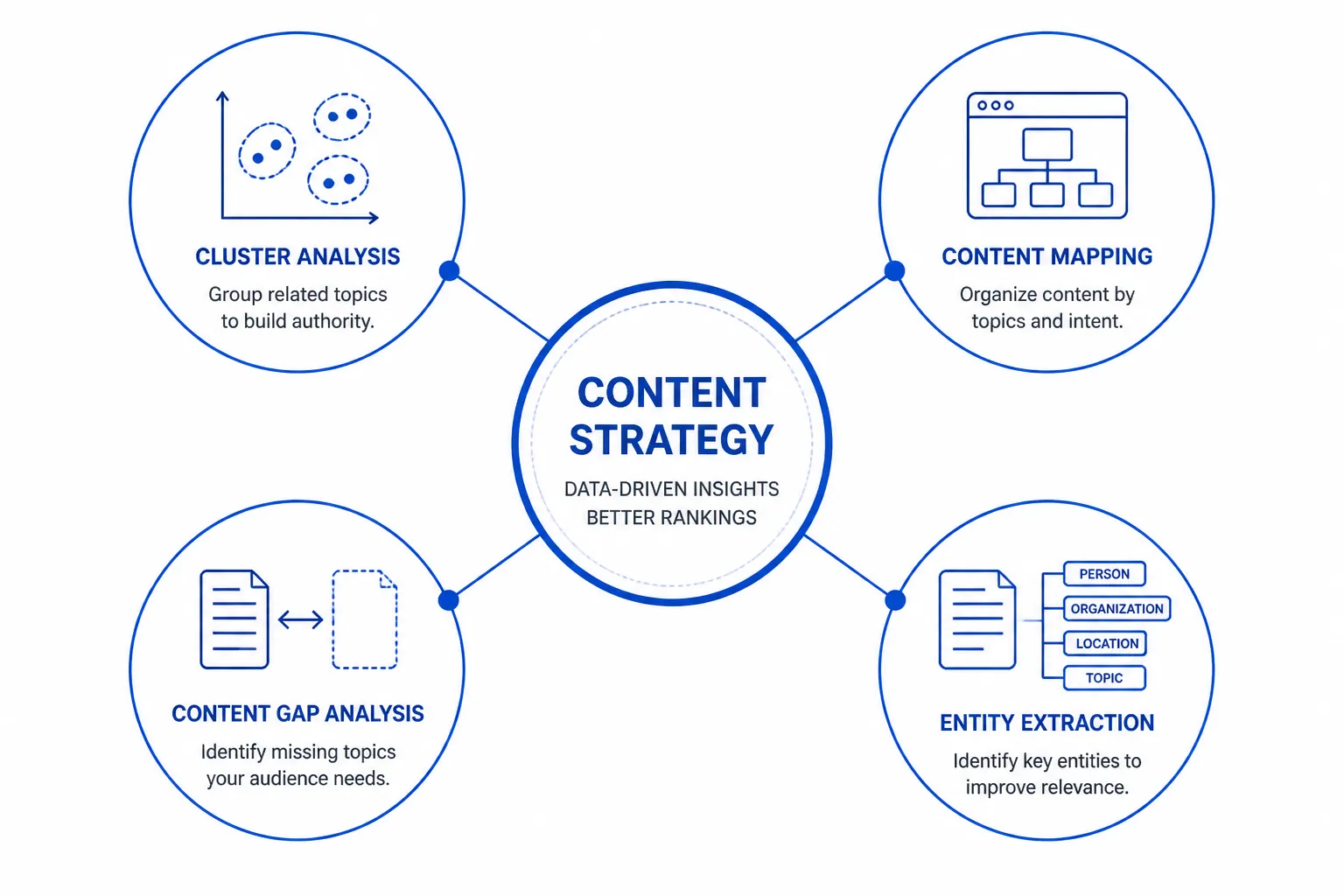
Topical authority tools turn SEO research into a structured coverage plan. That matters because search engines reward depth more than scattered publishing. When your site is organized around one subject, it looks like a credible source instead of a loose stack of posts.
The core functions are straightforward, and each one pushes your topical authority further:
- Cluster analysis: groups related terms by shared intent and SERP overlap. That cuts duplicate targeting and helps you decide whether a query belongs in a hub, pillar, or supporting page.
- Content mapping: turns those clusters into a publishable content roadmap with page order, URL structure, intent, and internal linking guidance. Floyi’s topical maps add spreadsheet, silo, and outline views, so you can move from research to execution faster.
- Content gap analysis: compares your coverage with competitors and surfaces missing subtopics, whitespace, and weak clusters. Some tools also score authority from 0 to 100 using cluster coverage, competitive completeness, and rank quality.
- Entity extraction and auditing: checks whether your pages cover the people, places, concepts, and related terms that define the topic in the real world. That makes it easier to spot content that is too thin, too broad, or simply misaligned.
A strong audit checklist for topical coverage helps you decide which pages to keep, optimize, consolidate, or prune. Those actions support better rankings, stronger click-through rate, less cannibalization, and cleaner query-to-page matching in Google Search Console.
For agencies and in-house teams, the best topical authority tools make authority visible before and after publishing. They also fit existing planning workflows and produce client-ready outputs instead of forcing manual spreadsheet cleanup.
How Do You Compare Platforms For Topical Authority Tracking?
Match the platform to the layer you need to report on. “Tracking” covers four different jobs, and most tools do one or two of them well rather than all four.
| Layer | What it answers | Strongest options |
|---|---|---|
| Rank tracking | Did positions move? | Ahrefs, Semrush, Search Atlas, and SEO PowerSuite |
| Cluster and coverage tracking | How much of the topic is published and performing? | Floyi, MarketMuse and RankDots |
| Page quality tracking | Is this page good enough to ship? | Clearscope, Surfer SEO and Floyi |
| AI visibility tracking | Are you cited in AI answers? | Floyi and Ahrefs |
On positions, Ahrefs and Semrush have the deepest keyword databases. Search Atlas ships a Keyword Rank Tracker with daily updates plus location and device targeting, and SEO PowerSuite covers the widest set of search engines on a one-time license.
Above the keyword level, MarketMuse scores inventory depth across a topic set, RankDots tracks whole clusters rather than single queries, and Clearscope’s Content Inventory connects Google Search Console and groups published pages into Content Views. Floyi’s Topical Authority Scorecard reports Content Authority, Market Authority and AI Authority against the map, with share of voice across up to 10 tracked competitors and trends from seven days to a year, and Silo Analysis breaks the same numbers down by pillar.
On page quality, Clearscope and Surfer score terms while you write. Floyi’s Page Quality Scorecard grades the finished draft 0 to 100 across relevance, content quality, information gain, next step, and trust.
Questions To Ask On A Demo
- Can I see coverage as a percentage, and what’s it a percentage of?
- Can I roll positions up by silo instead of reading 400 keyword rows?
- Does it show what I planned against what actually shipped?
- Does it report AI answer presence separately from rankings?
Those four questions tell you what a platform reports. Whether the number it hands back deserves the word authority is a different question, and most authority scores measure a proxy underneath the label.
How Do You Choose The Right Tool?
The best choice starts with the workflow, not the logo on the homepage. You get better results when the tool matches the stage you actually need, whether that means seed discovery, clustering, optimization, or publishing.
A simple way to narrow the field is to compare output first:
| If you need… | Prioritize… | Best fit for… |
|---|---|---|
| Topic scope and question mining | Research tools | AlsoAsked or Semrush Topic Research |
| Clean clusters and hierarchy | Clustering and map tools | Intent grouping and topic maps |
| Briefs and on-page guidance | Optimization tools | SurferSEO or MarketMuse |
| Final production handoff | Publishing tools | WordPress or your CMS |
Budget and team size matter just as much. Solo SEO consultants and small agencies often only need XLSX or Markdown exports so research can move into draft without extra overhead. Larger teams usually need guardrails, validation, and free re-clustering so a scope shift does not trigger a new paid cycle.
Search Atlas is a strong option if you want a map-to-publish path with less manual glue. Its documented flow moves from generate map to spreadsheet view, then into a Bulk AI template, upload, bulk-generate, review, and publish to WordPress through MetaSync.
Floyi is the better fit when you want closed-loop execution in one system. Its topical map flow keeps titles, intent, snippets, and URL slugs aligned, while review-ready XLSX and Markdown exports help strategists and editors work from the same structure instead of separate spreadsheets.
The final decision comes down to role fit and rework. Strategists need breadth, clustering, and gap visibility. Editors need stable briefs and clean outputs. Technical SEO leads need scalable exports and validation. Agencies need artifacts clients can approve quickly. The right tool shortens the path from seed discovery to publishable content with the least friction.
How Do You Turn Research Into Publishable Output?
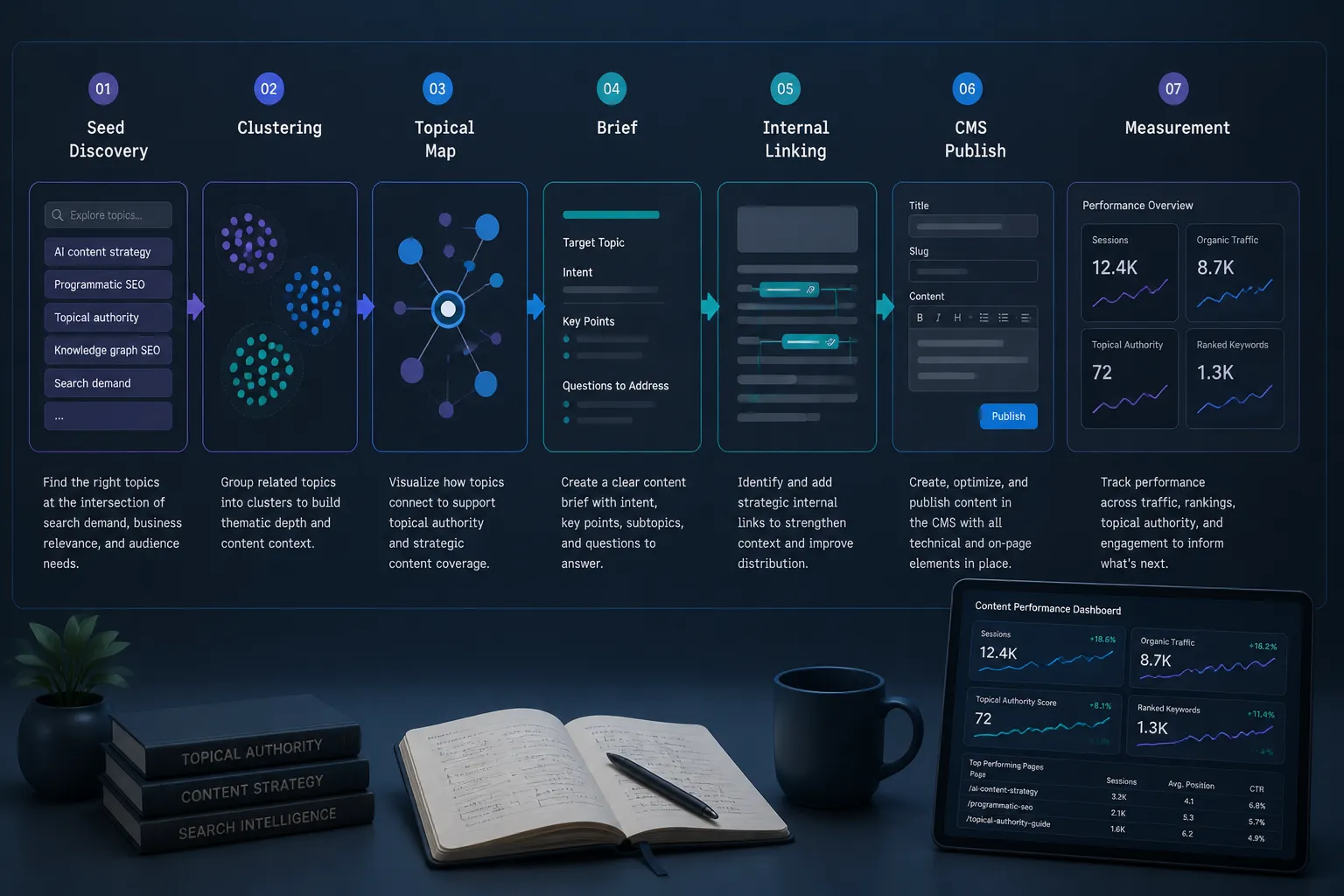
Treat research like a production pipeline, not a report that sits in a folder. The clean path is seed discovery, clustering, topical map, brief, internal linking, CMS publish, and post-publish measurement. That shift turns SEO research into shipped pages, and it starts with a structured content plan for topical authority.
Seed discovery should start broad and then get selective. Refresh the SERP, review market authority, share of voice, and domain-rank signals, then sort opportunities into leading, contested, and trailing silos. That helps you spot high-importance gaps that are not published yet instead of bloating the map with low-value ideas.
From there, build the topical map around entities and intent, not just keywords. One pillar page should connect to supporting pages with semantic terms, related entities, and enough variation coverage to answer the full topic set without near-duplicates. In practice, strong content mapping gives you a content roadmap that is easier to brief, draft, and publish.
A publishable brief turns the map into something a writer can use without guesswork. It should inherit audience context, brand voice, competitor sources, internal-link intent, and visibility signals. It should also define the page purpose, the target angle, and the required entities. When your team works across AI writing tools, a clean export path matters because it keeps the topical structure intact during drafting and bulk generation.
The internal-link plan belongs in the output, not in a follow-up pass. Relevance-scored suggestions, parent, sibling, and subtopic anchors, plus placement tracking, make it easier for each page to strengthen the cluster and support the money page. Tools like Link Whisper can help, but the real goal is a tidy internal linking architecture that reflects how people and search engines move through the topic.
| Stage | What it produces | What to measure |
|---|---|---|
| Seed discovery | Priority gap list | Share of voice, domain rank |
| Clustering | Entity-led topic groups | Common-topic growth, coverage depth |
| Briefing | Writer-ready page plan | Brief completeness, entity coverage |
| Publishing | WordPress or GitHub output | SEO metadata, publish success |
| Measurement | Performance readout | TAS, Content Authority, Market Authority, AI Authority |
Your workflow closes the loop when content goes live with WordPress integration or a GitHub publish step, then gets measured against the same signals that shaped the plan. Teams can track metrics such as Topical Authority Score, Content Authority, Market Authority, and AI Authority, alongside domain rankings and share-of-voice movement to measure topical authority progress. That gives you a content roadmap you can keep improving instead of rebuilding from scratch.
About the author

Yoyao Hsueh
Yoyao Hsueh is the founder and CEO of Floyi, the topical authority platform, and the founder of Main Heading, an SEO and AI search agency. He created Topical Maps Unlocked, a course studied by thousands of SEOs, content strategists and digital marketers, founded TopicalMap.com, a done-for-you topical mapping service for agencies and enterprise teams, and publishes the weekly Digital Surfer newsletter on SEO, content strategy and AI search.
About Floyi
Floyi is a closed loop system for strategic content. It connects brand foundations, audience insights, topical research, maps, briefs, and publishing so every new article builds real topical authority.
See the Floyi workflow