
Subdomain Choice and Topical Authority Guide
Learn how subdomain choice affects topical authority, link equity, crawl behavior, and AI search visibility, plus how to migrate safely.
Subdomain choice shapes topical authority, crawl behavior, link equity, and AI citation signals, so SEO and content ops leads need a structure that matches the business model. A subdomain is a separate or semi-independent property that can rank, but it often builds authority more slowly than a subdirectory tied to the root domain.
The comparison in this piece covers when a subdomain is justified, how link equity and crawl signals split, and how governance and engineering constraints change the call. It also outlines migration mapping, 301 redirects, canonical tags, Search Console checks, analytics updates, and the metrics that show consolidation after a move.
For SEO agency managers, technical SEO leads, content strategists, and in-house growth teams, the decision matters because it affects how fast one brand can earn trust across search and AI systems. A help center that moved into a subdirectory and started receiving stronger internal links is the kind of result that shows why structure choices are never neutral. Keep reading for the criteria that make the call defensible.
Subdomain Topical Authority Key Takeaways
- Subdomains can rank, but they often build topical authority separately from the root domain.
- Subdirectories usually consolidate backlinks, internal links, crawl signals, and semantic clusters better.
- Split hostnames can fragment authority and weaken AI citation consistency.
- Use subdomains when technical separation, regional isolation, or governance needs require it.
- Migrations need one-to-one redirects, updated canonicals, and aligned sitemaps.
- Search Console and analytics should track indexed pages, crawl activity, and landing-page changes.
- Consolidation is working when backlinks, rankings, clicks, and AI citations move toward one host.
How Does Subdomain Choice Affect Topical Authority and When Is It Justified?
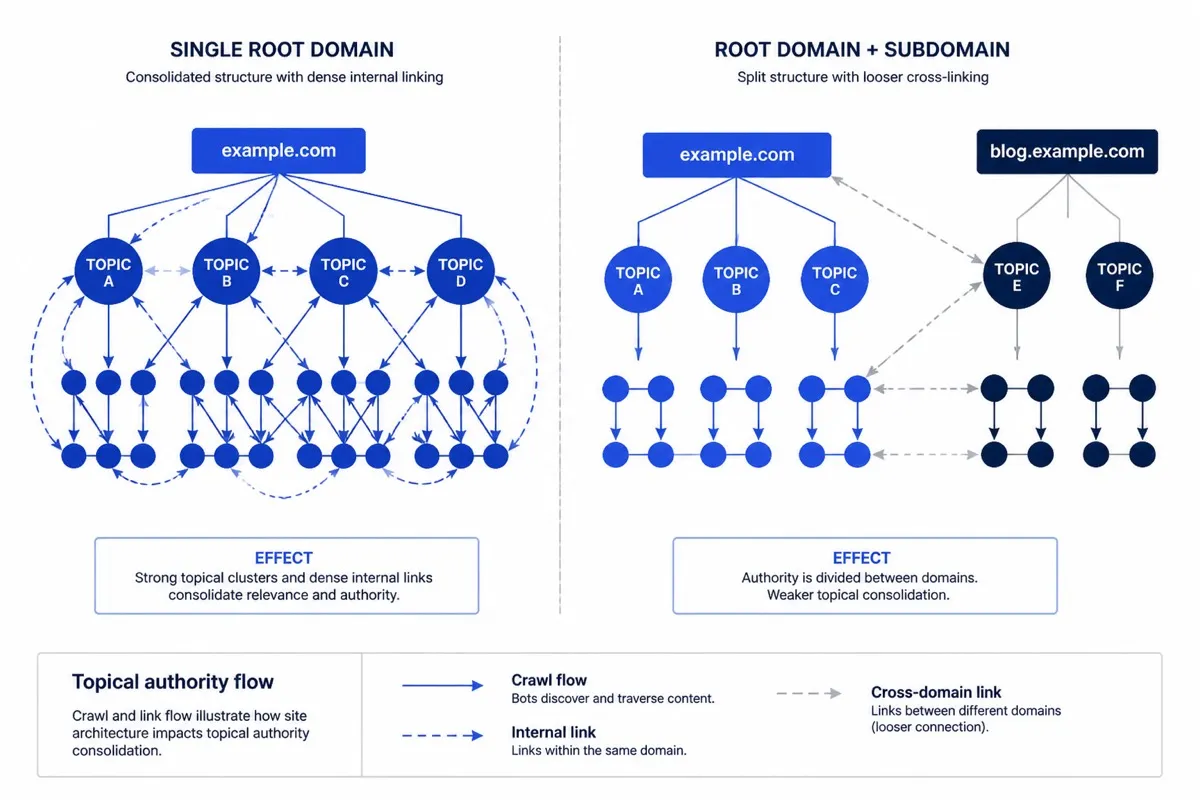
A subdomain can rank, but it often acts like a separate or semi-independent property. That usually means topical authority builds more slowly than it does on a subdirectory tied to the root domain. Google has said both structures can perform, but the SEO outcome is not identical. A subdirectory often gets more benefit from internal linking, authority consolidation, crawl behavior, and semantic clustering, which is why the subdomain vs subdirectory decision matters so much.
The main risk is fragmentation. When related content sits on different hostnames, link equity, brand mentions, and entity associations can split across two properties. Search systems may then read weaker cohesion and less consistent citation patterns. That can reduce both SEO visibility and artificial intelligence (AI) visibility. Large language models (LLMs) also depend on clear topical signals, so a split architecture can weaken the unified trust signals that support topical authority.
A subdomain is still defensible when business or technical needs outweigh the default SEO strategy. Common reasons include:
- Separate business units with different goals and teams
- Major product separation that needs its own experience
- Regional or language isolation for local operations
- Security constraints or infrastructure limits
- A content experience that needs independent governance
In those cases, subdomain SEO is a trade-off, not a mistake. The key is to choose the site structure that matches the operating model and accept that authority may build on a different timeline. For teams making a site structure call, the practical test is simple: if the content should strengthen one shared authority graph, keep it close to the root. If it must operate as a genuinely separate experience with its own workflows and measurement, a subdomain can be justified even if it takes longer to earn comparable authority.
That is the decision rule we recommend when your SEO strategy has to balance growth, governance, and technical reality.
How Do Subdomains Split Link Equity And Crawl Signals?
A subdomain can build its own authority profile, so backlinks, engagement, and crawl signals do not always merge into the root domain the way they usually do in a subdirectory setup. In search engine optimization (SEO), that means PageRank and topical relevance can split across hosts instead of reinforcing one shared site entity.
That split creates the classic trapped PageRank problem. Links earned by blog.example.com often strengthen that host first, while the main domain may see little benefit unless cross-linking pushes value back and forth. That is why subdomain SEO often feels more isolated than a folder-based structure.
The practical effect shows up in topical authority and crawlability. When related content lives on example.com and blog.example.com, search engines can treat the properties as more separate, which makes authority look fragmented. When the same topics sit in subfolders, signals usually accumulate more cleanly, and internal linking helps crawlers move from broad themes to narrower pages.
If you keep a subdomain, the bridge has to be deliberate:
- Use prominent internal linking between the subdomain and the main site.
- Keep those links topically relevant so they reinforce the same subject cluster.
- Place links on high-visibility pages rather than hiding them in the footer.
- Audit indexing subdomains so important pages are actually discovered and crawled.
- Watch for backlink dilution when authority is spread across multiple hosts.
Strong link equity can move beyond the host boundary, but only when that bridge is intentional. If your goal is to consolidate backlinks, engagement signals, and topical relevance under one entity, a subdirectory structure usually gives you the cleaner path.
When Does A Subdomain Still Make Sense?
A subdomain makes sense when isolation is the goal, not an accidental byproduct. It creates a clean boundary for infrastructure, permissions, and audience experience. It also creates a second SEO surface, so links, crawl activity, and indexing signals can fragment unless the properties stay connected.
Technical separation is the strongest case. A separate CMS, hosting stack, release cadence, or engineering workflow can reduce deployment risk and simplify versioning. That split works best when the content layer and the product layer move at different speeds.
Audience separation is another valid reason. International SEO often justifies a subdomain when the language or region needs a distinct experience. Enterprise branding can also sit apart from the core site when the message, offer, or buyer journey is materially different.
Common subdomain uses:
- Web applications subdomain: app, dashboard, API, and support portal experiences that behave like product interfaces
- Support portal subdomain: help centers and service hubs that need different tooling and permissions
- User portals: account areas, community spaces, and operational workflows that should stay separate from editorial content
- User-generated or operational content: sections where quality risk could dilute the main site’s topical focus
The trade-off is clear. A subdomain can protect the brand and contain risk, but it usually transfers less authority than a subdirectory. Use it intentionally when separation matters more than consolidating topical strength on one domain.
How Should You Choose Between A Subdomain And Subdirectory?
The default choice is a subdirectory when your goal is to build topical authority, improve AI search visibility, and keep one brand story under one host. A subdomain can still rank, but that outcome usually comes down to internal linking, authority consolidation, crawl behavior, and semantic clustering. The implementation baseline for topical authority matters because site structure shapes how signals move.
A clear decision order keeps the choice tied to business value:
- Topical authority gain: Choose the setup that concentrates related content around core product and revenue pages.
- AI visibility: Keep related content on one host when you want LLMs to read the brand as one coherent entity.
- Operational cost: Favor the option that reduces duplicate templates, reporting, release steps, and analytics work.
- Product fit: Separate only when the user experience or business model genuinely requires it.
That is why subdirectory SEO usually wins for blogs, documentation, customer stories, and educational hubs that support the main offering. Those page types reinforce root domain authority and keep the information architecture aligned with the main offer. A subdomain makes more sense when the experience is truly separate, such as a distinct app, a support portal, or a region-specific property with different governance rules.
Governance and engineering constraints belong inside the SEO strategy, not outside it. If a subdirectory lets your team reuse the same CMS, analytics setup, internal linking model, and publishing workflow, the long-term overhead stays lower. A subdomain often adds duplicated design systems, reporting paths, and release coordination.
The cleanest rule is simple:
- Choose the simpler site structure when it protects growth without splitting authority.
- Use a separate property only when distinct teams, journeys, or operational boundaries create real business value.
- Accept the SEO trade-off only when the separation is worth the cost.
That decision framework keeps your site structure aligned with growth goals, product needs, and the way search systems interpret your brand.
Which Factors Should You Score First?
Start with SEO impact because it determines where authority concentrates. If the pages should share backlinks, internal links, and topical clustering, a subdirectory usually gives you stronger consolidation. If a content set needs its own topical map, a subdomain can still be defensible, especially when architecture patterns for clean topic boundaries show a clear boundary between entities.
Audience separation and content ownership come next. Separate customer journeys, content maturity, or regional experiences can justify a split. When the same audience should move from editorial content into product content, a unified structure keeps the semantic graph dense and easier for search systems to read. The team model matters too. If publishing sits inside the main SEO and editorial workflow, the information architecture should reflect that operating reality.
Engineering cost and platform limits should be scored explicitly. Redirects, templates, analytics, and ongoing maintenance all take real effort. Legal, regulatory, and compliance needs can override the other factors when policies, regional rules, or risk controls require separation.
A weighted matrix keeps the decision consistent across blogs, docs, support centers, and international sites:
- First weight: authority transfer and topical consolidation
- Second weight: workflow fit and team ownership
- Third weight: implementation cost and maintenance burden
- Fourth weight: compliance and regional separation
Prioritize the factors that affect authority transfer first, then use operational cost and governance complexity as tie-breakers.
How Do Governance And Engineering Constraints Change The Choice?
Governance should drive the architecture choice before SEO preference does. When ownership, release cycles, and analytics sit inside one operating model, a subdirectory usually keeps DNS, SSL, Search Console, and reporting overhead lower. When teams are split across markets or platforms, a subdomain can be the cleaner operating model even if it is not the strongest SEO option.
That trade-off gets sharper in international SEO. Separate country teams, deep localization, or materially different market rules can justify subdomains, especially when hreflang impact on topical authority is part of the plan. When language or country sections can live under one domain, many international SEO teams still prefer subdirectories because authority consolidates more cleanly and measurement stays simpler.
Engineering constraints often decide the structure. Subdomains usually add extra DNS setup, separate SSL handling, and sometimes separate Search Console properties. A support portal subdomain may be the right boundary for help content, while web applications subdomain patterns often fit product releases, user portals, and other independent stacks.
The practical test is deployment fit. If product content, docs, and marketing pages ship from different pipelines, a subdomain can match the release boundary. If one CMS and one CI/CD flow can manage everything, a subdirectory usually improves crawlability, canonicalization, internal linking, and site speed consistency.
Teams that cannot fully consolidate can still reduce fragmentation:
- Use one canonical URL pattern across the section.
- Keep sitemaps tightly scoped to each property.
- Mirror navigation and internal links where users need continuity.
- Build a clear redirect map before moving content between stacks or domains.
That makes the decision a governance test, not a taste test. If strict separation is required, accept the operational cost. If not, favor the structure with the fewest moving parts and the best chance of consolidated topical authority.
How Do You Migrate Without Losing Authority?
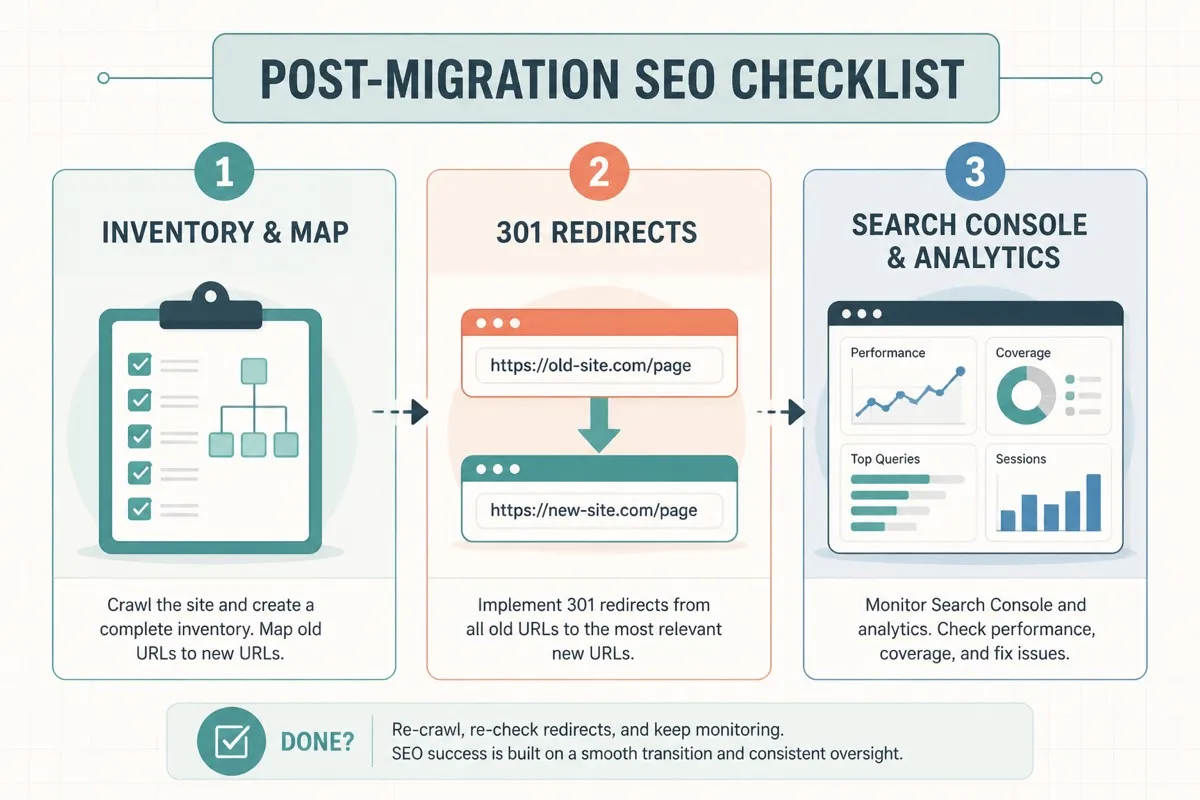
Migration protects authority when the move is mapped page by page and measured as an SEO project, not just a site swap. We treat a silo structure that consolidates subdirectories as the strategic baseline because subdirectory SEO works best when the URL change supports a cleaner content graph, stronger internal linking, and cleaner canonicalization.
The safest sequence starts with inventory and mapping:
- Build a full URL inventory: Capture every subdomain page and map each one to the closest subdirectory destination.
- Flag orphaned URLs: Identify pages without a useful match, then decide whether to merge, redirect, or retire them.
- Avoid homepage dumping: Keep unrelated pages away from the root homepage so topical authority consolidates around the right hub pages.
- Preserve page relevance: Match old and new URLs by intent and content type so link equity follows the topic, not just the path.
Page-level 301 redirects should be as direct as possible. Short redirect chains protect crawl efficiency, reduce wasted PageRank, and help backlink value transfer cleanly. Permanent redirects are the default choice here. A migration like the QRCodeDynamic Ghost-to-PHP move through Cloudflare Workers shows the same principle when blog authority stays pointed at the root domain.
Launch day is about consistency across every signal. Update canonicals, internal links, navigation, breadcrumbs, and XML sitemaps at once. Do not leave canonical tags on the old subdomain, and do not rely on redirects alone to tell crawlers which URL is preferred. Good technical SEO depends on one clear version of each page.
Google Search Console should become your migration checkpoint. Verify the new property, submit updated sitemaps, compare old and new URL coverage, and watch for soft 404s, redirect errors, duplicate canonicals, and coverage drops. That gives you a fast read on whether site speed, crawl behavior, and indexing are holding steady after the move.
A 30-day monitoring plan should focus on indexed pages, crawl activity, canonical targets, and backlink landing behavior instead of isolated traffic spikes or other vanity metrics (source, source).
- Indexed pages: Track which URLs enter and leave the index.
- Crawl frequency: Watch whether important pages get revisited consistently.
- Core topic rankings: Compare movement on hub pages and high-value clusters.
- Backlink landing behavior: Confirm external links land on the intended destination.
Use the migration to clean the system, not just rename URLs. Consolidate overlapping pages, prune outdated variants, and tighten semantic internal links around hubs. Reported gains after subdomain moves can reflect broader cleanup work, such as redirect fixes, canonical updates, internal linking changes, and pruning duplicate pages, rather than URL structure alone (source).
What Should Your Redirect And Canonical Plan Include?
Your redirect and canonical plan should protect relevance first and reduce duplication second. A good migration keeps authority on the closest matching destination, not a generic home page. It also gives search engines a clean signal about which URL should rank after the move.
Start with a one-to-one 301 map from each legacy URL to its nearest new equivalent. Avoid catch-all redirects unless no relevant replacement exists. That preserves intent, keeps internal linking meaningful, and limits authority loss during the transition.
Keep redirect paths as short as possible before launch. Remove redirect chains and loops, because extra hops slow crawling and can weaken SEO signals during the move. The simplest path is old URL to final URL, with no detours.
Canonicalization should match the final architecture. Each indexable page should point to itself with a canonical tag. Duplicate, test, or transitional versions should point to the preferred URL on the main site or subdomain. If you run country or language versions, pair canonicals with hreflang so search engines do not treat market variants as competing duplicates.
The practical checklist looks like this:
- Map every old URL to the closest matching new page
- Remove redirect chains and loops before launch
- Self-canonicalize indexable pages on the preferred version
- Canonicalize duplicates and transitional URLs to the final destination
- Use hreflang for language and country variants
- Keep utility assets separate when needed, such as apps or dashboards, while core content follows the same consolidation rules
Subdomains can lead search engines to build separate topical maps, so keep that split only when separation is intentional. If consolidation is the goal, move content into the main site and align canonicalization with the destination URLs.
How Do You Update Search Console And Analytics?
A clean analytics handoff starts before launch and continues for at least 30 days after. Before the move, verify the destination property in Google Search Console and keep the old subdomain property live so you can compare indexing, coverage, and query trends during the transition.
After launch, submit the new XML sitemap right away. Then check that indexed URLs, canonical targets, and crawl status follow the new folder structure instead of the retired subdomain. The URL removals tool should stay limited to true deprecations or accidental stragglers, while redirects and canonicals handle the main consolidation.
In analytics, preserve continuity with these updates:
- Cross-property reporting: Compare the old subdomain and the new folder structure side by side.
- Launch annotation: Mark the migration date so traffic shifts, ranking changes, and crawl dips are easy to interpret.
- Tracking rules: Update filters, hostname rules, and landing-page reports if events, conversions, or audience segments are split across properties.
Monitor Search Console coverage, sitemap discovery, and top landing pages for 30 days. Lingering crawl errors, duplicate URLs, or missing query impressions usually signal an incomplete handoff.
How Do You Prove The New Structure Is Working?
Start with a clean baseline that connects SEO and AI visibility. Measure AI-citation share, answer presence, share of voice, click-through rate, and assisted conversions before and after the change. That baseline shows authority consolidation, not just a rank bump.
A weekly cadence works best for core signals, and a monthly readout works best for assisted conversions. Compare Treatment vs. Control, then look for sustained movement instead of a single strong week. A practical test is to set an internal AI-citation share target above Control for several consecutive weeks, then review share of voice at week 8 or later to confirm the new structure is holding up over time (source).
The new structure should also push more signals toward the same entity. Over time, stronger root domain authority and broader domain authority should concentrate on the consolidated path. Fewer split citations, fewer competing URLs, and more queries landing on the same page set are the clearest signs that the migration is sticking.
Use these proof points to judge progress:
- AI search lift: citation share and answer presence on the consolidated URL set
- Organic quality: impressions and click-through rate on clustered pages in Google Search Console
- Authority concentration: fewer weak-signal pages and stronger performance on core topic pages
- Fragmentation risk: similar queries still resolving to different URLs, or one section still earning most citations while the rest lags
That pattern also helps you spot backlink dilution early. Observational testing can show different citation patterns between subdomains and subdirectories, so the better choice is to compare both setups in your own data before treating one structure as stronger for AI visibility (source, source). Your job is to confirm that trend in your own data and show that the new structure is absorbing authority instead of scattering it.
Which Metrics Show Authority Consolidation?
Authority consolidation shows up when the root site starts absorbing signals that used to sit in isolation. A useful scorecard ties backlinks, clicks, rankings, crawl behavior, and AI citations together so you can judge the shift as one system.
Use these signals together:
- Backlink consolidation: Referring domains should increasingly point to the canonical subdirectory instead of staying isolated on the subdomain. A practical benchmark is a rising share of backlinks and internal links pointing to the preferred path over 30 to 90 days, along with fewer duplicate URLs and cleaner canonical signals (source, source).
- Organic clicks: Measure root-domain performance, not only migrated URLs. Week-over-week click gains on the consolidated section and faster trust transfer to new pages both point to healthy consolidation.
- Ranked keywords: Count top 10 positions across the full topical cluster. Authority is consolidating when the root domain captures a larger share of total ranking value, not just more impressions.
- Crawl frequency: Compare crawl cadence before and after migration. More frequent revisits, faster discovery of new pages, and fewer orphaned crawls suggest better consolidation.
- AI citation rate: Add AI visibility to the dashboard. Track citation share, answer presence, and share of voice across AI Overviews, AI Mode, ChatGPT Search, and Gemini.
A simple benchmark table makes the pattern easier to read:
| Metric | Healthy signal |
|---|---|
| Backlinks | More referring domains to the canonical subdirectory |
| Clicks | Consistent week-over-week growth at the root level |
| Keywords | More top 10 rankings and more cluster ownership on one domain |
| Crawl | Sustained increase in crawl visits on the preferred path |
| AI citations | At least 10% treatment gain vs. control for three straight weeks |
If one metric improves while the others stall, treat that as partial consolidation rather than proof of success. The architecture is working when all five signals move in the same direction.
How Do You Spot Fragmented Signals Early?
The earliest warning is usually a domain-level ranking dip that doesn’t match the quality of your content. That often means authority is splitting across hosts instead of consolidating around one topic map. The site may still look strong at the page level while the domain loses momentum overall.
A fast triage pass should compare the main domain and any subdomain by topic and by search behavior. If one side improves while the other stays flat, the pattern points to fragmentation rather than isolated page performance. Watch for these signals:
- Indexation drift: closely related pages get indexed at different speeds, or they move in and out of the index.
- Crawl imbalance: new URLs on one host are discovered quickly while similar URLs on another host lag.
- Link dilution: strong pages stop passing clear relevance through the cluster, and related links become thin or inconsistent.
- Host split behavior: one subdomain starts to act like a separate property, which is a common risk in indexing subdomains.
Crawl patterns usually make the problem easier to confirm. Subfolders often inherit the domain’s crawl rhythm. Subdomains may need to be learned as separate areas. If a subdomain was added to support the core topic, assume search engines are building separate topical maps until the signals say otherwise.
The practical response is to tighten internal links, reduce split topic cues, and favor the structure that reinforces one authority signal before adding more content.
Subdomain Choice FAQs
If you’re weighing subdomain trade-offs, these FAQs cover the questions SEO and content teams ask most before making a structure decision. They focus on authority, crawl behavior, analytics, and the practical impact on future migrations.
Do Subdomains Share Topical Authority?
Only partly. Search engines often treat a subdomain as a separate or semi-independent property, so topical authority usually builds there first instead of flowing automatically from the root domain. Host-level signals, link equity, crawl patterns, and content depth tend to accumulate within that subdomain, and strong cross-linking can help clarify the relationship and pass some context, but each host still needs its own topical depth, relevant backlinks, and consistent coverage for durable visibility.
Can A Subdomain Rank For Main Topic?
Yes, a subdomain can rank for the main topic, but it usually has a weaker connection to the root domain than a subdirectory, so topical authority can take longer to build. If you use a subdomain, strong internal linking, tight semantic clustering, and broad topic coverage help search engines connect it to the core subject. Authority, crawl signals, and backlinks can also accumulate separately when the architecture stays split. If content moves later, careful redirects help main-topic signals consolidate instead of remaining fragmented across both hosts.
Does Subdomain Content Need Separate SEO?
In most cases, your subdomain can follow the same SEO strategy as the main site when it serves the same audience and topic cluster. Unified tracking makes it easier to compare subdomain and root-domain pages in one view, and the same content-cluster logic plus internal linking pattern helps reinforce topical authority. Treat the subdomain as a separate property only when it has a distinct purpose, audience, or governance model, because backlinks may build equity there without reliably flowing to the root domain, so intentional cross-linking matters if you want shared equity and stronger site-wide relevance.
Should Blog And Main Site Stay Separate?
If your blog supports the core product, brand, or main SEO goals, keep it in a subdirectory so backlinks, internal links, crawl signals, and topical authority build under one root domain. A separate subdomain is harder to defend because it can split authority and slow trust transfer, while AI answer engines usually connect editorial pages more easily to the brand when they sit close to the main site structure. Use a subdomain only when a real technical or operational need calls for isolation.
About the author

Yoyao Hsueh
Yoyao Hsueh is the founder and CEO of Floyi, the topical authority platform, and the founder of Main Heading, an SEO and AI search agency. He created Topical Maps Unlocked, a course studied by thousands of SEOs, content strategists and digital marketers, founded TopicalMap.com, a done-for-you topical mapping service for agencies and enterprise teams, and publishes the weekly Digital Surfer newsletter on SEO, content strategy and AI search.
About Floyi
Floyi is a closed loop system for strategic content. It connects brand foundations, audience insights, topical research, maps, briefs, and publishing so every new article builds real topical authority.
See the Floyi workflow