
Multilingual SEO Playbook for Topical Authority
Learn how to build multilingual topical authority with localized topic maps, technical setup, hreflang, and measurement.
Multilingual SEO builds topical authority when agencies and content teams localize topic clusters for each market. It’s the trust a site earns by covering one topic set across languages with consistent depth and local relevance.
The playbook covers market selection, localized keyword research, entity mapping, URL architecture, hreflang, internal linking, and language-level QA. It also turns that work into topic lists, AI-assisted briefs, and refresh rules that keep each locale aligned with search demand. The process is built for repeatable automation, not one-off translation.
For heads of content, SEO leads, and directors of content operations, the goal is to scale coverage without breaking brand voice or measurement. A Spanish cluster can win when it uses local phrasing, reciprocal hreflang, and pages that cover pricing, setup, and comparisons in the market’s own language. Keep going to build a system that scales across languages and proves business impact.
Multilingual SEO Topical Authority Key Takeaways
- Multilingual topical authority depends on full topic coverage in each language, not translation alone.
- Local keyword research should shape pillars, spokes, and supporting pages for every market.
- Choose subfolders, subdomains, or ccTLDs based on authority goals and local trust needs.
- Reciprocal hreflang and self-referencing canonicals prevent cross-language duplication and confusion.
- Internal links should strengthen each language silo before connecting across markets.
- Measure coverage, rankings, clicks, and AI visibility separately by language.
- Update refresh rules, briefs, and maps as demand, competitors, and entities change.
What Is Multilingual Topical Authority?
Multilingual topical authority is how strongly your site is trusted to answer the same topic set across languages and markets. It builds on the same fundamentals as the core implementation model for topical authority: sustained relevance, internal linking, entity coverage, and steady performance in both search engine optimization (SEO) results and artificial intelligence (AI) answers. It isn’t a single-page win. It’s the pattern that makes a language version feel complete, credible, and worth ranking or citing.
Translation alone isn’t enough. Searchers don’t read like translators. Multilingual SEO works best when you localize content for the market. That means adapting:
- Native idioms
- Local spelling
- Tone
- Examples
- Currency
- Units
- Region-relevant references
Cultural relevance lowers friction for readers. It also helps AI systems see that the page was built for the market instead of copied into it.
A practical localization strategy covers the full topic cluster in each language:
- Build a pillar page for the core topic in every target language.
- Add supporting subtopics that answer adjacent questions in that market.
- Publish long-tail articles that match practical local intent.
- Connect the cluster with internal links so each language version reinforces the others.
- Include money pages inside the cluster, but do not stop at conversion pages.
- Reuse the same strategic map across client accounts and markets.
The breadth and depth turn localization into a ranking asset. Google holds a dominant global search share in many regions.
Weak cluster coverage in one language can hand visibility to competitors with fuller topical coverage. Agencies and content teams should treat each language as its own topic ecosystem, not as a translation queue. Groups managing several markets often turn this work into multi-brand topical authority.
AI-driven overviews raise the stakes. Language-matched systems reward clear structure, complete coverage, and localized expertise. When your content answers the full topic in the right cultural frame, it’s more likely to be summarized or cited in AI-generated answers. For agencies and content teams, the playbook works like an operating system: define the topic universe once, localize it by market, and reuse the map for briefs, drafting, internal linking, and measurement without duplicating effort.
The real signal is whether a language version becomes the preferred source for its topic cluster. Competitor coverage, SERP patterns, and AI mention and citation signals all help you judge that shift.
How Do You Choose Target Languages And Markets?
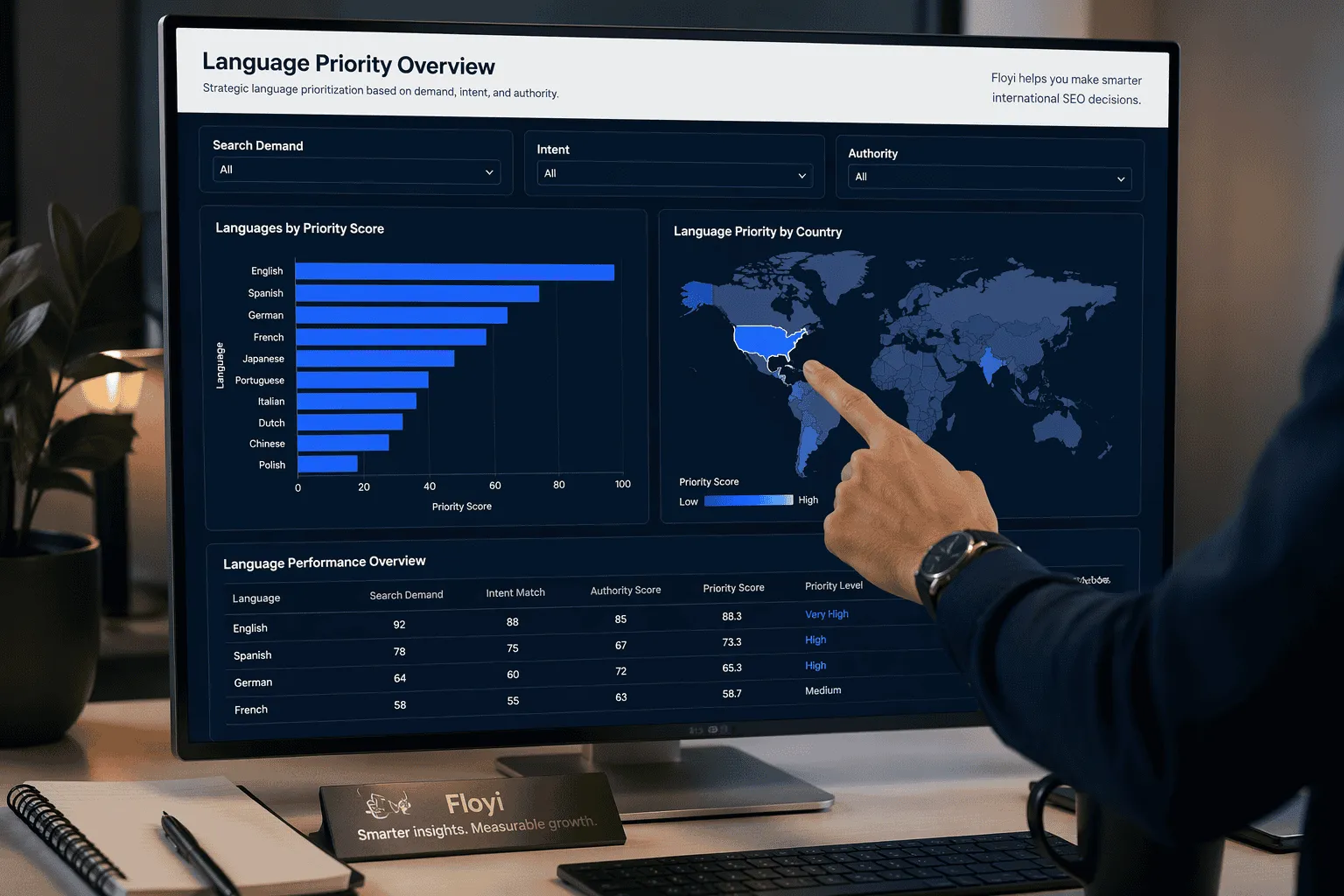
Choose markets where search demand and commercial intent overlap. Population size alone can mislead you. A smaller locale with comparison, pricing, or vendor queries often deserves priority over a larger market that only attracts broad informational traffic.
A practical way to define target languages is to score each language-market pair before launch. Use localized keyword research instead of translating an English list. Native phrasing, intent shifts, and semantic terms change by region. Regional search behavior also shapes what people click, compare, and buy, making SERP review matter as much as volume.
Prioritization factors:
- Search demand and intent. Focus on queries that signal comparison, setup, pricing, or purchase readiness.
- Authority and fit. Look for ways to build on existing authority through brand recognition, backlinks, or ranking history.
- SERP parity and format. Reverse-engineer the top results in each locale. One market may reward a long guide. Another may favor a product-led or comparison page.
- Quick-win potential. Start with clear content gaps, existing brand awareness, or technical queries that still perform well in English.
The separate domains vs subfolders decision should match your localization strategy and your authority-building horizon. Subfolders often work better for authority consolidation. Country-code domains send a stronger local signal. They usually require separate trust building for each domain.
| Structure | Best use case | Authority impact | Tradeoff |
|---|---|---|---|
| Subfolders | Shared brand and faster rollout | Strong for authority consolidation | Less local signal than a country domain |
| Subdomains | Semi-independent markets | Moderate consolidation | More setup and tracking complexity |
| Country-code domains | Deep local trust building | Strong local signal | Separate authority building for each domain |
The right setup depends on how fast you need traction and how much maintenance you can support. If you want a lighter launch, subfolders usually win. If the market needs stronger local trust, a country-code domain can be the better fit.
How Do You Build Localized Topical Maps?
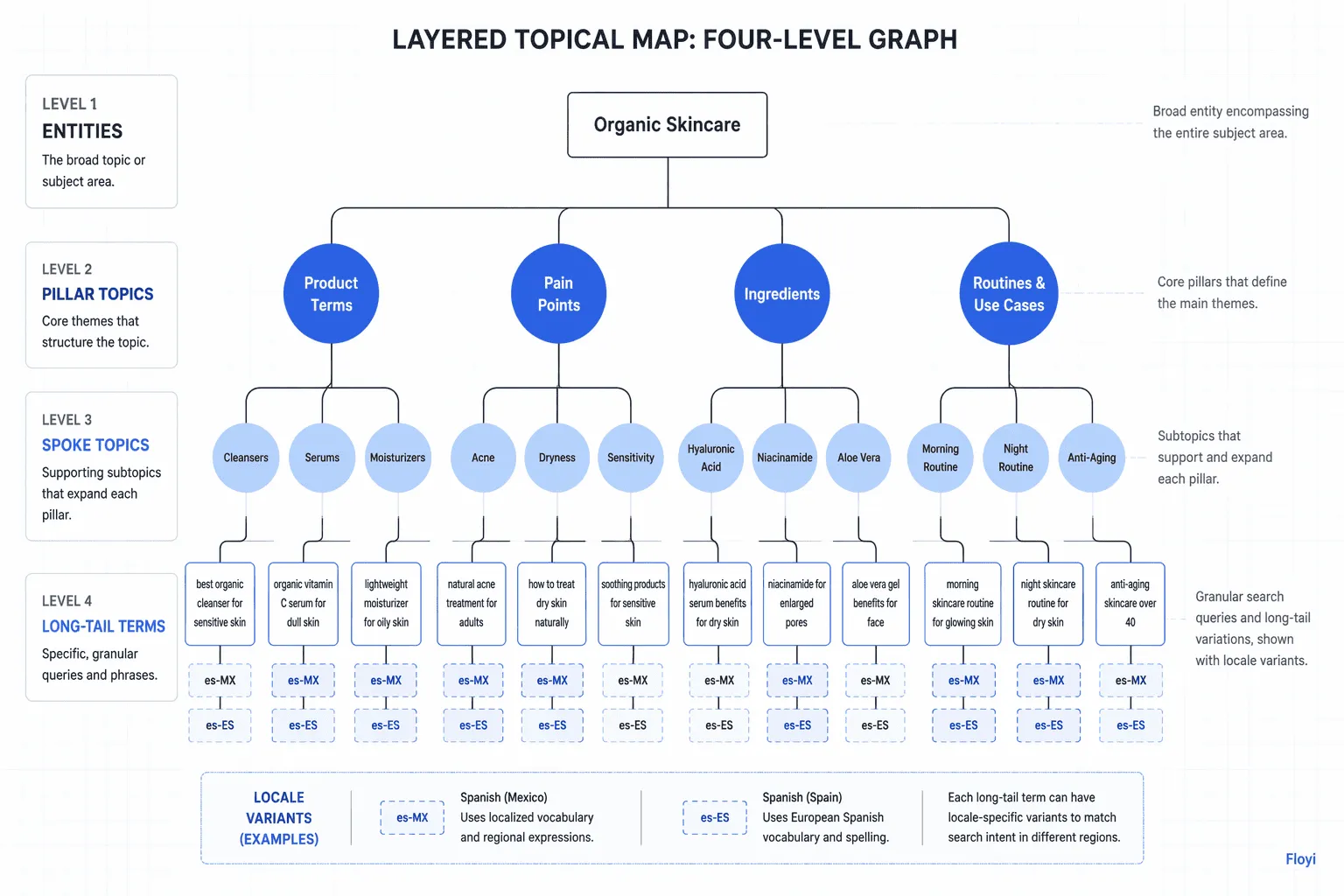
A localized topical map starts with the entity set in each market, not with a translated keyword list. The process maps the people, products, problems, modifiers, and questions that define demand in each language, then sorts them from broad pillar themes to narrower spoke topics. Each language should work as its own topical graph with complete internal relationships. The structure keeps consistent entity coverage across markets.
Semantic SEO works when the map reflects how people actually search in that locale. Use localized keyword research to shape the structure, then check whether the topic choices match regional search behavior instead of home-market assumptions. The goal is to localize content without flattening meaning or forcing English phrasing into a market where it doesn’t fit.
A practical entity scan should include:
- People and roles that show up in search queries
- Product or service terms that local buyers already use
- Pain points and jobs to be done in the local language
- Modifiers tied to geography, price, seasonality, or urgency
- related entities that search engines expect around the topic
After the entity set is clear, build pillar-and-spoke clusters around the same core intent in every market. The route to that intent can change by language. Examples, use cases, phrasing, and content formats should match local expectations. Replicating topical breadth matters, but the delivery has to fit the market.
A repeatable build process looks like this:
- Define one pillar topic for the locale and confirm the target entity set.
- Add spoke pages that answer adjacent questions, comparison needs, and transactional intent.
- Check overlap so each page supports the same topic family without cannibalizing the others.
- Extend the chain until the locale covers the full intent range from introductory explainers to decision-ready content.
Gap analysis tells you what to publish first. Compare page counts by language, note missing entities or subtopics, and find where competitor coverage is weak or where high-value intent is underserved. Track impressions, clicks, rankings, topic depth, and crawl behavior. The data shows where clusters can expand with the clearest upside.
| Signal | What to check | Priority meaning |
|---|---|---|
| Page count by language | Which locales lag behind | Structural gaps |
| Missing entities | Terms and questions absent from the map | Weak coverage |
| Competitor depth | Where rivals stop short | Fast-entry opportunity |
| Impressions and clicks | Where demand exists but engagement is low | Content mismatch |
| Crawl behavior | Which pages are discovered and refreshed most often | Internal importance |
Local SERP patterns should shape format choices too. Some markets reward list-style explainers. Others favor deeper how-to or comparison pages. The topical map should reflect how information appears in search.
Language-aware silo and hub patterns help you connect that map to navigation and internal links.
Keep the topical map in a spreadsheet or mind map that tracks pillars, spokes, target entities, primary keyword themes, and content status. Update it as seasonality, trending questions, and new competitors change demand. The living system becomes the source of truth for internal linking, site architecture, and the next wave of localized expansion.
How Do You Set Up The Technical Architecture?
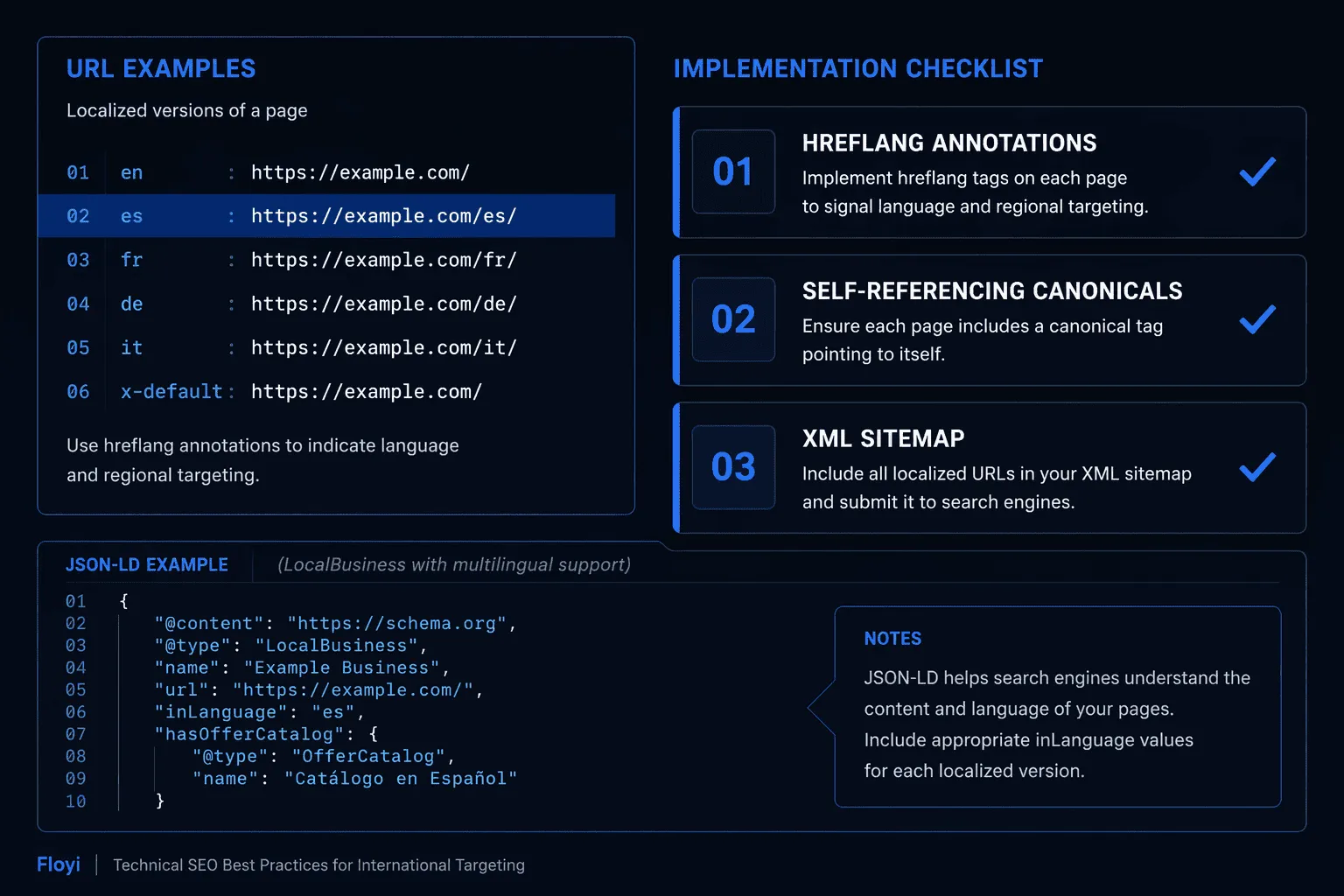
The safest default is usually subfolders like example.com/es/ or example.com/fr/. In Multilingual SEO, subfolders make the technical structure easier to manage and help consolidate PageRank within the same brand domain. The separate domains vs subfolders choice only makes sense when you need a strong country signal and can support trust-building on each domain. The implementation playbook for multilingual topical authority works best when you need one repeatable pattern across many markets.
A simple URL strategy looks like this:
| Architecture | Best fit | Main tradeoff |
|---|---|---|
| Subfolders | Most multilingual brands and agencies | Clean governance is required, but scale is strong |
| Country-code top-level domains | Markets that need a strong local signal | Each domain must build its own authority |
| Language parameters | Temporary testing only | Indexing is often weak, and maintenance is harder |
Avoid language parameters like ?lang=de for permanent localization. They create weak signals and are often ignored during indexing. Clean folders and stable naming are easier for crawlers and for your content team.
Once the URL model is set, keep the naming system consistent across every language. Localized slugs are the right choice when a direct translation feels awkward or unnatural. Each version should also have unique Title Tags. It should have unique Meta Descriptions. Its H1 to H3 copy should match local intent instead of copying the source page structure.
A solid hreflang implementation is complete and reciprocal:
- Every localized page lists all alternates.
- Each page self-references its own language and region.
- Language codes stay consistent across the site.
- Return tags match in both directions.
- Broken pairs stay on your priority QA list.
Missing self-references, broken reciprocal links, and mismatched codes create duplicate-content confusion and can surface the wrong URL. Pair those tags with self-referencing canonical tags on every localized page. Don’t point translations back to one source URL. The shortcut creates cross-version cannibalization and weakens the value of each localized asset.
Structured data should match the page type and the publishing stack. JSON-LD is the cleanest format because it separates schema from visible content and stays stable across deployments. Place it in the right template or head area for:
- WordPress templates
- Shopify theme files
- Webflow page settings
- Wix head settings
- Headless build templates
Localized schema with hreflang keeps markup aligned when one localized URL needs its own schema without duplication.
The language switcher should be visible, predictable, and non-destructive to page context. Send users to the equivalent localized page whenever possible. If no exact match exists, route them to the nearest relevant hub and make the change clear.
Before requesting indexing, verify these failure points:
- The localized page is indexable.
- The page is included in the correct XML sitemap.
- The page is linked from the right language hub.
- Titles, headings, and canonicals point to one language.
- The switcher resolves to the correct localized URL.
This checklist catches the issues that most often block multilingual visibility and keeps your architecture ready to scale.
How Do You Expand Entity Coverage And Internal Links?
A coverage audit shows where multilingual topical authority is breaking down. Compare published pages, drafts, and the entities surfaced in AI Overviews against your core topic map. Then label each gap as missing, thin, duplicated, or overused. The label-driven workflow keeps semantic coverage growing without filler pages or bloat.
A practical audit flow looks like this:
- Inventory each language silo and map every URL to one target topic.
- Compare live pages, draft assets, and AI-surfaced entities with the planned entity set.
- Flag gaps that create keyword cannibalization or weaken consistent entity coverage.
- Prioritize the changes that close the biggest authority gaps first.
Each missing subtopic should become a content brief with a clear purpose. Define the target intent, the related entities to include, and the cluster page it should strengthen. The process helps you build a Semantic Content Network that supports semantic SEO and reinforces existing authority where it already exists.
The strongest multilingual structures mirror the same hub-and-spoke model in every locale. Each language version should act as a self-contained hub that can compete inside its own SEO ecosystem, with the same topic architecture across versions. When core information changes, update every language version together. Stale or orphaned pages get left behind otherwise.
Internal linking should reinforce depth inside each language silo before it points elsewhere. Use the most important internal link first and keep links in main copy lean. Varied descriptive anchor text helps readers and crawlers read the relationship. Place the strongest links within the first 1,500 to 2,000 words when the destination is relevant.
Those patterns help consolidate PageRank and make the topical hierarchy easier to read.
Cross-language linking should stay minimal and intentional. Don’t mix languages inside body-content links. Reserve cross-language connections for hreflang switches or clearly labeled language toggles. Users and crawlers shouldn’t confuse translation pairs with localized relevance.
Machine translation isn’t a substitute for local coverage. Local keyword research plus human editing or transcreation will catch intent shifts, market-specific phrasing, and local signals that translation alone often misses. The same local review also protects crawl and index consistency. Monitor language-switcher behavior, uneven internal links, and secondary languages that are being under-crawled to keep localized pages discoverable.
How Do You Measure Multilingual Topical Authority?
Measure multilingual topical authority as a language-by-language scorecard, not as a sitewide average. The split stops one strong market from hiding weak performance elsewhere. A practical model uses three inputs per language and rolls them into a Topical Authority Score with a geometric mean. No single strength can cover a gap.
The scorecard works best when the language metrics stay separate:
| Measure | What it tells you | Why it matters |
|---|---|---|
| Content Authority (CA) | How fully the language covers planned topics and entities | Shows whether local coverage is deep enough |
| Market Authority (MA) | How the language performs in search demand and organic share | Shows whether the market is earning attention |
| AI Authority (AIA) | How often the language appears in AI answers and AI mentions | Shows whether the market is visible in AI-driven discovery |
| Topical Authority Score (TAS) | The combined score across CA, MA, and AIA | Gives you one roll-up number per language segment |
The core KPI set should stay segmented by language:
- Indexed page count versus planned coverage
- Impressions, clicks, and average position
- Organic sessions and engaged sessions
- Assisted conversions from organic traffic
- Topic coverage gaps and entity-completeness gaps
Those gaps tell you whether a language is underbuilt, too thin, or losing share to a stronger rival. They also separate content problems from distribution problems. A language can earn traffic and still miss the entities your topical map requires.
A topical map audit should compare the planned pillar-cluster structure with what is live in each language. The review exposes missing entities, duplicate intent, thin translations that miss local questions, and clusters that have grown so wide they create cannibalization risk. Historical data and authority matter here. They show whether a drop is a short-term swing or a structural issue.
The technical structure needs its own checkpoint. Messy architecture suppresses authority fast. Validate hreflang implementation, canonical alignment, language-specific indexation, and subfolder or subdomain consistency before you trust the scorecard. Then flag language-switcher bugs, canonicals that point across languages, wrong-locale pages getting indexed, and secondary-language URLs that are crawled less often.
A closed-loop workflow works best when the cadence is repeatable:
- Segment Google Search Console by language and market.
- Pull crawl data from tools such as ONCRAWL.
- Build Looker Studio dashboards with regex-based language rules.
- Add log-file analysis to spot under-crawling, duplicate crawl paths, and unusual bot behavior.
- Review trend lines against the current topical map and the prior crawl baseline.
An ONCRAWL case study pattern helps when you compare current crawl behavior with older crawl patterns by language. The comparison makes hidden crawl waste visible and ties technical drift to ranking loss. It also gives you a cleaner explanation for why one market is slipping even when new pages have shipped.
Prioritize remediation where technical errors block your most important clusters, where the gap between planned coverage and shipped pages is largest, or where rankings and AI mentions are weakest despite strong content depth. The discipline keeps your program focused on the markets most likely to move total topical authority.
Multilingual Topical Authority FAQs
These FAQs cover the most common questions you face when building multilingual topical authority, including site structure, localization choices, and measurement. They set up a clearer way to compare options and make decisions with less guesswork.
1. Should You Translate Or Localize Content?
Translate when the source page already fits the market closely. Localize or transcreate when the audience needs native tone, idioms, examples, currency, units, and local references. Machine translation with human post-editing works well, followed by a locale-aware quality pass for terminology, formatting, and factual parity. Run native keyword research first when intent, terminology, or SERP behavior may differ. Keep every language version updated when core information changes.
2. How Many Languages Should You Launch First?
Start with 1 to 3 languages, not a full global rollout. Define target languages by demand, strategic value, and your capacity to keep quality high in each market. Launch the primary language cluster first. Add the next language only after you have early signals on rankings, engagement, and localization gaps. Match the rollout to your URL structure. Subfolders or subdomains are easier to manage centrally. ccTLDs work best when local trust-building is in scope.
3. Can One Topic Cluster Work Across Markets?
One topic cluster can work across markets when the core search need stays the same. Reuse the structure as a framework, not as copy-paste. Keep the pillar-plus-supporting-page model, then localize the query set, examples, entity coverage, and internal angle for each language. If intent shifts by country, rebuild the cluster from the local SERP first. Spanish in Spain can behave very differently from Spanish in Mexico or US Spanish demand. Full topical authority comes from covering each market’s missing subtopics and entities, not from translating only the pillar page.
4. How Do You Avoid Cross-Language Cannibalization?
Use reciprocal hreflang on every language version and add a self-referencing canonical for each localized URL. Keep internal links language-specific. Localize keyword research before translation. A human editor or transcreator can then match local search intent and avoid keyword cannibalization. If indexing slips, check language-switcher URLs, hreflang pairs, canonical targets, redirect loops, parameterized URLs, and duplicate language folders first. Audits show about 70% of multilingual sites get hreflang wrong.
About the author

Yoyao Hsueh
Yoyao Hsueh is the founder and CEO of Floyi, the topical authority platform, and the founder of Main Heading, an SEO and AI search agency. He created Topical Maps Unlocked, a course studied by thousands of SEOs, content strategists and digital marketers, founded TopicalMap.com, a done-for-you topical mapping service for agencies and enterprise teams, and publishes the weekly Digital Surfer newsletter on SEO, content strategy and AI search.
About Floyi
Floyi is a closed loop system for strategic content. It connects brand foundations, audience insights, topical research, maps, briefs, and publishing so every new article builds real topical authority.
See the Floyi workflow