
Across 1,256 brands, nearly half explore to 4 levels in research. After SERP validation, 87.7% consolidate to 3, and zero remain at 4. That is not a failure of ambition. That is intent-based de-duplication working as designed.
Most SEO tools cap at two levels: a pillar and its supporting articles. That is what their architecture supports. But what do teams actually do when the tool does not constrain them? Do they build deeper maps? Or does two levels reflect what teams actually need?
We had a unique vantage point to answer this. Before building Floyi, I ran TopicalMap.com, a productized SEO agency that completed 300+ client engagements using our topical authority methodology. Real authority often required deeper structure than pillar plus clusters. Most subjects naturally expand from broad to specific, and flattening them to two levels created intent overlap, messy internal linking and reporting that did not roll up cleanly.
That production experience is why Floyi models hierarchy to four levels. It is not feature bloat. It is pattern recognition from real client work and how search algorithms and LLMs parse topic taxonomy, entity relationships and semantic structure.
We assumed teams would push to four levels when given the option. What we found was more nuanced: research explores at four, the algorithm consolidates to three, but teams with deep subject expertise still create four levels when the nuance demands it.
Key Takeaways
- Nearly half of brands (48.5%) explore to 4 levels during research.
- After SERP validation, 87.7% consolidate to 3 levels. Zero remain at 4.
- That consolidation is not a failure of ambition — it is intent-based de-duplication preventing cannibalization.
- In execution (Authority Maps), 73.5% of teams operate at 3 levels.
- The 8.9% that reach 4 levels do so where subject expertise reveals nuance that deserves its own page.
- Three levels is where most teams execute per subject — not necessarily where the site as a whole stops. Multiple maps often combine to 4 levels site-wide.
The Lifecycle: From Exploration to Execution
Most teams think of a topical map as a one-time deliverable: build it, approve it, execute it.
In practice, the map you start with is rarely the map you end up executing on. In Floyi, the workflow moves through three distinct stages:
Topical Research: Explore Without Constraints
This is where you discover how deep the subject naturally goes. You brainstorm structure, identify potential branches and see where the topic wants to expand.
Depth here reflects ambition and curiosity. It has not yet been validated by search evidence.
A personal injury law firm exploring “Personal Injury” might build this in research:
- Pillar: Personal Injury Practice
- Hub: Car Accidents
- Branch: Rear-end collisions
- Resource idea: “what to do after a rear-end collision”
- Resource idea: “rear-end collision claims process”
- Resource idea: “rear-end collision settlement timeline”
- Branch: Intersection accidents
- Branch: Rideshare accidents
- Branch: Rear-end collisions
- Hub: Car Accidents
That is 4 levels of depth. The team is mapping the full shape of the subject before worrying about what earns its own URL.
Topical Maps: Validated Intent
Here our topic mapping algorithm analyzes topical relationships, search data and user intent to produce an executable map where every node deserves its own URL.
This is where depth consolidates. The final map reflects validated intent, not just brainstormed breadth.
For the same law firm, the algorithm finds that “what to do after a rear-end collision” and “rear-end collision claims process” share significant SERP overlap - same top results, same dominant page types, same user intent. It merges them into one resource. The map settles at 3 levels:
- Pillar: Personal Injury Practice
- Hub: Car Accidents
- Branch: Rear-end collisions
- Resource: “What to do after a rear-end collision (claims process guide)”
- Branch: Intersection accidents
- Branch: Rideshare accidents
- Branch: Rear-end collisions
- Hub: Car Accidents
Three resource ideas became one page. The branch stays, but the 4th level consolidates where intent overlapped.
Authority Maps: Living Strategy
This is where the map becomes a system you review and refine weekly.
Authority Maps track coverage, gaps, new topics and priority shifts as your industry evolves. New questions emerge. Competitors move. Content needs refreshing.
Three months into execution, the law firm’s Authority Map has evolved. “Rideshare accidents” is getting search traction and earns two new resources underneath it. Meanwhile, a branch on “minor fender benders” consistently underperforms and gets merged into the rear-end collisions branch. The map is not static. It reflects what the data and the team’s expertise say matters now.
For agencies, this is the artifact that ties strategy to execution and makes client reporting defensible.
- Personal Injury Practice
- Car Accidents
- Rear-end collisions
- "what to do after a rear-end collision"
- "rear-end collision claims process"
- "rear-end collision settlement timeline"
- Intersection accidents
- Rideshare accidents
- Personal Injury Practice
- Car Accidents
- Rear-end collisions
- "What to do after a rear-end collision (claims process guide)"← merged
- Intersection accidents
- Rideshare accidents
- Personal Injury Practice
- Car Accidents
- Rear-end collisions
- "What to do after a rear-end collision (claims guide)"
- Minor fender bendersmerged ↑
- Intersection accidents
- Rideshare accidents↑ growing
- "Uber accident liability"new
- "Lyft passenger injury claims"new
What the Data Shows
We measured maximum topical hierarchy depth at each stage across all 1,256 brands. The pattern is clear.
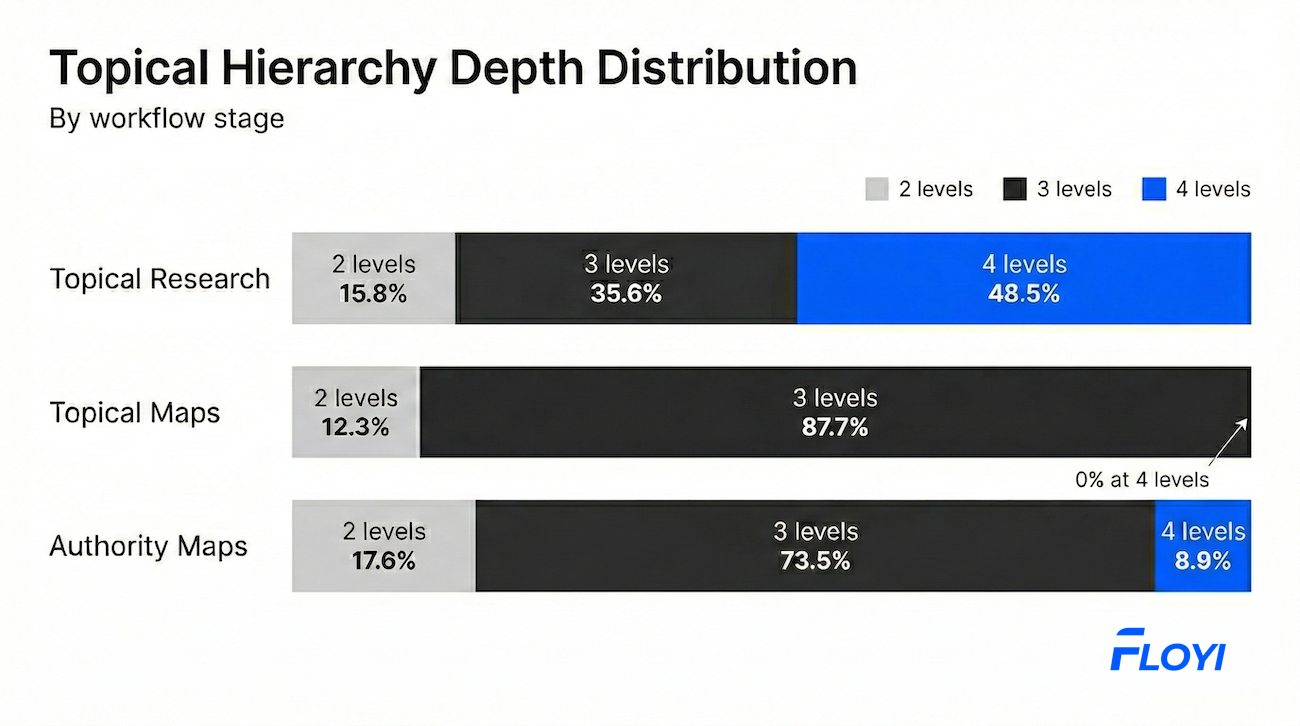
Topical Research
Nearly half of brands build to full depth when exploring the subject.
| Depth | Brands | Share |
|---|---|---|
| 2 levels | 199 | 15.8% |
| 3 levels | 448 | 35.6% |
| 4 levels | 609 | 48.5% |
When you give content teams freedom to structure a subject, they naturally go deep. The demand for granular topical hierarchy is real.
Topical Maps
The algorithm validates and consolidates. Zero maps reach 4 levels.
| Depth | Brands | Share |
|---|---|---|
| 2 levels | 154 | 12.3% |
| 3 levels | 1102 | 87.7% |
| 4 levels | 0 | 0.0% |
Why 0% at 4 levels: This is the headline finding. Two factors drive it.
First, the algorithm analyzes semantic relationships and search data, identifies overlapping topics and merges them when the SERPs confirm they serve the same query. If two subtopics share the same results, they become one page, not two.
Second, most teams choose narrower core topics (on-page SEO instead of SEO, lions instead of zoo animals) that naturally cap at 3 levels. If you build multiple topical maps for narrower subjects, you rarely need 4 levels in any single map.
Authority Maps
Execution lives at 3 levels for most teams.
| Depth | Brands | Share |
|---|---|---|
| 2 levels | 221 | 17.6% |
| 3 levels | 923 | 73.5% |
| 4 levels | 112 | 8.9% |
Teams that actively track topical coverage overwhelmingly operate at Pillar → Hub → Branch depth. A small percentage (8.9%) push to genuine 4-level depth in specific areas where their subject expertise reveals nuance that deserves its own page. This is the governance angle: agencies cannot manage what they cannot see in one system.
Why some return to 2 levels: Two reasons. First, Authority Maps reflect the underlying topical map plus user refinements (merges, flattens, renames). A team may start with a 3 or 4-level map, then intentionally flatten specific areas because that portion of the topic only warrants Pillar → Hub depth.
Second, the core topic itself may be narrow. A brand running a small topical map for a specific section of their site, not the full domain, may only need 2 levels for that map. That does not mean the site is 2 levels deep. It means that particular subject did not require more.
The site-wide picture: The same logic works in reverse. A team may operate individual topical maps at 3 levels, but their site covers multiple subjects. When those maps combine into a site-wide topical strategy, the full hierarchy often reaches 4 levels. Three levels is where most teams execute per subject, not necessarily where the site as a whole stops.
The Key Insight: 0% at 4 Levels Is the System Working
In Topical Research, 48.5% of brands build to 4 levels.
In Topical Maps, 0% reach 4 levels. 87.7% settle at 3.
The point is not to force depth. The point is to let the data decide what deserves its own URL.
- Different intent → deserves its own page
- Same intent → belongs on the same page
Three levels often means the team explored at four, and intent evidence confirmed three was right. That is not flattening. That is de-duplication to prevent cannibalization.
How to Tell When Consolidation Is Right
Not every merge is obvious. Here is what to look for:
- SERP overlap: If two queries return 7 or more of the same top 10 results, they share intent. One page serves both.
- Same dominant page type: If both queries surface long-form guides (not one guide and one comparison), the user expects the same format. Separate pages will compete with each other.
- Same stage of the buyer journey: “What to do after a rear-end collision” and “rear-end collision claims process” both serve someone who just had an accident. They belong on the same page. “Rear-end collision settlement amounts” serves someone further along. That earns its own page.
When in doubt, check the SERPs. The algorithm automates this, but understanding the logic helps you evaluate and refine the output.
Why Agencies Converge on 3 Levels
For an SEO lead managing 5 to 50 client sites, the hierarchy you can operate weekly matters more than the hierarchy you can brainstorm.
Three levels gives you:
- A clean rollup for reporting (Pillar and Hubs)
- Clear ownership and delegation (Branches)
- A consistent internal linking model
- Less overlap and fewer mystery ranking shifts
Three levels is the depth your team can assign, QA and report on weekly without losing context.
Resources still matter, but execution stabilizes at the level your team governs and reviews consistently.
For the KPI and reporting angle, see our guide on topical authority.
What Depth Looks Like in Practice
Here is the difference between a 2-level map and a real subject hierarchy.
E-Commerce Supplement Brand
Pillar: Supplements
- Hub: Protein Powder
- Branch: Whey protein
- Resource: Whey vs plant protein for muscle building
- Branch: Plant-based protein
- Branch: Whey protein
- Hub: Vitamins
- Branch: Vitamin D
- Branch: Multivitamins
Personal Injury Law Firm
Pillar: Personal Injury Practice
- Hub: Car Accidents
- Branch: Rear-end collisions
- Resource: What to do after a rear-end collision (step-by-step)
- Branch: Intersection accidents
- Resource: Who is at fault in a left-turn accident
- Branch: Rear-end collisions
- Hub: Slip and Fall
- Branch: Premises liability
- Resource: What makes a slip and fall case valid
- Branch: Premises liability
Real topics naturally move from broad to specific. Your map should reflect that.
Why 2 Levels Breaks Down
The problem with 2-level tools is not just missing depth. It is missing relationships.
A 2-level map shows a pillar article and its supporting articles. That is it. There is no structure connecting one pillar to another, no way to see how hubs relate across the site.
Without those relationships, topics drift. A supplements brand ends up with a protein powder pillar that overlaps with a fitness nutrition pillar. A law firm publishes car accident content under two different pillars without realizing it. Each pillar looks fine in isolation, but the site as a whole sends mixed signals about what it is actually about.
Search algorithms evaluate semantic coherence at the site level, not the pillar level. When your content diverges across unconnected pillars, the algorithm cannot determine your site’s authority on any single subject. You end up with broad coverage and shallow topical authority.
Three levels solve this because the hierarchy itself is the relationship model. Hubs connect to a Pillar. Branches connect to Hubs. The structure makes overlap visible before you publish, not after rankings plateau. For a deeper breakdown on why hierarchy matters, see our guide to topical hierarchy for SEO.
What to Do With This
If you are rebuilding your client delivery system, here is how to use depth correctly:
- Start with real subject breadth. Narrow topics often stabilize at 3 levels. Broad topics naturally produce 4.
- Explore deeper than you plan to ship. Research is where you discover the true shape of the subject.
- Let SERP intent evidence consolidate. If two nodes share intent, do not force two pages.
- Operate at the level you can govern weekly. For most agencies, that is Pillar → Hub → Branch.
The Real Cost of the Wrong Depth
Teams that stay at 2 levels do not just miss structural nuance. They miss the feedback loop.
A 3-level map tells you when a branch is underserved, when two hubs are drifting into each other, and when a new topic deserves its own node. A 2-level map cannot surface any of this because the relationships are not modeled. You find out something is wrong when rankings stall, not when the map is built.
The teams and agencies in our data that govern at 3 levels are not doing it because it is fashionable. They are doing it because it is the shallowest depth at which the system gives you useful signals back.
If you want to see what 3-level execution and 4-level research look like end to end, explore a Demo Brand inside Floyi. A complete project is pre-filled so you can inspect every stage before spending credits.
Methodology
Population: 1,256 Floyi brands. Each brand completed all three stages: Topical Research, Topical Maps, and Authority Maps. Depth was measured at each stage.
What we measured: Maximum hierarchy depth observed at each stage of the workflow.
Depth definition:
- 2 levels: Pillar → Hub
- 3 levels: Pillar → Hub → Branch
- 4 levels: Pillar → Hub → Branch → Resource
Why Pillar, Hub, Branch, Resource instead of pillar, cluster, topic, page: The standard terms are ambiguous in context. “Cluster” can mean a topic cluster, a keyword cluster, or a hierarchy level — so when you say “this cluster,” nobody knows which one you mean.
“Topic” has the same problem: are you talking about a topic at the topic level, or a topic in general? You end up with sentences where the same word means three different things.
And “page” assumes every node is a web page, but a resource could be a tool, a video, a calculator, or an interactive element. Pillar, Hub, Branch, and Resource each describe a specific function in the hierarchy with no overlap with other SEO terminology.
Important nuance: A shift from 4 levels in research to 3 levels in maps is often the algorithm consolidating topics with overlapping intent, not a lack of ambition.