
Search Volume vs. Search Intent: How to Prioritize Topics
Search volume estimates demand, but search intent shows whether your buyers are searching. Rank topics by fit first and use volume only as a tiebreaker.
A keyword with thousands of estimated monthly searches can still be the wrong topic to publish next. Prioritize intent and persona fit first, then use search volume to compare opportunities that are equally relevant and feasible. Volume estimates describe modeled query activity, not the traffic a page will earn.
The difference matters because a large estimate can hide mismatched audiences, hard-to-enter results or SERP features that answer the query without a click. Volume still has a job. It sizes reach and breaks ties between topics that already fit your audience.
Search Volume vs. Search Intent Key Takeaways
- Search volume estimates query demand, not the visits or conversions a page will earn.
- Persona fit and intent set topic priority before volume enters the decision.
- The five types of search intent are Informational, Navigational, Commercial, Transactional, and Generative.
- Check the live SERP to judge page format, click opportunity and ranking feasibility.
- Compare volume estimates within one tool and one market, because providers use different methods.
- Use volume as a tiebreaker between similarly relevant topics, not a pass-or-fail threshold.
- Floyi’s Priority Topics - Write Next rates missing topics High, Medium or Low, and volume only orders topics within each rating.
What Do Search Volume and Search Intent Measure?
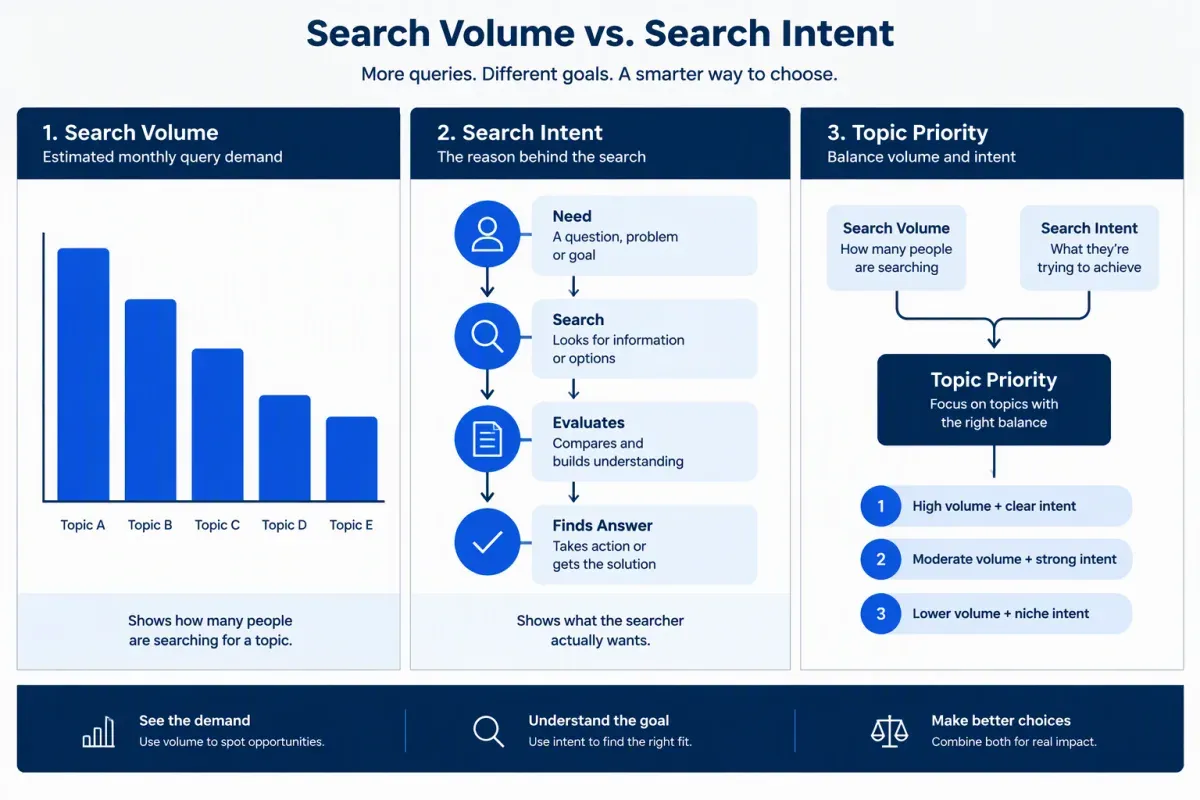
Search volume estimates how often people search for a keyword in an average month. Search intent describes why they search and what they hope to get done. In the search volume vs search intent comparison, volume measures potential audience scale. Intent shows whether that audience fits a persona and a business goal.
Volume is estimated demand, not a count of the visits a page will receive. Rankings, SERP features, seasonality, and what searchers do next all shape the traffic a page earns. A high estimate can’t tell you whether the people behind those searches are prospective customers or whether your content can meet their needs.
Intent is the qualitative half. Search intent analysis tells you who is likely searching, what task they want to finish and whether your page and offer can serve that task. A query with real demand still isn’t worth prioritizing if your business can’t help the searcher move forward.
That makes volume and intent a question of scale and fit, not an either-or choice. Persona fit sets priority. Volume then sizes the opportunity or breaks a tie between topics that serve your audience equally well. A smaller query tied closely to your product’s use case often beats a broader query that attracts people you can’t serve.
Context changes keyword intent, too. Someone searching “cafeteria” may want a nearby place to eat, not general information about cafeterias. The ranking pages usually show which reading Google favors, so check whether they match the task your persona needs to complete.
For a deeper look, see what search intent tells you and how to confirm it in the SERP. Here are the five types of search intent in one line each:
- Informational intent: learn something or get an answer.
- Navigational intent: reach a specific site, brand or page.
- Commercial intent: compare options before deciding.
- Transactional intent: buy, sign up or take another immediate action.
- Generative intent: ask an AI system to create or synthesize something. Read more about the Generative intent category and why it joins the classic four.
Why Can Search Volume Estimates Mislead You?
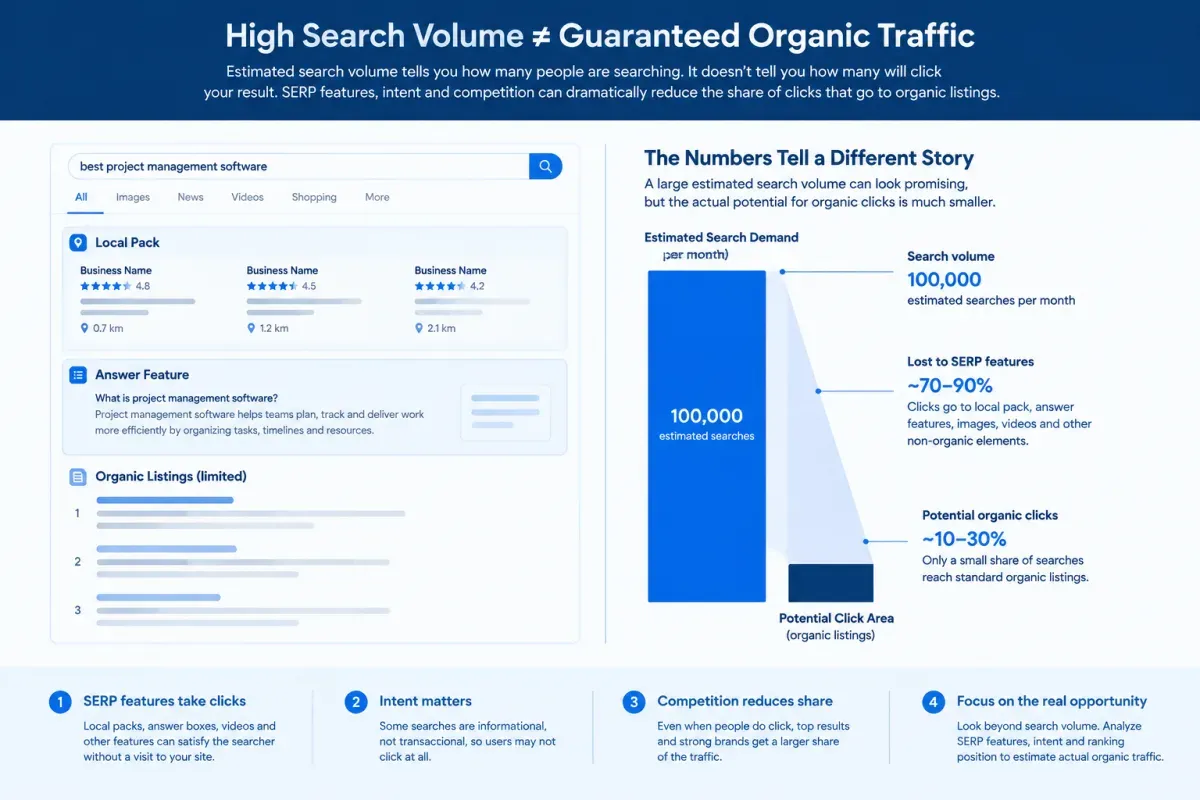
Search volume estimates describe modeled query activity, not the number of people who will visit your page. They help you compare topics, but they aren’t a traffic forecast or a promise of clicks. Treat them as a directional read on keyword popularity and demand.
Providers can report different keyword search volume for the same query in the same country. Their data sources, modeling methods and update schedules differ. Estimates can also lag emerging interest or smooth over sudden shifts in demand. Compare opportunities within one tool and one market. Mixing providers can make one topic look stronger only because the methods differ.
A strong ranking doesn’t guarantee a click either. Searchers may pick another result, get the answer from a SERP feature or decide the page doesn’t fit. High-volume keywords are often broad keywords, and established sites tend to hold those results. A page sitting at position 20 can earn few clicks despite large estimated demand.
The live results page shows how much of that demand can become organic traffic. For a local query such as “pet grooming,” a Google Local Pack sends many searchers to nearby businesses before they reach standard listings. Other features answer the query on the page, and AI Overviews can meet some needs without a visit. Check which features appear and how much room is left for organic results. Headline volume overstates traffic potential when the SERP satisfies searchers elsewhere.
Ambiguous queries draw visitors whose needs don’t match your offer. Someone searching “website” might want code snippets, a free website builder or a web design agency. A page serving one of those readings attracts poorly matched visits from the other two. Count only the share of demand that fits your persona, the page you can build and your business goal.
So topic intent and search volume estimation work best in sequence. Decide what the searcher wants first, then judge whether your page can meet that need. Before comparing estimates, assess four factors:
- Intent and business fit: estimate whether searchers want what your page and business offer.
- Click opportunity: check whether SERP features answer the query or send users elsewhere.
- Ranking feasibility: weigh the strength of the pages already ranking.
- Provider consistency: compare figures from the same tool and market.
No universal cutoff defines a good keyword search volume. A fixed threshold can’t account for provider variation, click opportunity, ranking feasibility, and business fit. Use volume as a comparative signal between similarly relevant topics, not as a pass-or-fail rule.
How Do You Prioritize Topics by Intent Before Volume?
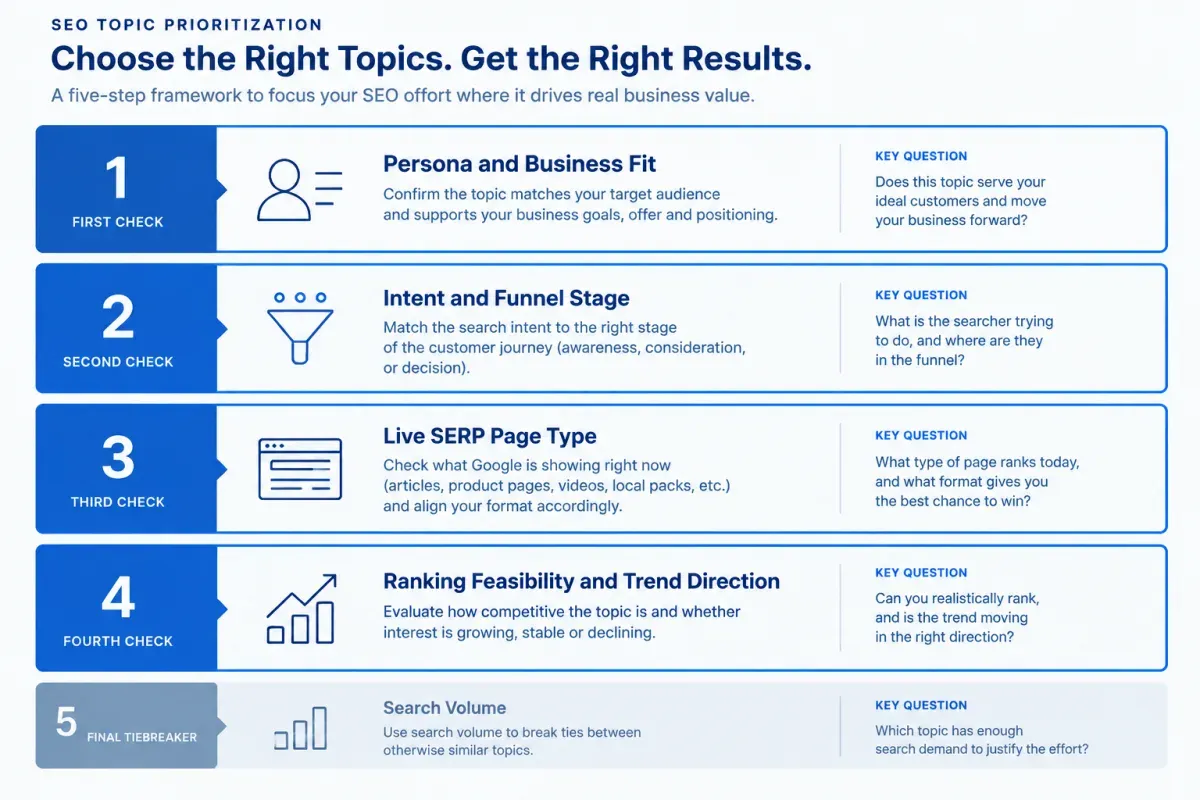
Prioritize topics by persona fit, intent, SERP format, ranking feasibility, and trend direction, in that order, then use search volume only to break ties. When you’re prioritizing keywords by intent and volume, this intent-first order keeps high-demand queries from displacing topics that fit your audience and support a meaningful next step.
Apply these five checks in order:
-
Confirm persona and business fit. Identify who would search for each topic, what decision they’re facing and whether they match a persona you serve. Then ask whether useful content could connect credibly to your offer or a relevant next step. Set aside topics that fail either test, whatever their volume. High demand can’t make the wrong audience valuable.
-
Label intent and funnel stage. For each topic that passes, decide what the searcher is trying to do and where they sit in the funnel: TOFU, MOFU or BOFU. Label the intent as Informational, Navigational, Commercial, Transactional, or Generative. These labels show where a topic belongs in the queue. Use them to balance coverage across the funnel rather than cutting every awareness-stage topic in favor of bottom-of-funnel keywords.
-
Check the page type in the live SERP. SERP analysis tests your reading of the query against what actually ranks. Note whether the leading pages are guides, product-category pages or comparisons. Comparison-heavy results call for a comparison page, while category-dominated results make a long guide a poor fit. Matching content to search intent starts here, before anyone writes a word. For existing pages that rank with the wrong format, learn how to match page format to intent.
-
Assess feasibility and trend direction. Weigh competitor strength against your existing authority and coverage. Keyword difficulty and search volume are signals, not guarantees. A broad head term may be out of reach while a focused long-tail query is realistic now. Check whether interest is stable, rising, falling, or seasonal, and review existing pages in Search Console where you can. A zero-volume estimate doesn’t prove a topic lacks value, especially for questions people ask AI assistants.
-
Use volume to order the remaining topics. Compare estimated volume only among topics with similar fit, intent and feasibility. Treat estimates as directional, especially for emerging topics that keyword databases haven’t caught yet. Volume breaks a close tie. It can’t replace a credible connection to your business.
This order is the core of keyword prioritization in an SEO content strategy. It also tells you when to stop. Stop adding topics when they repeat existing coverage, show weak intent or risk cannibalization. Revisit the queue as coverage and performance change, and check whether published pages reach the persona and support the next step you planned.
Which Wins, High Volume or High Fit? A Worked Example
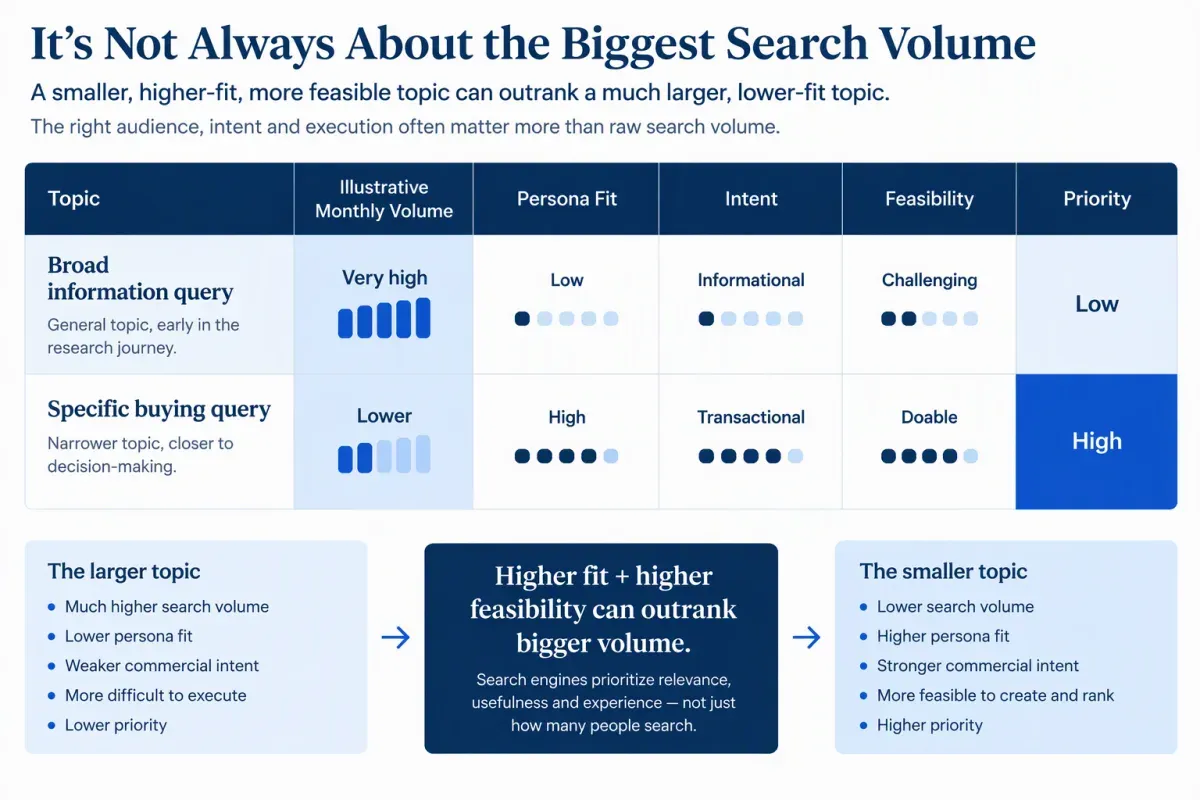
High fit wins when the goal is qualified visits, leads or sales. Volume only orders topics that already fit your persona. Even when reach is the goal, broad topics your persona actually searches serve you better than large audiences you can’t help.
Here is the method applied to a fictional company that sells SEO software to in-house content teams. Its goal is qualified visits. The volumes are illustrative, not live market data, and the feasibility ratings are assumptions.
| Topic | Illustrative monthly volume | Persona fit | Intent and funnel stage | SERP feasibility | Priority |
|---|---|---|---|---|---|
| What is SEO | 20,000 | Low. Most searchers are beginners outside the persona. | Informational, TOFU | Low. Long-established reference sites hold the results. | Fourth |
| Best SEO tools | 5,000 | High. In-house teams may be comparing options. | Commercial, MOFU | Medium. Established comparison pages compete. | Third |
| Buy SEO software | 500 | High. The query matches the product and a buyer’s need. | Transactional, BOFU | Medium. A purchase-focused page would need to match the results. | Second |
| Brand name plus pricing | 200 | High. The searcher wants details of this company’s offer. | Transactional, BOFU | High. A clear pricing page fits the query closely. | First |
“What is SEO” has the largest number and still ranks last. Its likely visitors don’t match the persona, and reference sites make the results hard to enter. “Best SEO tools” fits the audience, but comparison intent at MOFU sits a step further from a decision than a purchase query.
The two BOFU topics pass the fit and intent checks, so both rank above the research queries. Feasibility separates them. A pricing page closely fits the branded query, so it goes first even though “buy SEO software” has more searches. Volume never decides the order here. It would only matter if two topics tied on every earlier check.
That’s search intent vs keyword volume in practice. Intent says what a searcher wants. Volume estimates how often people search. High-intent keywords point toward conversion potential but don’t guarantee it, since the offer and page still have to meet the need.
The 500-versus-20,000 comparison is an illustration, not a forecast. When leads or sales are the goal, 500 well-matched searches can be worth more than 20,000 poorly matched ones. High-volume, low-fit visits can still build awareness. They’re just less likely to become leads.
Low-volume high-intent keywords follow the same pattern outside SaaS SEO. A query such as “hire Shopify e-commerce developer for custom checkout” might have an illustrative 50 monthly searches. Each one signals someone looking for a provider. A broad e-commerce query brings more visitors, but many have no need the service solves.
To compare topics on likely outcomes, multiply each topic’s estimated searches by your own click share and your own conversion rate. Take both from Search Console and your analytics, not from industry averages. Your own data reflects your rankings and your offer.
Informational keywords still make sense when reach or early education is the goal, or when a broad topic serves as a hub for narrower pages. Choose by the outcome you want, then let your own performance data refine the next round.
How Can Floyi Support Volume-Last Prioritization?
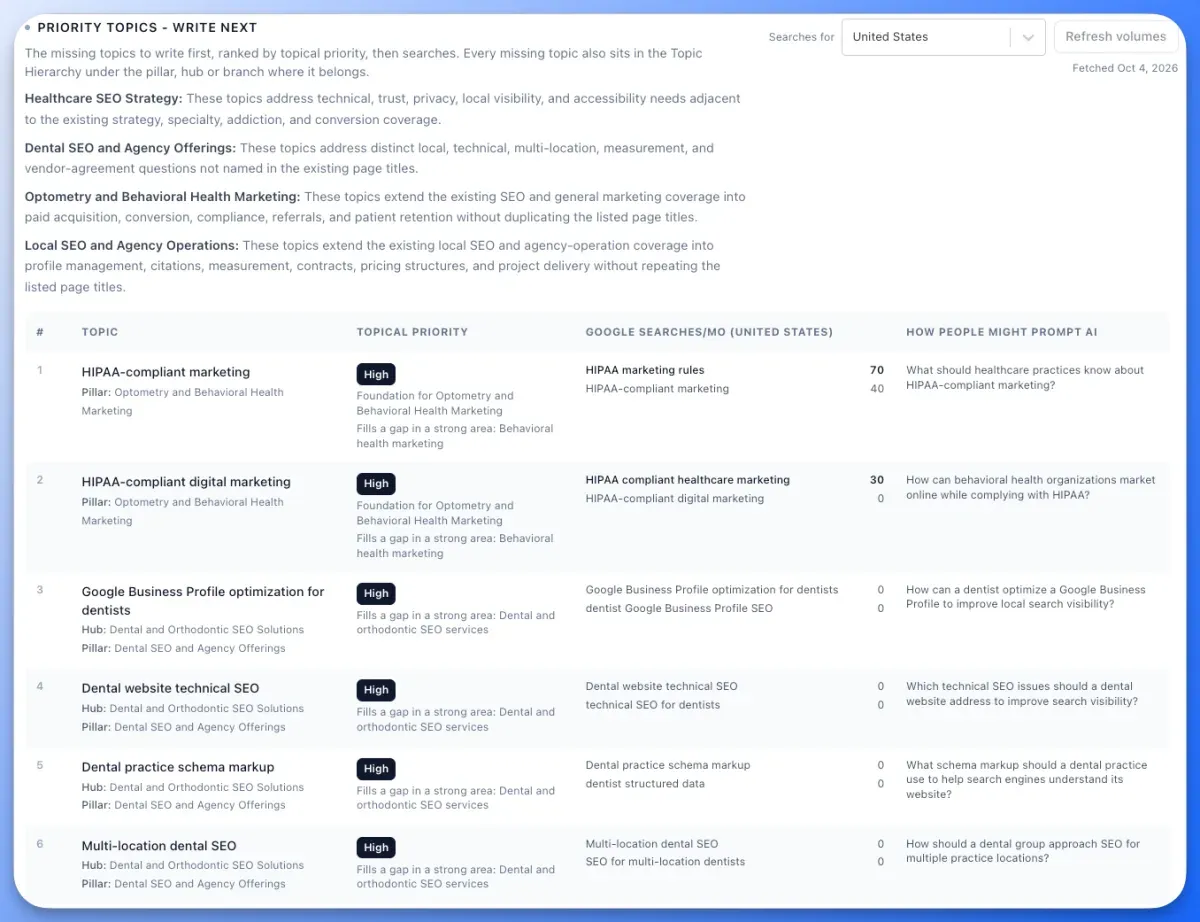
Floyi shows each topic’s intent, funnel stage and place in the map next to its demand, and its Topical Audit uses volume only to order topics that share a priority. Ignoring volume can mean missing viable reach. Choosing by volume alone puts broad, low-fit terms ahead of content that supports leads or sales.
Planning starts with your brand and audience, not a keyword export. That context shapes each topic’s funnel stage and carries your brand voice and personas into briefs. The map organizes topics as Pillar > Hub > Branch > Resource rather than a flat list. You can see whether a topic anchors a broad area or answers a focused question before you look at demand.
In the Authority Planner, every topic shows its search intent and funnel stage. Floyi labels both automatically, and you can change either to match how your business sells. A topic can carry up to two of the five intents. Values you set stay put when Floyi re-labels the map, unless you rename or combine that topic in the Organizer.
The topic details drawer adds evidence, starting with ranking pages and People Also Ask questions. With Search Console connected, it also shows clicks, impressions, average position, top queries, and impression trends for the matched URL. These signals show how existing pages perform. They don’t prove a new topic will rank, so weigh them alongside fit and coverage.
The Topical Audit applies the same rule to gaps. Priority Topics - Write Next lists up to 15 missing topics and rates each High, Medium or Low. The rating reflects how much a topic would strengthen what the audited site already covers. Search volume orders topics only within the same rating and never changes the rating itself. Each missing topic also lists every way people search for it with its monthly volume, plus how people might prompt AI about it.
A brief generated from the Planner follows the intent and funnel stage you set there. It includes SERP consensus, information gain and internal links from the Planner, so the page is built for the searcher you chose.
Start with the topics you plan to write next. Check their intent and funnel stage, then let volume order whatever ties. Build an intent-first plan in Floyi.
Search Volume vs. Search Intent FAQs
These questions cover where search volume still helps, when low numbers deserve attention and what volume data leaves out.
1. Is Search Volume Important for SEO?
Yes, as a sizing and tiebreaking signal. Search volume helps estimate potential reach, compare otherwise equal topics and decide how much effort a page warrants. It can’t show whether searchers match your persona, whether you can rank or whether a visit leads anywhere. Pick topics by persona fit, intent and feasibility first, then let volume order the ones that pass.
2. When Should You Target Low-Volume Keywords?
Target low-volume keywords when their searchers match your audience, the intent fits your offer and the query points toward a valuable action. Then check the results. The opportunity is realistic when current pages match the query poorly and you can publish a more useful answer. Your niche, competition and goals decide whether the topic merits the investment.
3. Does Google Trends Show Search Volume?
No. Google Trends shows relative interest on a 0 to 100 scale for a chosen location and time range, not monthly searches. Use it for direction, seasonality and comparing queries.
You can compare a topic, which groups related searches, or an exact search term, so compare like with like. Pair Trends with a volume estimate from a tool such as Google Keyword Planner when you need both.
4. Does Search Volume Include Questions Asked in AI Assistants?
Not in standard keyword tools. Their volume estimates come from search engine data, so prompts people send to ChatGPT or Gemini aren’t counted. A topic can show little or no recorded volume and still come up often in AI conversations. Judge those topics by persona fit and intent, check whether AI answers already cover them well and keep strong-fit topics in the plan.
About the author

Yoyao Hsueh
Yoyao Hsueh is the founder and CEO of Floyi, the topical authority platform, and the founder of Main Heading, an SEO and AI search agency. He is an expert in topical authority and topical mapping. He created Topical Maps Unlocked, a course studied by thousands of SEOs, content strategists and digital marketers, founded TopicalMap.com, a done-for-you topical mapping service for agencies and enterprise teams, and publishes the weekly Digital Surfer newsletter on SEO, content strategy and AI search.
About Floyi
Floyi is a closed loop system for strategic content. It connects brand foundations, audience insights, topical research, maps, briefs, and publishing so every new article builds real topical authority.
See the Floyi workflow