
What Is Search Intent? Types, SERP Validation, and Content Planning
Search intent is the goal behind a query. Learn the four types, validate intent with SERP evidence, and turn findings into content plans.
Search intent is the underlying goal behind a query, and it determines the page experience most likely to satisfy that search. Keyword modifiers offer an initial hypothesis, but SERP validation confirms whether Google favors an explainer, comparison, destination page, or transaction path.
The four dominant search intent types are informational, navigational, commercial investigation, and transactional. Google’s Search Quality Rater Guidelines evaluate usefulness against the intent interpreted from the query, not keyword repetition alone. Review the top 10 organic results, recurring page formats, and features such as People Also Ask, Shopping results, local packs, and knowledge panels before planning content.
Floyi’s Authority Planner connects validated intent to funnel stage, topical priorities, existing URL performance, and the Pillar > Hub > Branch > Resource map. Measure rankings alongside qualified traffic, task completion, conversions, and assisted conversions, then recheck the SERP when performance or result composition changes.
Search Intent Key Takeaways
- Search intent is the underlying goal behind a query, beyond its literal keywords.
- Informational, navigational, commercial, and transactional are the four dominant intent patterns.
- Query modifiers suggest intent, but live SERP patterns provide stronger validation.
- Review the top 10 organic results for recurring content types, formats, and angles.
- Featured snippets, Shopping, local packs, and People Also Ask can reveal secondary needs.
- Match page format and CTA to the dominant task the searcher needs completed.
- Recheck intent when SERP composition, rankings, qualified traffic, or conversions change.
What Is Search Intent?
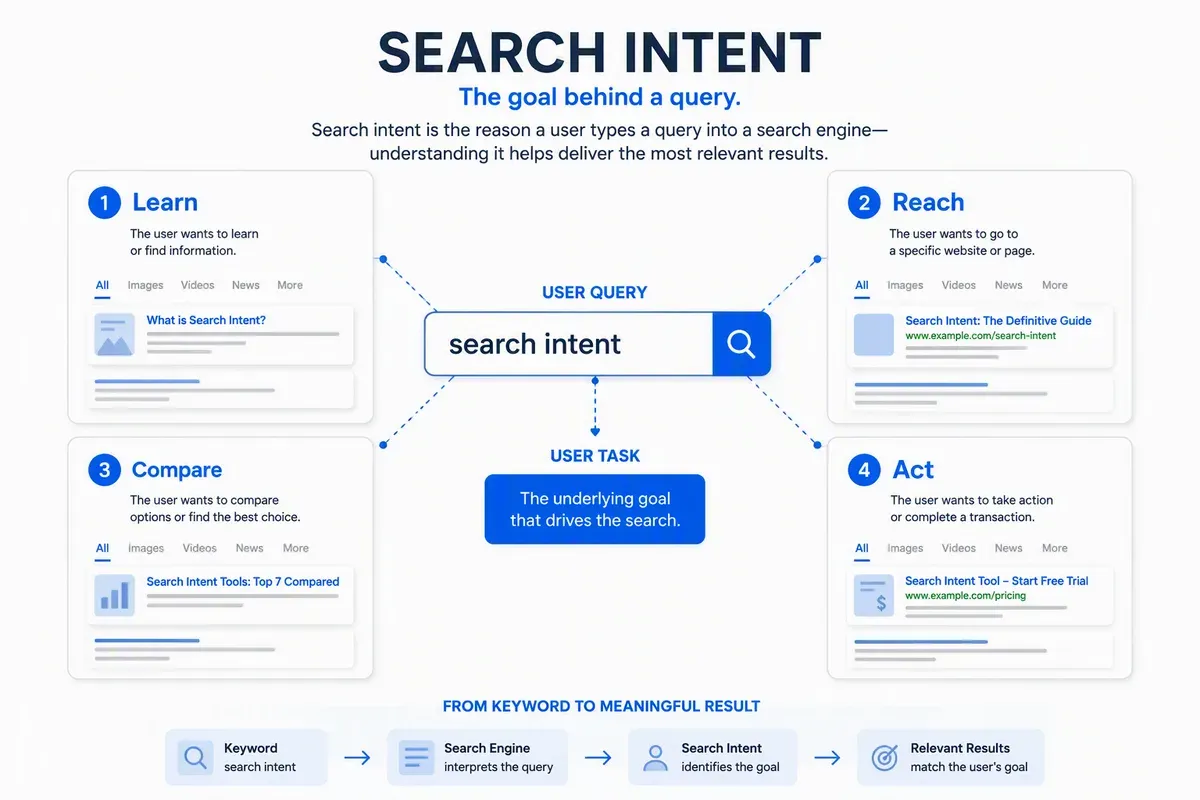
Search intent is the underlying goal behind a query: what someone wants to find, learn, compare, buy, reach, or do, beyond the words entered into a search engine.
A search intent definition separates the visible keyword from the expected outcome. User intent behind “weather” is usually a current local forecast, while “how do people predict the weather” seeks an explanation of forecasting methods. One query can also support a larger task, such as finding movie showtimes before purchasing tickets and getting directions.
Google’s Search Quality Rater Guidelines say search result usefulness depends on the user’s intent as interpreted from the query, not just the words typed. Egg-salad recipes may repeat relevant terms yet fail a search for “is egg salad healthy,” which calls for nutrition and health information. Important modifiers change what a helpful result must address:
- Specificity: “Non-emergency” narrows a Lewis County phone-number search away from urgent services.
- Outcome: “Buy” calls for a different destination than “Compare” or “How does it work?”
- Task stage: A direct answer may precede a later product-page visit or recipe search.
Query interpretation identifies what a query refers to, while query intent identifies what the searcher wants to accomplish. “Apple,” for example, may mean the technology company or the fruit, and each interpretation can support several goals. Specific queries usually signal one dominant need, although a single searcher may still have related follow-up needs.
The search engine results page (SERP) is Google’s visible estimate of dominant intent, not proof that every ranking result serves users well. Before planning search engine optimization (SEO) content, validate recurring page formats, result features, and angles across the SERP. That evidence turns keyword intent classification into a defensible content decision.
Why Does Search Intent Matter for SEO?
Search intent matters for SEO because it decides what a page has to do, not just which words it contains. Search intent in SEO guides page decisions beyond keyword repetition.
Search engines assess meaning through synonyms, entities, qualifiers, ambiguity, and context. A page about tooth loss in pike fish may contain “five years old,” but it cannot answer a parent’s question about a five-year-old child. The age and subject are meaningful qualifiers, so keyword overlap alone does not establish relevance.
Intent analysis turns a target keyword into a content decision. Most queries fall into one dominant category:
- Informational: Learn a fact, process, definition, or explanation.
- Navigational: Reach a specific brand, website, or destination.
- Commercial: Compare options before choosing.
- Transactional: Complete an action, such as buying, booking, or signing up.
The dominant category should shape the page type, format, depth, and call to action. A direct-question query may need a concise answer, while a comparison query needs decision criteria. AI-powered content strategy in practice connects those choices to topical planning instead of treating each keyword as an isolated task.
SERP evidence tests whether your classification matches Google’s interpretation. Featured snippets, knowledge cards, and knowledge panels can answer part of a need before the click, raising the standard for what your page must add.
Intent alignment also supports conversion rate optimization because useful content helps visitors take an appropriate next step. Keep the immediate query central, then account for location, device, and prior behavior when those factors change what a helpful result requires.
What Are the Four Search Intent Types?
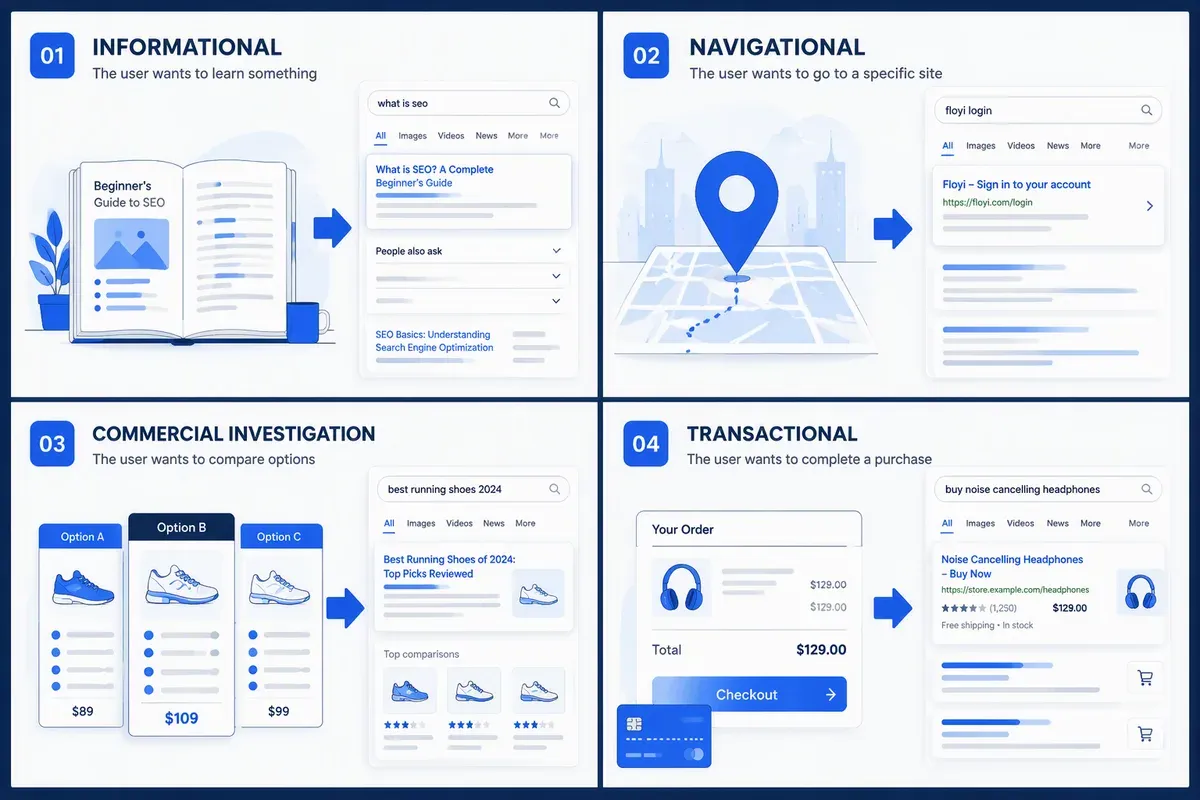
Search intent types identify the outcome a person expects from a query. The four primary patterns are informational, navigational, commercial investigation, and transactional, though each is a dominant pattern rather than a rigid label.
A query can support more than one reasonable goal. Google’s Search Quality Rater Guidelines say a query can have more than one likely user intent, so one interpretation may support several reasonable needs. For example, “Apple” may refer to the company, a device, or the fruit, so your page format should reflect the SERP’s prevailing interpretation.
| Intent type | Searcher’s main goal | Representative queries | Likely page format |
|---|---|---|---|
| Informational intent | Learn, understand, or get an answer | “What is SEO?”, “H₂O boiling point,” “How to tie a tie” | Explainer, guide, tutorial, tool |
| Navigational intent | Reach a known destination | “Netflix login,” “GitHub homepage,” “Apple support” | Official homepage, login, support page |
| Commercial intent | Compare options before choosing | “MacBook vs ThinkPad,” “Best laptops under $1,000,” “Nike vs Adidas” | Comparison, review, buyer’s guide |
| Transactional intent | Complete a defined action | “Buy red shoes,” “Buy noise-cancelling headphones,” “Spotify discount” | Product, pricing, signup, download page |
Informational intent means the searcher wants knowledge, not a particular destination or purchase path, so “Weather today” usually calls for a quick answer, while “retirement planning” signals broad exploration, where readers may need different guidance, tools, and levels of detail.
Navigational intent means the searcher already has a destination in mind, even without knowing its exact web address, and “Gmail login,” for example, requires the official account screen, not a general article about email providers.
Commercial intent sits between learning and action. Searchers compare reviews, pricing, specifications, and alternatives because they are making an active selection decision. That distinction separates “best coffee makers” from “buy Breville coffee maker,” even though both concern the same product category.
Transactional intent signals readiness to buy, subscribe, register, download, or use a service. Match the dominant SERP pattern first, then account for any secondary intent that changes the page format.
How Do Informational and Navigational Intent Differ?
Informational intent means a searcher wants an answer, explanation, or instruction. Navigational intent means they want to reach a known website, page, login screen, or local destination. Queries such as “what is SEO,” “H₂O boiling point,” “how to tie a tie,” and “how to bake sourdough bread” seek knowledge, while “Netflix login,” “GitHub homepage,” “Nike official site,” and “Titanic IMDb” seek a destination.
Query wording gives you an initial signal, not a final classification. Informational searches often use “who,” “what,” “when,” “how,” “guide,” or “tips,” although “weather today” reflects a simple information need without a question word. Navigational searches commonly name a brand, product, department, location, address, or phone number.
| Intent | Common query signals | Likely SERP evidence | Appropriate destination |
|---|---|---|---|
| Informational | How, what, guide, tips | Featured snippets, knowledge panels, People Also Ask, videos | Guide, tutorial, or answer page |
| Navigational | Brand, login, official site, homepage, address | Official domain, sitelinks, maps, contact details | Homepage, login, location, or contact page |
Validate the initial reading in the SERP before choosing a format. A misspelled URL can still show clear navigational intent when the intended destination is obvious, as with “www.netflix.coom.”
For an informational target, lead with the answer and support it with clear headings, concise paragraphs, visuals, and relevant FAQs. For “Target hours,” “CNN health,” or “Chef Chu phone number,” optimize the page the searcher needs rather than publishing a generic article. Correct classification keeps each target keyword tied to the page built to satisfy it.
How Do Commercial and Transactional Intent Differ?
Commercial intent signals evaluation before commitment, while transactional intent signals readiness to complete a defined action. Both sit near a purchase, but commercial queries ask Google to narrow a choice, whereas transactional queries expect a product, offer, checkout path, or other immediate action.
Commercial investigation intent covers searches for recommendations, reviews, comparisons, and alternatives. “Best coffee makers” is commercial rather than informational because the searcher wants purchase guidance, not a definition. Comparison modifiers provide useful early signals:
- Best or Top: “Best coffee makers,” “best cheap phones,” and “best laptops under $1,000” need ranked choices and selection criteria.
- Review or Compare: “MacBook vs ThinkPad” calls for a side-by-side decision page, not a single product detail page.
- Alternatives or Vs.: “Nike vs Adidas” indicates that the searcher is weighing candidate brands before selecting one.
Transactional intent uses language tied to purchase, access, or enrollment. Queries such as “buy Breville coffee maker,” “buy red shoes,” “buy iPhone 17 online,” “subscribe,” “sign up,” “download,” “coupon,” and “Spotify discount” usually indicate that a searcher has selected, or nearly selected, what they want.
Modifiers are strong clues, not final proof. A broad product query can support research, browsing, and purchase, and one person may have several goals. Google’s September 2025 Search Quality Evaluator Guidelines recognize that product research can include reviews, specifications, brands, models, and pricing before purchase.
Treat “best coffee makers” and “buy Breville coffee maker” as a readiness contrast, then inspect the ranked SERP before choosing a comparison page or a conversion page.
How Do You Identify Search Intent?
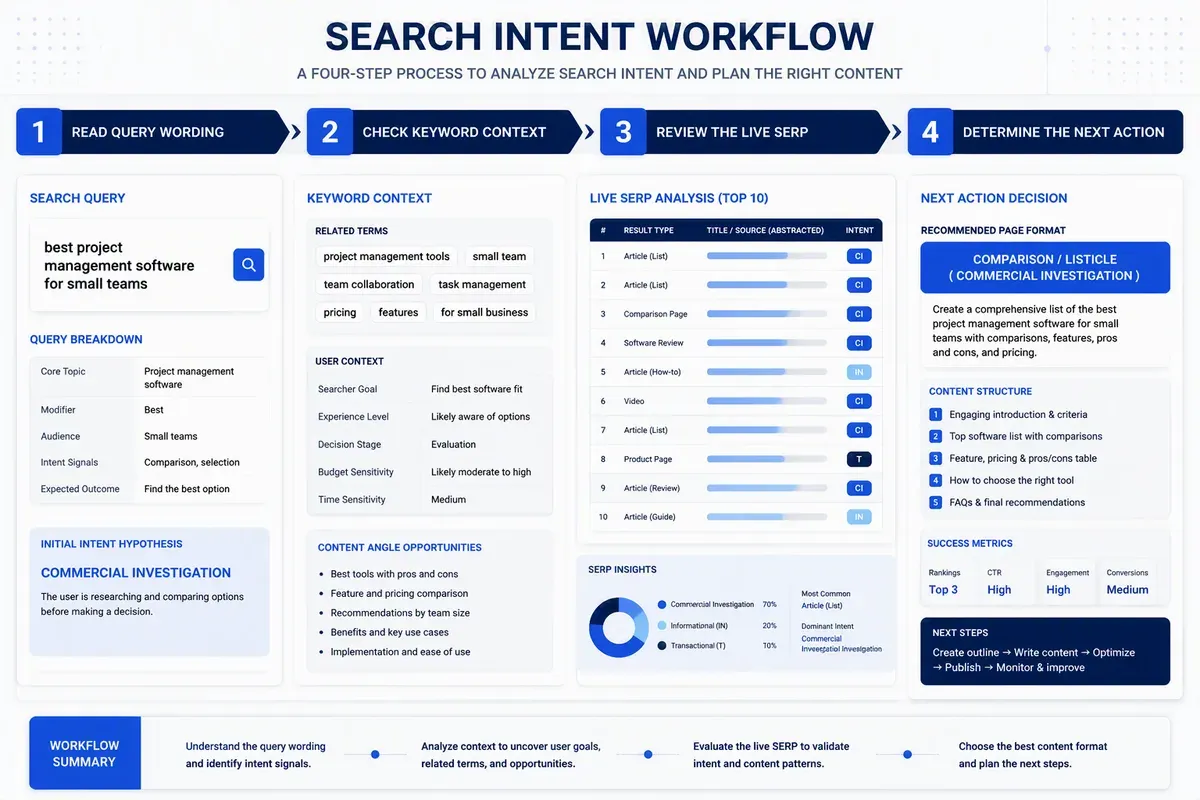
With the four dominant patterns in mind, identify search intent by treating the search query as evidence of a need, then validating that reading against context and live Google results. How to identify search intent is a decision about the page experience you create, not how often you repeat a keyword.
Use this four-signal workflow:
- Read the query wording: Separate the subject from modifiers such as “what,” “how,” “best,” “affordable,” “buy,” “learn,” and “easy.” These words indicate the answer or action the searcher expects. “Is egg salad healthy,” for example, requires nutritional information rather than a recipe that only mentions egg salad.
- Check keyword context: Review related searches, possible product or brand meanings, location cues, and freshness needs. “Verbena” may refer to a plant for most searchers but an Austin restaurant for local users. Broad institution searches can reasonably support a website visit, research, or directions.
- Review the live SERP: Examine the top 10 results for repeated topics, page formats, structures, and SERP features. Product pages, guides, local packs, videos, comparison content, and official sites reveal the intent Google associates with the query.
- Determine the likely stage and next action: Decide whether the searcher needs a direct answer, broader research, a purchase path, a specific destination, or an in-person option. Mixed intent is common, so the primary page should satisfy the dominant need while making room for valid secondary needs where the format supports them.
Intent classification should shape the page type and angle. An informational query may need a definition and examples, while a commercial query may require comparison criteria, pricing context, or alternatives. Google’s helpful-content guidance says pages are evaluated for originality, completeness, and value, so content that misses the searcher’s goal may fit the query less well even if it repeats the keyword.
Time-sensitive terms need another SERP review before publication because dominant meanings shift with new products, events, and public figures. Measure impressions, rankings, and the page’s ability to support the next action implied by the query.
Validate Query Modifiers Against Google SERPs
Query modifiers provide a starting hypothesis, but Google’s live results reveal the intent it associates with the exact wording. SERP analysis compares that hypothesis with the content types, formats, angles, and SERP features visible on page one.
Query wording provides initial signals for each type of search intent. “How,” “what,” and “examples” often indicate learning. A brand name may indicate navigation, while “best,” “vs,” and “reviews” suggest evaluation. “Buy,” “price,” and “near me” commonly signal an action-oriented query.
Use this process for how to identify search intent:
- Search the keyword exactly as written, without adding or removing modifiers.
- Assess the top 10 organic results for the prevailing page type, including articles, category pages, product pages, videos, tools, and landing pages.
- Compare the dominant format, such as a how-to, list, comparison, review, or direct-answer page.
- Identify the recurring angle: learning, evaluating options, reaching a destination, or completing an action.
SERP features can confirm or challenge the organic pattern. Featured snippets, knowledge panels, image packs, and video results often support informational needs. Shopping results usually reinforce transactional intent, while sitelinks can support a navigational interpretation.
Mixed results warrant a mixed-intent classification. A query may reasonably serve both website and visit-in-person needs, so build for the strongest recurring expectation rather than forcing a single label. Match the page to the searcher’s underlying goal, not keyword inclusion alone.
Document Your SERP Evidence and Confidence
A SERP evidence record makes an intent decision reproducible by tying it to what Google returns. SERP analysis should weigh live results more heavily than keyword modifiers, which can suggest intent but cannot confirm it.
Each query record needs four fields:
- Query context: Search term, date, location, device, and meaningful personalization limits.
- Organic pattern: Dominant page types, formats, and recurring angles among leading organic results.
- SERP features: Ads, Shopping results, a local pack, videos, images, People Also Ask, forums, and knowledge panels.
- Decision record: Final intent, confidence level, competing interpretation, and rationale based on the result mix.
For “best air fryer,” updated blog list posts point to commercial investigation, even when the modifier could invite a broader label. “Best coffee makers” and “best running shoes” generally need comparison, review, or recommendation pages rather than definition-focused content. Product pages and Shopping results may add transactional signals, but they should not outweigh a dominant review-list pattern.
Keep SERP features separate from organic rankings because they often expose secondary needs. A results page dominated by category pages for “coffee maker” supports consideration or transactional intent, while varied formats can indicate that Google is serving several reasonable needs.
Ambiguity belongs in the record. “Blender” can mean a kitchen appliance or open-source 3D graphics software, so note both interpretations, identify the prominent meaning and format, and assign high, medium, or low confidence. Visible contradictions prevent false certainty in content decisions.
How Do You Handle Local and Mixed Intent?
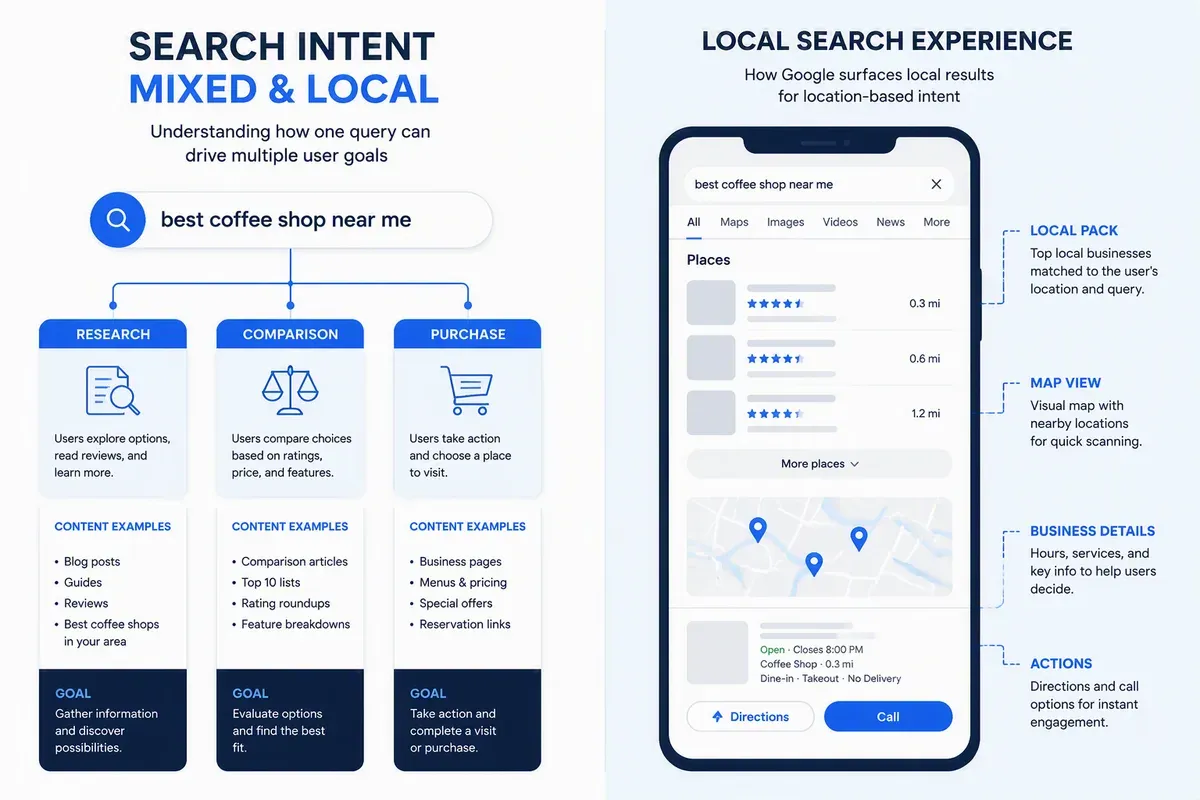
Mixed search intent means a query supports more than one reasonable user goal. When the evidence record shows several, the dominant task is the one the SERP consistently rewards.
Commercial investigation involves researching, comparing, or reviewing options before a decision. Transactional intent signals readiness to buy, subscribe, download, book, or complete another defined action. In search intent mapping, secondary needs belong on the page only when they support the same decision path:
- Best air fryer: A recommendations or comparison page can include purchase paths because evaluation leads the query.
- Blog platform free: A comparison-led guide can explain criteria while helping readers assess free options.
- Best running shoes: A review list, comparison, or recommendations page usually fits better than one asset combining history, category definitions, and individual product details.
Local intent is a context layer that can change both the preferred result and the meaning of a query. Searches for Walmart, hotels, Bank of America, or library may signal a nearby visit, an official-site visit, or general research. Near Austin, Verbena may refer to the restaurant, while elsewhere the plant is the more likely interpretation.
Validate local queries under the conditions in which the search occurs:
- Set the relevant locale and city: Location can change eligible results and entity meaning.
- Check the device view: Mobile SERPs often prioritize maps, calls, directions, and hours.
- Inspect action-oriented results: Assess local packs, map listings, location pages, directions, and “near me” language alongside organic results.
- Match the primary task: “Best iPhone repair shop near me” needs local, transaction-ready information, not a generic repair explainer.
When a SERP splits, choose the format that best serves the dominant pattern in the results. Separate pages when interpretations need different evidence or formats, such as kitchen blenders and Blender 3D software. Recheck ambiguous queries by location and over time, because changing SERP composition can change the priority intent.
How Do You Match Content to Intent?
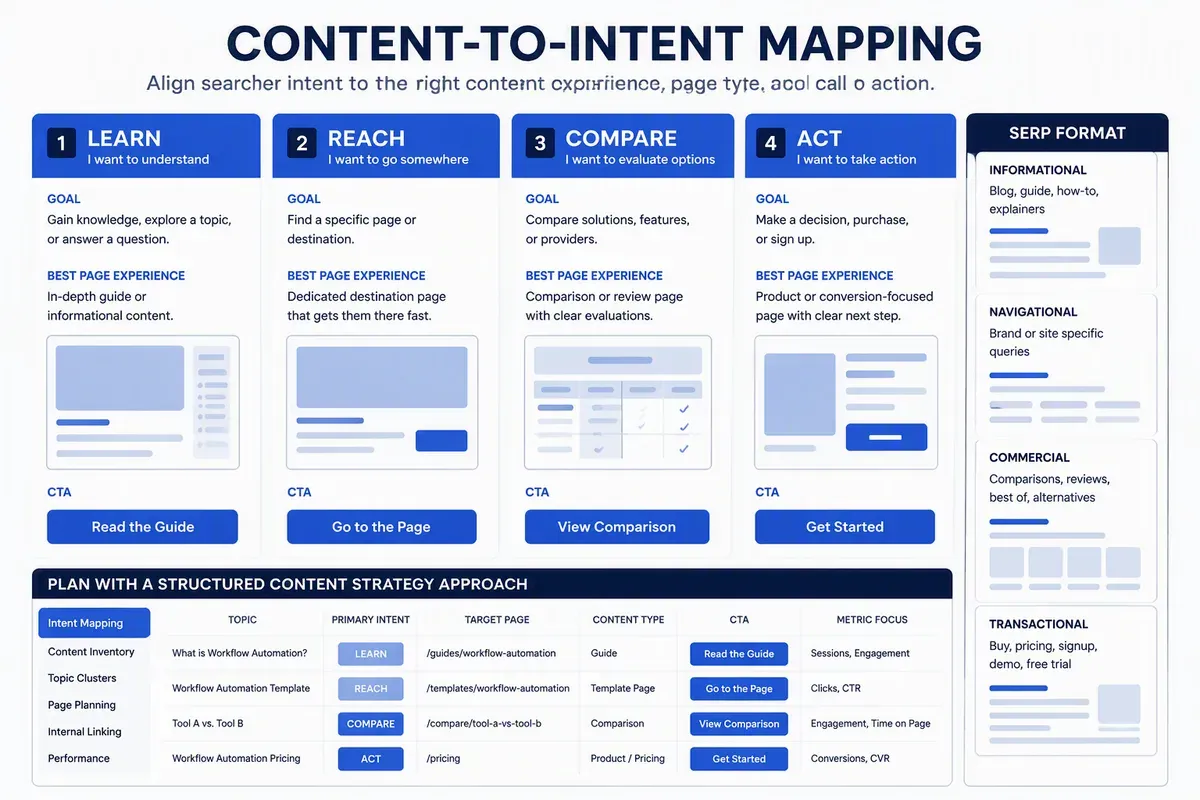
Matching content to intent means giving searchers a page that helps them complete their task, rather than repeating a keyword more often than competing pages.
The SERP indicates the expected content type, content format, and content angle. Review leading organic results, video and image blocks, shopping modules, and People Also Ask questions before drafting. A strong written guide can still miss the mark when results favor a visual demonstration.
| Intent | Searcher goal | Suitable page experience | Appropriate CTA |
|---|---|---|---|
| Informational | Learn, solve, or understand | Explainer, guide, tutorial, FAQ, video, diagram, or screenshot-led walkthrough | Read related guidance, use a template, or view the next step |
| Navigational | Reach a known brand, page, login, support area, or location | Direct destination page with exact naming and visible task paths | Sign in, contact support, get directions, repair, upgrade, or trade in |
| Commercial investigation | Evaluate options before choosing | Comparison page, review, buying guide, alternatives page, or curated shortlist | Compare plans, view pricing, or request a demo |
| Transactional | Buy, book, subscribe, download, or sign up | Product, category, pricing, booking, or action page with filters and proof | Buy, start a trial, book, download, or sign up |
For informational pages, choose the delivery method the SERP favors. Lead with the answer, then use concise steps and visuals that reflect the result page, recognizing that broad “what is” searches may support a guide, while a task such as learning a physical technique often needs a video tutorial. Treating every “how to” query as a text article is a frequent mismatch.
Navigational pages should remove barriers to the expected destination. Use the exact brand, product, or location name prominently, and make common actions immediately visible, so a product-support search needs paths for repair, upgrade, or trade-in, not a generic homepage.
Commercial investigation pages should make tradeoffs easy to assess before purchase. Decision criteria should cover use case, meaningful differences, limitations, and plan or price fit. Transactional pages must surface relevant purchasable options for qualifiers such as travel, gaming, or office use, alongside availability, eligibility, reviews, and filters.
How AI transforms content planning connects page-level intent decisions to broader topical planning. To learn how to optimize for search intent, validate each page against the SERP and measure whether qualified visitors complete its next action.
How Do You Turn Intent Into Content Plans?
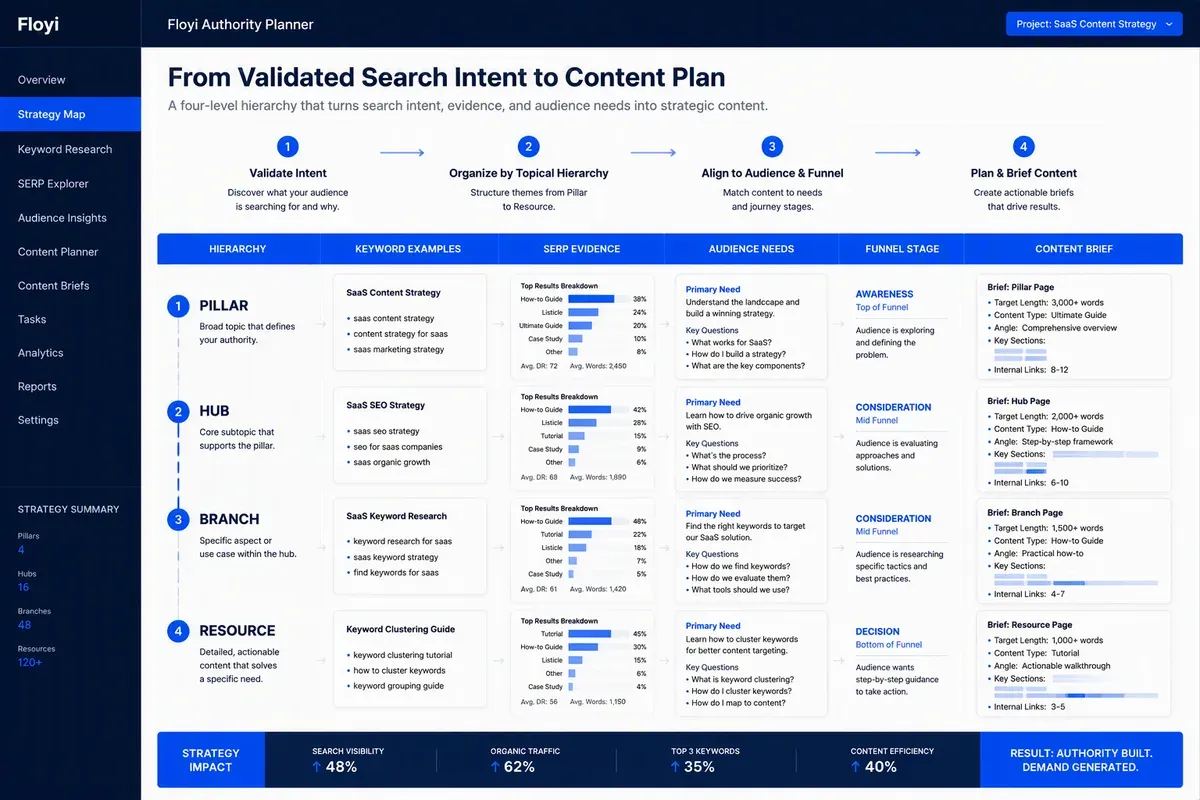
Intent becomes a content plan when every target keyword connects to the searcher’s goal, the page most suited to meet it, and brand context that justifies publishing.
Use this four-part sequence for each keyword:
- Define the job: Identify the immediate task, underlying audience need, and primary intent: informational, navigational, commercial investigation, or transactional. Keyword research supplies candidates, but a page belongs in the plan only when it satisfies the goal behind the query.
- Validate the three Cs: Review the SERP for content type, format, and angle. Modifiers such as “what,” “how,” “best,” “affordable,” and “buy” offer early clues, not proof. A query such as “best air fryer” usually needs a current recommendations list, not a forced product page. Google identifies relevance as one ranking consideration.
- Set the information contract: Specify the questions the page must answer, appropriate depth, required evidence, and scannable elements that readers and AI systems can quote. An awareness explainer needs a definition, examples, and a practical framework. A commercial page needs options, decision criteria, and tradeoffs without expanding beyond the query.
- Match the conversion path: Give layered queries a primary answer, then address the implied secondary need. “Blog platform free” can combine research and evaluation, so the page should answer the free-plan question before offering a relevant evaluation or purchase path.
Brand context keeps intent planning from becoming a volume-sorted spreadsheet. Capture reader expertise, pain points, voice, strategic importance, hub placement, and the perspective your brand can support. User search behavior varies by prior activity, device, location, and readiness, making buyer personas a necessary planning input.
Floyi’s Authority Planner connects intent, funnel stage, topical priorities, and existing URL performance across the Pillar > Hub > Branch > Resource map. Google says a page must be indexed and eligible for search snippets to be shown as a supporting link in AI Overviews or AI Mode, and helpful content should show clear sourcing and expertise.
Prioritize pages by audience and business value, then use published performance evidence to refine the next plan.
How Do You Measure and Refine Intent?
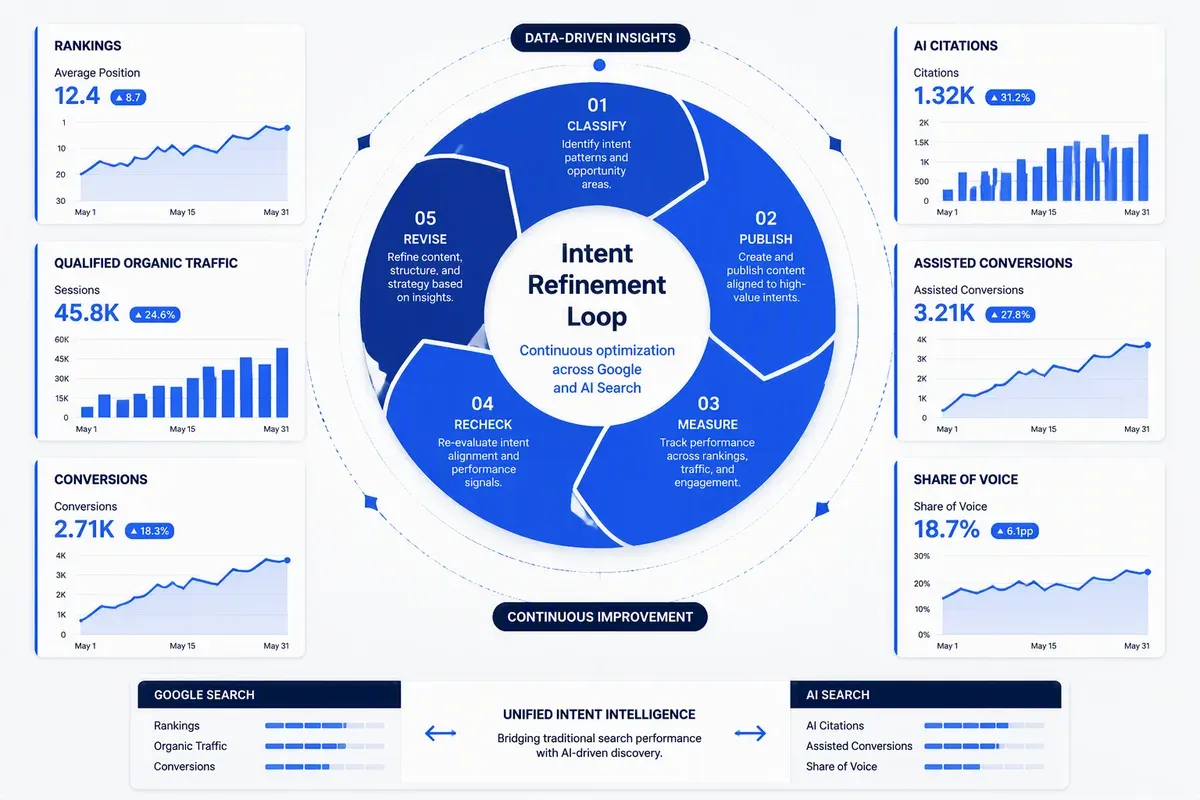
To refine the next plan with performance evidence, the Intent Refinement Loop tests whether a page still meets the goal behind a query, then changes the page or its intent classification when the evidence no longer aligns. Search engines aim to fulfill needs rather than match words alone, so rankings are a diagnostic signal, not proof of intent fit.
The loop follows five connected actions:
- Classify: Inspect the live SERP for leading result types, page formats, featured snippets, knowledge panels, shopping modules, local packs, and contradictory top-ranking pages.
- Publish: Build the format that best addresses the inferred need. What is generative search intent helps distinguish synthesized-answer queries from queries that call for a guide, comparison, or landing page.
- Measure: Evaluate rankings alongside qualified organic traffic, engagement, task-completion signals, conversions, and assisted conversions that match the page’s role.
- Recheck: Return to the SERP after meaningful performance movement and on a regular review cadence. Lower clicks may reflect a zero-click answer environment rather than a page that has lost intent alignment.
- Revise: Reassess the intent-confidence score against SERP evidence and performance outcomes. Mixed needs can justify a comparison module, separate needs can require separate pages, and persistent local results can support a local landing page.
Weak visits, shallow engagement, or absent next steps can expose a mismatch in audience need, angle, format, or content type even when rankings remain stable. Floyi’s Authority Planner can carry those findings into the next Pillar, Hub, Branch, and Resource decision.
AI search measurement should use a weekly baseline for answer presence, AI-citation share, share of voice, click-through rate, and assisted conversions. Annotate substantive page changes so you can connect an intent revision to performance across Google and AI-generated results.
Search Intent FAQs
These FAQs address practical search intent decisions, including how to read SERP evidence and align page formats with audience expectations. They help you connect topical scope to defensible content choices and business goals.
1. What Are the Three Cs of Search Intent?
The three Cs turn SERP patterns into a practical page plan. Content type is the broad ranking asset, such as a blog post, product page, category page, or video. Content format is the presentation, such as a how-to guide, listicle, review, comparison, or tool. Content angle is its promise, such as “for beginners” or “fastest.” Review Google results for the target keyword to match the dominant pattern. This keeps content aligned with the customer journey and marketing funnel.
2. Is Search Intent the Same as Buyer Intent?
Search intent is the purpose behind a query, while buyer intent indicates a person’s proximity to a purchase within that broader purpose. Search intent vs user intent shows why informational and navigational searches rarely establish purchase readiness on their own.
Commercial investigation, such as “MacBook vs ThinkPad” or “best laptops under $1,000,” reflects active comparison during the marketing funnel and customer journey. Transactional searches, including “buy red shoes,” “Spotify discount,” or a download, signal readiness to complete a specific action.
3. Can Search Intent Change Over Time?
Yes. Search intent is Google’s current interpretation of what users expect, not a permanent keyword label. Trends, news, seasonality, product availability, and releases can shift that expectation. Google’s quality guidelines use “iPhone” as an example: it once meant the first model but now usually signals the newest or upcoming version.
Validate each target keyword against the live SERP before creating or refreshing content. Page formats, result features, and the informational, commercial, and transactional mix show the intent Google associates with the query. Recheck established pages when rankings, traffic, or SERP composition changes.
4. Does Search Intent Vary by Device?
Yes. Device context can change user search behavior even when the query words remain the same. Mobile searches for pizza, gas stations, or Starbucks near me often indicate immediate action, so the local pack may prioritize maps, hours, directions, and call buttons. Desktop results may favor comparison and planning.
Navigational searches such as Netflix login still target a specific destination, but app links and login shortcuts can alter the SERP experience. Check mobile and desktop results in the searcher’s relevant locale when local intent is plausible, since location can change the result set and the page experience that best meets the underlying goal.
About the author

Yoyao Hsueh
Yoyao Hsueh is the founder and CEO of Floyi, the topical authority platform, and the founder of Main Heading, an SEO and AI search agency. He created Topical Maps Unlocked, a course studied by thousands of SEOs, content strategists and digital marketers, founded TopicalMap.com, a done-for-you topical mapping service for agencies and enterprise teams, and publishes the weekly Digital Surfer newsletter on SEO, content strategy and AI search.
About Floyi
Floyi is a closed loop system for strategic content. It connects brand foundations, audience insights, topical research, maps, briefs, and publishing so every new article builds real topical authority.
See the Floyi workflow