
How to Build Topical Authority in 30 Days: A 4-Week Sprint Plan
Build topical authority in 30 days with a 4-week sprint for one silo: lock the map, ship the pillar and hubs, link supporting pages, then set your baseline.
Thirty days won’t build established topical authority. A four-week sprint can scope, ship and measure one connected silo, and that foundation is what compounds over the following months.
Broad topic maps stall because they mix adjacent intents, duplicate existing pages and leave writers without clear parent-child relationships. This 30-day topical authority strategy works from one Pillar > Hub > Branch > Resource map. Brand context and personas shape the scope, the locked map feeds every brief and the Week 4 results set the next plan.
By Week 4, you’ll have a baseline for indexing, impressions, clicks, queries, AI mentions, and AI citations instead of a claim of finished authority. That evidence decides whether each next action is to create, optimize, consolidate, promote, or tighten internal links.
30-Day Topical Authority Sprint Key Takeaways
- Use 30 days to build and measure one focused silo, not to claim established topical authority.
- Lock one Pillar > Hub > Branch > Resource map before production starts.
- Define the audience, business outcome, authority anchor, and out-of-scope subjects in Week 1.
- Publish the pillar and first hubs as a connected set in Week 2.
- Add distinct supporting Resources and parent-child links in Week 3.
- Check crawlability, indexability, sitemap inclusion, and internal-link paths before you judge performance.
- Let baseline signals set the next sprint’s queue of create, optimize, consolidate, promote, or linking actions.
What Can You Build in 30 Days?
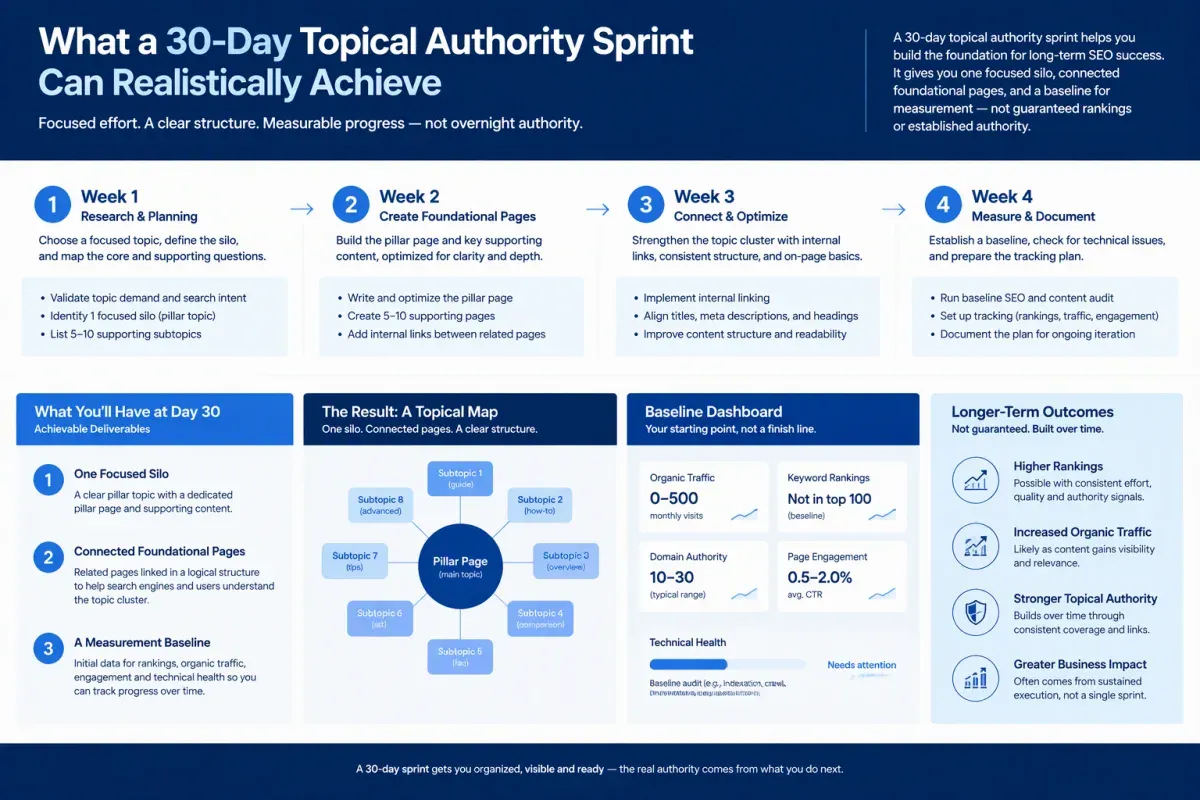
In 30 days, you can build a focused foundation and a measurement baseline for one silo. You can’t build established authority, guarantee rankings or promise a fixed traffic outcome. That’s the realistic answer to how to build topical authority in 30 days.
Authority compounds over months as coverage, internal links and external trust signals build up. New sites and competitive niches often need several sprints before visibility follows, so don’t plan around SEO rankings in 30 days. A 30-day topical authority plan works when it defines a narrow area, publishes its first connected pages and records the starting position.
The strategy behind the sprint lives in planning content around topical authority. This plan assumes that work and focuses on execution. Pick one audience and one micro-niche rather than an industry-wide goal. Programmatic SEO for early-stage B2B SaaS companies is a workable scope. SaaS SEO as a whole isn’t.
When you niche down for SEO, a narrow sub-topic keeps answers deeper and internal links more coherent. It also keeps the sprint away from low-intent pages that overlap existing content or cause cannibalization.
Here’s the sprint at a glance. Each done-check is a yes/no test your team can verify, not a traffic target.
| Week | Deliverable | Done-check |
|---|---|---|
| 1 | A locked Pillar > Hub > Branch > Resource map for one silo, with approved URL slugs | Does every planned page fit the hierarchy with an approved slug? |
| 2 | The pillar and first hub pages live | Are the pillar and every committed hub published and linked to each other? |
| 3 | Supporting pages live and linked to their parents | Does every live page link to its parent, with no orphans? |
| 4 | A baseline report and a prioritized next-sprint queue | Does the report record the baseline and give every gap an action? |
Match the baseline to the business objective. Organic traffic fits an awareness goal, while qualified leads, sales or AI search visibility may better reflect a commercial one. Impressions alone don’t show that authority is taking hold.
Site age changes where the month goes. If you need to build topical authority from scratch on a new domain, spend more of it validating the map and publishing foundational pages. An established site may need to optimize, consolidate or redirect competing pages inside the silo before adding new ones. Teams looking for how to build topical authority fast shouldn’t skip that cleanup.
When the month ends, the silo becomes the starting point for the 12-week execution playbook, which extends one sprint into a full quarter of execution.
Week 1: Scope and Lock Your Silo
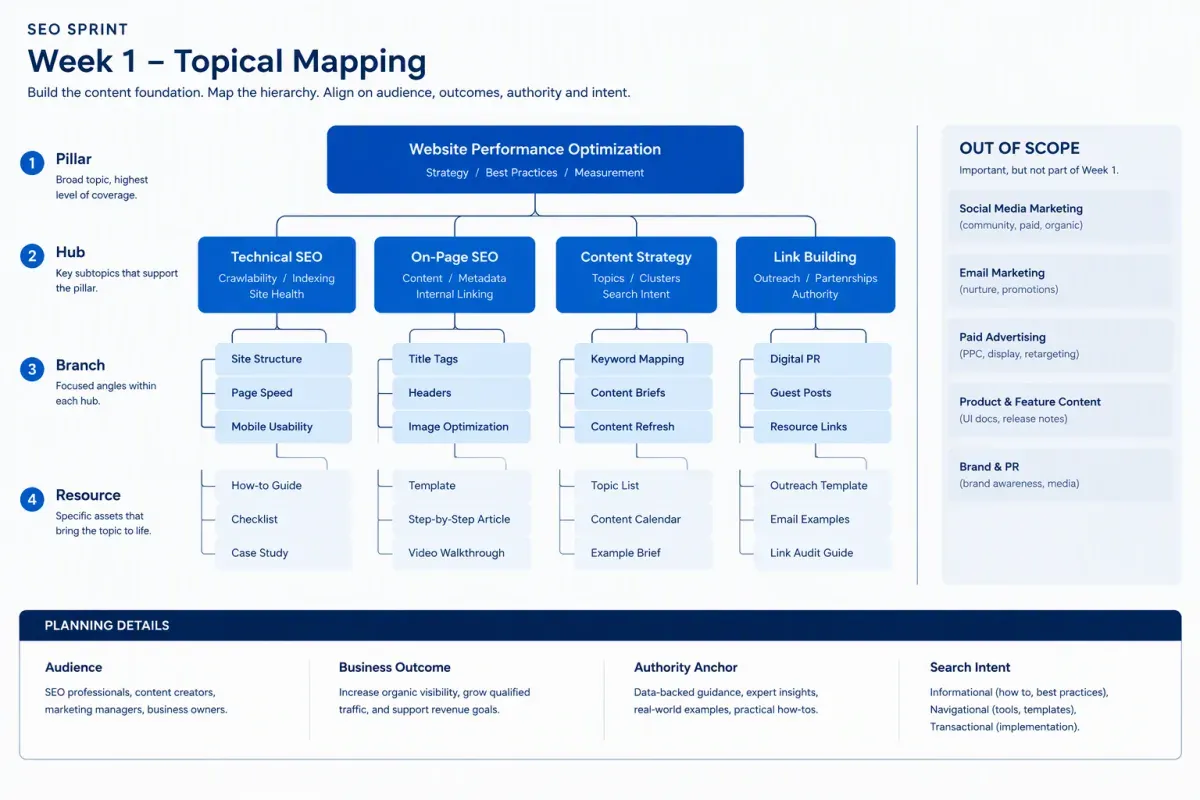
Week 1 turns one tightly bounded silo into an approved, locked publishing plan. Nothing gets drafted until the map is locked.
Start with a defined audience and one business outcome. Programmatic SEO for early-stage B2B SaaS is a workable focus. Name the adjacent subjects that will wait, such as technical SEO audits, link building, enterprise SEO, and product-led growth content.
A useful scope statement covers four things:
- Audience: the buyer persona and journey stage, such as an early-stage SaaS marketing lead assessing programmatic SEO.
- Business outcome: qualified leads, product adoption, organic traffic, or AI search visibility.
- Authority anchor: the narrow subject the site should become known for.
- Out-of-scope subjects: nearby topics that would dilute the queue.
Match ambition to the site you have. An SEO strategy for a new domain should target achievable, lower-competition gaps. Established sites can extend valuable coverage where they already have visibility. Publishing capacity matters too, because connected Resources strengthen a Hub and disconnected AI-generated pages rarely add depth.
Customer language should drive the research. Pull questions from sales calls, support tickets, reviews, Reddit threads, related searches, and People Also Ask results. Add competitor pages and query data from Ahrefs or Semrush. Then mark each candidate topic as missing, covered or overused on your site. This step is a short version of a topical content gap analysis, limited to the selected silo.
Next, build a topical map for SEO with a clear parent-child structure. In Floyi, Topical Research turns your core topic, brand context and personas into a four-level outline. The Topical Map then builds the Pillar > Hub > Branch > Resource hierarchy and validates it against SERP data. Each row carries a URL slug, page intent and internal linking guidance. Set coverage targets by Hub instead of chasing an article count.
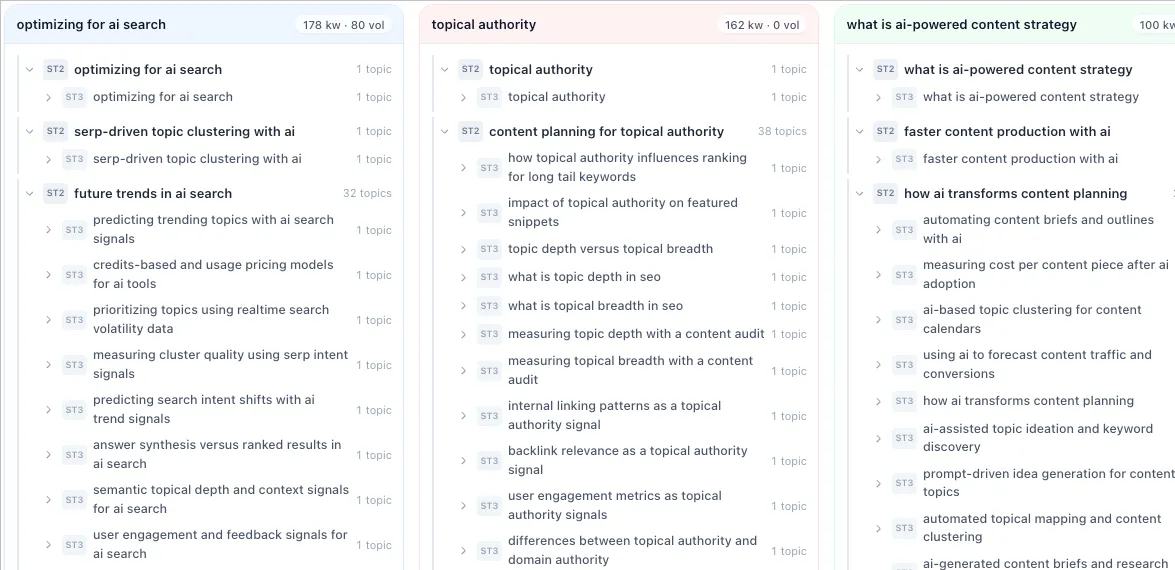
Keyword clustering should follow meaning and outcome, not shared words. Keep separate pages when queries need different formats, buyer stages or actions. Put queries that answer the same need on one Resource, even when the wording differs. That’s search intent optimization at the map stage, and it stops your topical authority content strategy from turning into a keyword list with competing pages.
To prioritize SEO topics inside the silo, score each remaining gap on these factors:
- Business value: support for the chosen outcome.
- Persona relevance: a problem and language specific to the reader.
- Intent strength: a clear content need behind the query.
- Competitive coverage: room for the site to build real depth.
- Production effort: the expertise, approvals and assets the page needs.
- Reusable assets: existing examples, product docs or research to draw on.
Then lock the map with a stopping rule. Reject any Resource with weak intent, a redundant job or too little Hub value to justify the cannibalization risk. Run the map’s hierarchy validation to catch orphaned rows, broken hierarchy chains and inconsistent topic names. Finalize URL slugs and parent-child paths, and export the map as XLSX, Google Sheets or Markdown if stakeholders sign off outside Floyi. Generate the Week 2 and Week 3 briefs from the locked topics in the Authority Planner, so each brief carries the map’s internal link and anchor text guidance.
Week 1 is done when:
- The silo has a written out-of-scope list.
- Every Resource has one primary intent and an approved URL slug.
- No two Resources target the same intent.
- The map passes validation with every parent-child path resolved.
- The Week 2 and Week 3 content production plan is fixed.
Week 2: Publish Your Pillar and Hubs
Week 2 ships the pillar and the first hub pages as a connected live set. Brief, draft, edit, and publish them from the locked map, starting with the hubs that close the largest audience and business-value gaps.
Give the pillar one clear job. It orients newcomers to the silo, frames its major questions and routes readers to deeper hubs through descriptive internal links. Good pillar page SEO comes from clarity and usefulness, not a word target, so the pillar shouldn’t try to absorb every sub-question.
Each content hub needs a distinct intent, a promised outcome and a boundary before it goes live. An SEO pillar might introduce keyword research, on-page SEO, indexing diagnosis, and organic traffic measurement, while each hub answers one of those questions in depth. That separation is what makes a pillar-cluster content strategy work, because it limits cannibalization between cluster pages.
Follow the locked map in this order:
- Brief and draft the pillar page.
- Pick hubs by coverage gap and business value, not by what’s easiest to write.
- Edit each page against its brief, audience, brand voice, and assigned intent.
- Publish the pillar and hubs together.
- Link the pillar to every live hub and each hub back to the pillar.
Set the SEO publishing schedule from your team’s real capacity for research, drafting, editing, and review, not from a ranking formula. As an example, a two-person team might commit to the pillar plus two hubs this week. A subject that needs original research, demos or expert input may justify fewer pages. One page that completes the reader’s task beats several thin summaries.
Intent should govern the final edit:
- Informational pages: answer the query directly with steps and concrete examples.
- Comparison pages: give decision criteria and real tradeoffs.
- Problem-solving pages: show likely causes, the diagnostic path and the fix.
A hub fails when it repeats the pillar’s overview instead of delivering the outcome it promised.
Differentiate the set with original content for SEO that competitors can’t reproduce by paraphrasing search results. First-hand experience, original data, a proprietary framework, custom diagrams, demos, or expert perspectives all qualify. Support factual claims with credible sources and cut repetitive AI filler. Clear headings and short passages make each page easier for readers and AI systems to quote accurately.
The Authority Planner keeps production tied to the approved map. It shows each topic’s outgoing internal links and incoming anchor text options, generates briefs and publishes to WordPress or GitHub. The full contextual linking pass belongs in Week 3.
Week 2 is done when:
- The pillar and every committed hub are live with canonical URLs.
- Each published URL is listed in the XML sitemap.
- Every page matches its approved brief and search intent.
- The pillar links to every live hub with descriptive anchors, and each hub links back.
Week 3: Ship Supporting Pages and Links
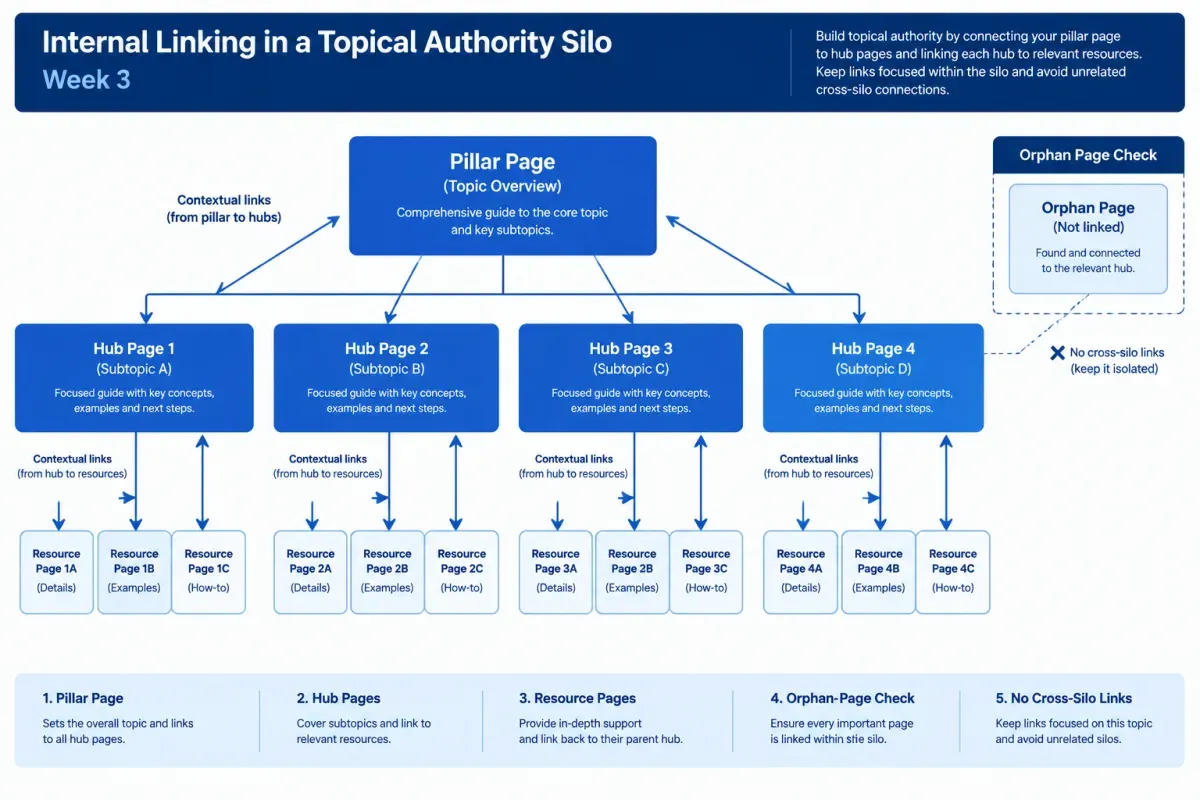
Week 3 publishes the supporting Resources that complete your selected hubs. Work only from the Week 1 map. Adjacent subjects wait for a later sprint, because authority builds through connected coverage, not through every keyword that looks promising.
Each supporting page should resolve one reader question the pillar or hub raises but doesn’t answer fully. That might be an edge case, a comparison, a common mistake, or a practitioner scenario. SEO topic clusters stay coherent when every page serves a separate need rather than a slight variation of an existing keyword.
Build each supporting-page brief in this order:
- Confirm distinct intent. Check that no existing page already answers the same primary question. A page on choosing a reporting cadence and a page on reporting content outcomes may share language, yet they support different decisions. Merge overlapping ideas or sharpen the angle before drafting.
- Lead with the answer. Put the recommended decision, method or framework near the top, so the reader doesn’t wade through background first.
- Ground it in a scenario. Use a compact situation from the parent hub: the reader’s problem, the recommended method, the likely tradeoff, and the next relevant Resource. An agency deciding whether two briefs target the same intent makes cannibalization easier to spot than a definition does.
- Add first-hand substance. Practitioner observations, demos, original data, diagrams, or expert input give readers and AI systems a reason to prefer your page over a paraphrase of what already ranks. Visible author experience supports E-E-A-T, but only when the content shows that experience.
A Resource earns its place by extending its parent, not repeating it.
Your internal linking strategy for topic clusters should guide readers, not meet a quota. Hub-and-spoke internal linking connects the pillar or hub to a Resource when the reader needs the next level of depth. Each Resource links back to its parent hub, and to a sibling only when that sibling continues the same task. Skip links to clusters in other silos during the sprint, so the silo’s structure stays clear.
Anchor text should say what the destination helps the reader do. “Resolve overlapping search intent” signals a useful outcome. “Learn more” doesn’t. The right link count depends on the page’s role and real relationships, and forced links make the structure harder to use.
Before publishing, check the routes readers and crawlers will follow:
- Parent route: every Resource links up to its parent hub, and the hub links to the pillar.
- Depth route: the pillar or hub links down to a Resource when it adds needed depth.
- Sibling route: cluster pages link only when they answer connected parts of the same task.
- Intent route: no two pages compete for the same need through minor keyword variations.
- Orphan check: every page gets at least one contextual link from inside the silo.
Mapped coverage is the stopping rule. A smaller set of connected Resources beats disconnected AI drafts or a rush to cover every adjacent phrase.
Week 3 is done when:
- Every scheduled Resource is live or moved to the next sprint with a written reason.
- Every live supporting page links to its parent hub.
- No page in the silo is orphaned.
- No two published pages target the same search intent.
Week 4: Measure, Fix and Plan the Next Sprint
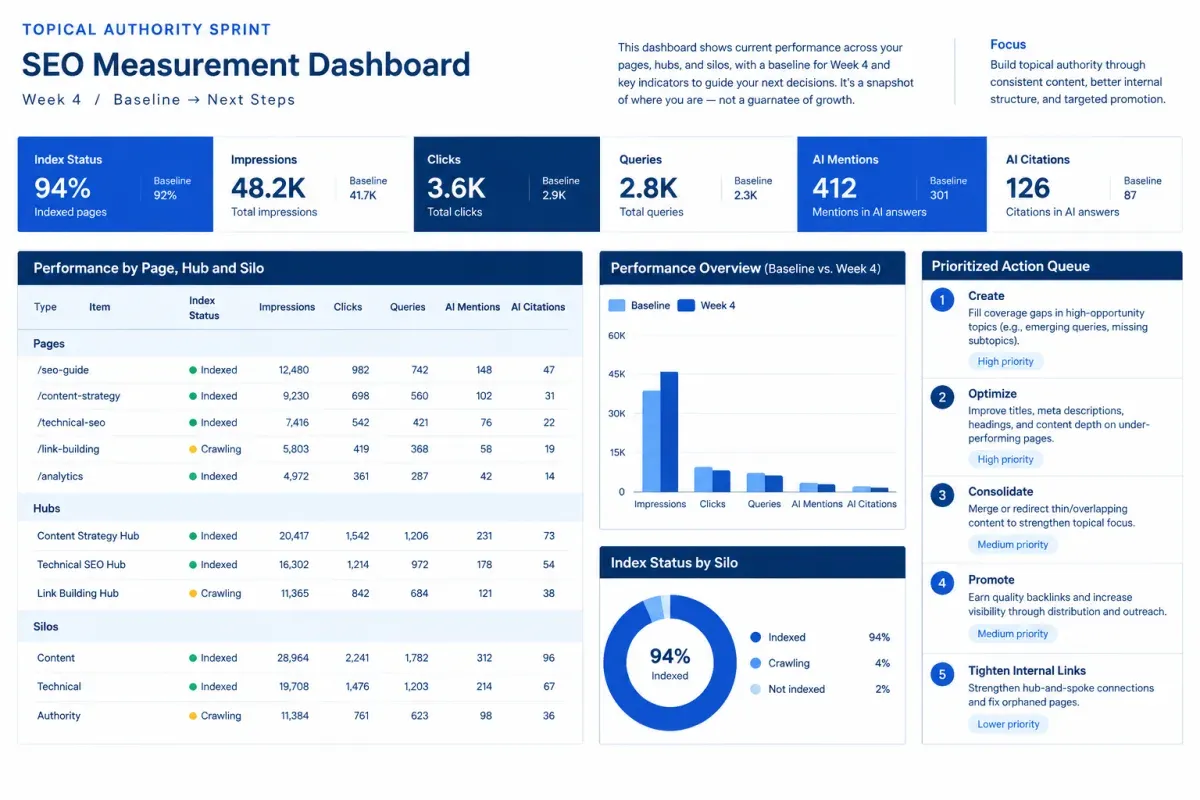
Week 4 turns the sprint into a baseline-and-decision checkpoint, not proof that authority is complete. Start by comparing every shipped URL against the approved topical map to find unshipped priorities, overlapping angles and subtopics that still need their own page.
Check technical readiness before judging performance. Confirm each canonical URL returns a successful response, is crawlable and indexable, appears in the XML sitemap, and is reachable through internal links and navigation. Check mobile usability and load speed too. Google’s Core Web Vitals guidance treats a Largest Contentful Paint of 2.5 seconds or less as good, which makes it a useful diagnostic target. Then submit the updated sitemap in Google Search Console.
Your SEO baseline metrics should separate new URLs from refreshed legacy content and track results by page, hub and silo:
- Record coverage. Capture index status, impressions, clicks, click-through rate, and the queries generating visibility.
- Read early signals carefully. Rising impressions and broader query coverage suggest Google is finding and testing the content. Zero impressions can point to indexing, internal-link, relevance, or demand problems.
- Check AI visibility. Run the same set of micro-niche prompts built from audience questions. Record whether the brand or page is cited, mentioned without a citation or absent.
- Compare language. Check whether the query wording matches your keyword and topic mapping. A mismatch can mean the page covers a related topic but misses the searcher’s framing.
None of these signals confirms durable rankings, traffic or topical authority after one month. Keep AI mentions, AI citations and Google clicks as separate topical authority KPIs in the report.
Quick wins should come from observed evidence, not a generic on-page SEO checklist. High impressions with a weak click-through rate call for a sharper title and meta description. Adjacent or unintended queries usually mean the opening answer, headings or incomplete sections need work. Add a definition, procedure, comparison, or evidence only when it strengthens the page’s assigned role. Don’t commission another article when the proposed topic repeats existing intent.
Weak-signal pages need a diagnosis before more content enters the queue. Look for orphaned URLs, cannibalization and gaps between the map and searchers’ language. If coverage is strong but visibility stalls in a competitive space, more posts won’t fix it. Point relevant backlinks, mentions, partnerships, and distribution at the pillar and the highest-value hub instead.
Floyi’s Organic Audit maps Search Console queries to the topics on your map. Its By Page view shows cannibalization, misattributed pages and orphaned traffic. The Visual Map colors each topic by AI search presence: cited, mentioned or not present. The Authority Planner turns Scorecard signals into a prioritized execution plan and generates the next sprint’s briefs.
Score each uncovered subtopic on business value, persona relevance, search intent, production effort, existing assets, and observed performance. Give each one action: create, optimize, consolidate, promote, or tighten internal links. Stop when a proposed page duplicates existing intent, because content bloat weakens the silo.
Week 4 is done when the baseline report records index status, impressions, clicks, queries, AI mentions, and AI citations by page and hub. Every weak or unshipped priority has an action, and the next queue is approved.
Before you plan the next sprint, score your silo’s topical authority in Floyi and let the coverage and visibility gaps set the queue.
30-Day Topical Authority Sprint FAQs
These questions cover scope, pacing, measurement, and stakeholder reporting for a 30-day SEO sprint, with realistic expectations for what the first month can show.
1. Can New Websites Build Topical Authority in 30 Days?
A new website can make real progress in 30 days, but it can’t claim established topical authority or guaranteed rankings after one sprint. Use the month to set a clean baseline, publish one focused hub and track indexing and impressions. Impressions signal visibility, not authority.
Build depth inside one narrow topic through an authority anchor, supporting pages and contextual internal links. Complete answers to related long-tail questions matter more than a high post count. For a new domain or a competitive market, the SEO results timeline usually spans several sprints of coverage, trust and mentions.
2. How Many Pages Should a 30-Day Sprint Ship?
Ship only the pillar, hubs and Resources your team can research, write, edit, and review against approved briefs within four weeks. How many articles to publish for SEO is a capacity decision, not a ranking formula. Complete coverage of each chosen hub matters more than output. Hold redundant, low-intent or cannibalization-prone ideas for the next sprint instead of publishing filler.
3. What If You Fall Behind During the Sprint?
Protect the sequence, not the calendar. Lock the Week 1 map before drafting, and keep the pillar and first hubs in scope if production slips. Move lower-priority Resources into the next sprint’s queue with a short reason instead of publishing thin pages or skipping editorial review.
Still run Week 4. Capture index status, queries, impressions, internal-link status, technical issues, and content gaps so the next queue starts from evidence, not guesses.
4. What Should You Report to Stakeholders After 30 Days?
Report the topical scope, the shipped work and the baseline, not a claim of authority or a ranking forecast. Include priority-page index status plus impressions and queries from Search Console. Add early clicks where demand allows, internal-link completion and AI mentions or citations for the prompt set. Impressions show that Google found the pages, not that authority exists. Close with the next sprint’s prioritized queue, since authority compounds over months of sustained coverage, sound internal links and external trust signals.
About the author

Yoyao Hsueh
Yoyao Hsueh is the founder and CEO of Floyi, the topical authority platform, and the founder of Main Heading, an SEO and AI search agency. He is an expert in topical authority and topical mapping. He created Topical Maps Unlocked, a course studied by thousands of SEOs, content strategists and digital marketers, founded TopicalMap.com, a done-for-you topical mapping service for agencies and enterprise teams, and publishes the weekly Digital Surfer newsletter on SEO, content strategy and AI search.
About Floyi
Floyi is a closed loop system for strategic content. It connects brand foundations, audience insights, topical research, maps, briefs, and publishing so every new article builds real topical authority.
See the Floyi workflow