AI Search vs. Traditional Search: What Changes for Publishers
AI search writes an answer while traditional search ranks links. See what changes for publishers in queries, click paths, citations, and what stays the same.
A first-place organic result and an AI citation aren’t the same thing. Traditional search asks the searcher to choose a ranked link. AI search assembles an answer from retrieved material and may cite a supporting page or simply name a brand.
That changes what visibility means before anyone visits. Search Console still shows rankings, impressions, clicks, and click-through rate, but it can’t show whether an AI answer named your brand. The differences between AI search and traditional search come down to five things: output, query, click path, what earns visibility, and how you measure it.
Strong pages remain the shared foundation. Clear answers, accurate facts, descriptive internal links, and complete topical coverage help a page compete in the SERP and give AI systems material to retrieve.
AI Search vs. Traditional Search Key Takeaways
- Traditional search ranks pages, while AI search writes synthesized answers from retrieved sources.
- A brand mention and an AI citation are separate signals, so count them separately.
- AI answers can settle a need without a click, which changes why people open a cited page.
- One conversational prompt can carry Informational, Commercial, Transactional, and Generative intent at once.
- Google says AI Overviews and AI Mode need no special optimization or schema markup.
- Search Console still measures ranked results, but it doesn’t separate AI features or show unlinked mentions.
- Crawlable, accurate, well-structured pages serve both search experiences.
What Is the Difference Between AI Search and Traditional Search?
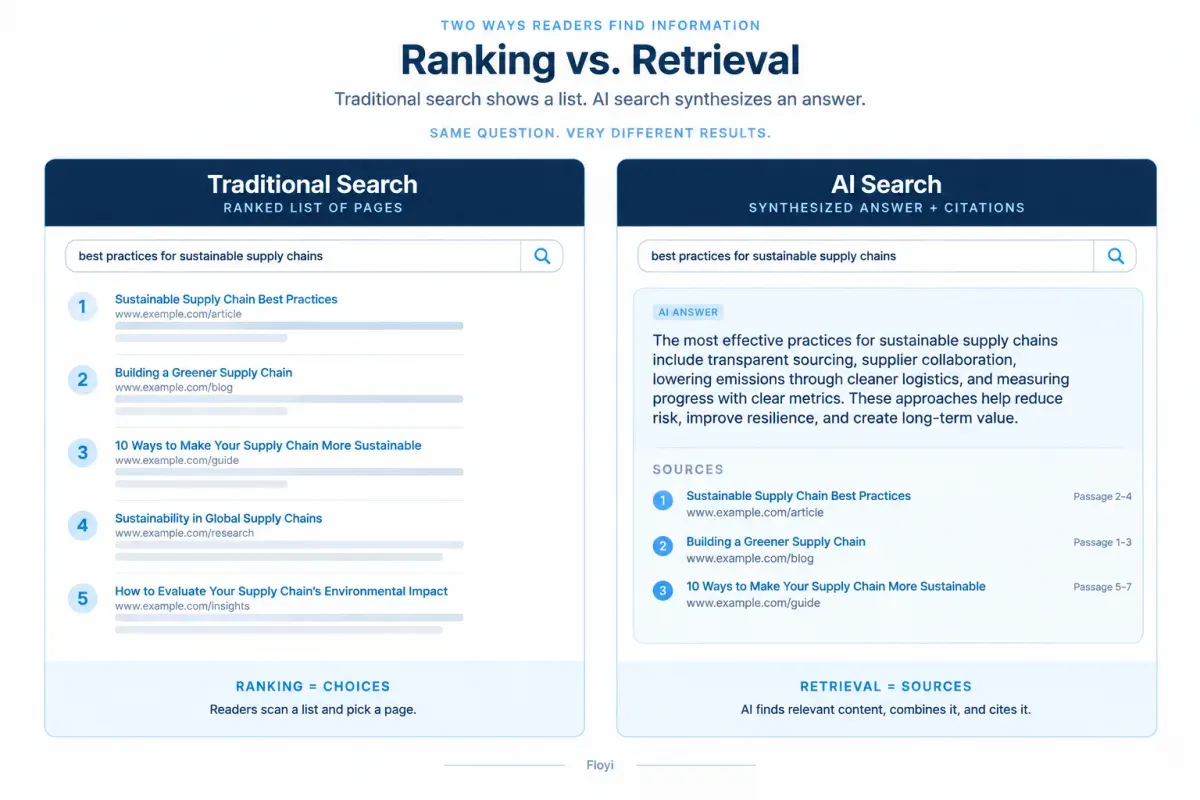
Traditional search ranks pages for you to open and compare. AI search reads sources for you and writes a synthesized answer, often with citations. The searcher’s job shifts from picking sources to checking the answer and what supports it.
For publishers, traditional search is a results page of ranked links. Titles, snippets, ads, and SERP features compete for attention. Visibility means a position that a searcher can see and click.
AI search treats the query as a full question. The engine retrieves pages or passages, writes the answer in its own words and may name a brand, cite a source or link to a page it used. Here visibility means being inside the answer, not only sitting in the list below it.
The two aren’t separate worlds. A Google AI Overview appears on the regular results page, and Google AI Mode runs inside Google Search. Google’s guidance on AI features says a page must be indexed and eligible to show in Search with a snippet to appear as a supporting link. Other AI search engines also cite and link to the web sources they draw on.
The mechanics behind relevance are covered in how AI changes search algorithms. For publishers, the practical distinction is simpler. Traditional search makes you earn a click from a ranked result. AI search makes you earn a place in the answer and, where the engine shows them, its citations.
AI Search vs. Traditional Search Side by Side
The central difference in AI search vs traditional search is who assembles the answer. In one, the searcher compares sources. In the other, the engine does much of that work. This AI search comparison table sets the two side by side.
| Dimension | Traditional search | AI search |
|---|---|---|
| Output | Ranked links, snippets, ads, and SERP features | A synthesized answer, often with inline citations or source links |
| Query | Often short keyword phrases | Often conversational prompts with constraints |
| Interaction | A new search refines the request | Follow-up questions continue the thread, and some engines run related sub-queries |
| Click path | The searcher picks a result and visits it | The answer may settle the need before any click |
| Source visibility | Each result shows its domain, and ads are labeled | Sources sit beside or inside the answer, and brands can be named without a link |
| What wins | A page earns a ranked position | A passage gets retrieved and cited, or the brand gets named |
| Measurement | Rankings, impressions, clicks, and CTR in Search Console | Mentions, AI citations and share of voice across a query set |
| Best for | Specific sites, official pages, local listings, and original sources | Explanations, comparisons and multi-part questions |
Most rows trace back to that one shift. When the engine combines sources into a single response, the searcher does less comparison work. The cited original then carries more weight whenever a claim matters.
Your target changes with it. A page still needs to rank in traditional search. It also needs clear, supportable passages that an engine can retrieve and use in its answer.
Treat these as typical patterns, not fixed rules. One Google results page can mix ads, SERP features, ranked links, and an AI-generated answer. AI answers also vary by engine, prompt wording and conversation context. Use the table to keep click performance and answer-level visibility apart when you review results.
How Do Conversational Prompts Change the Query?
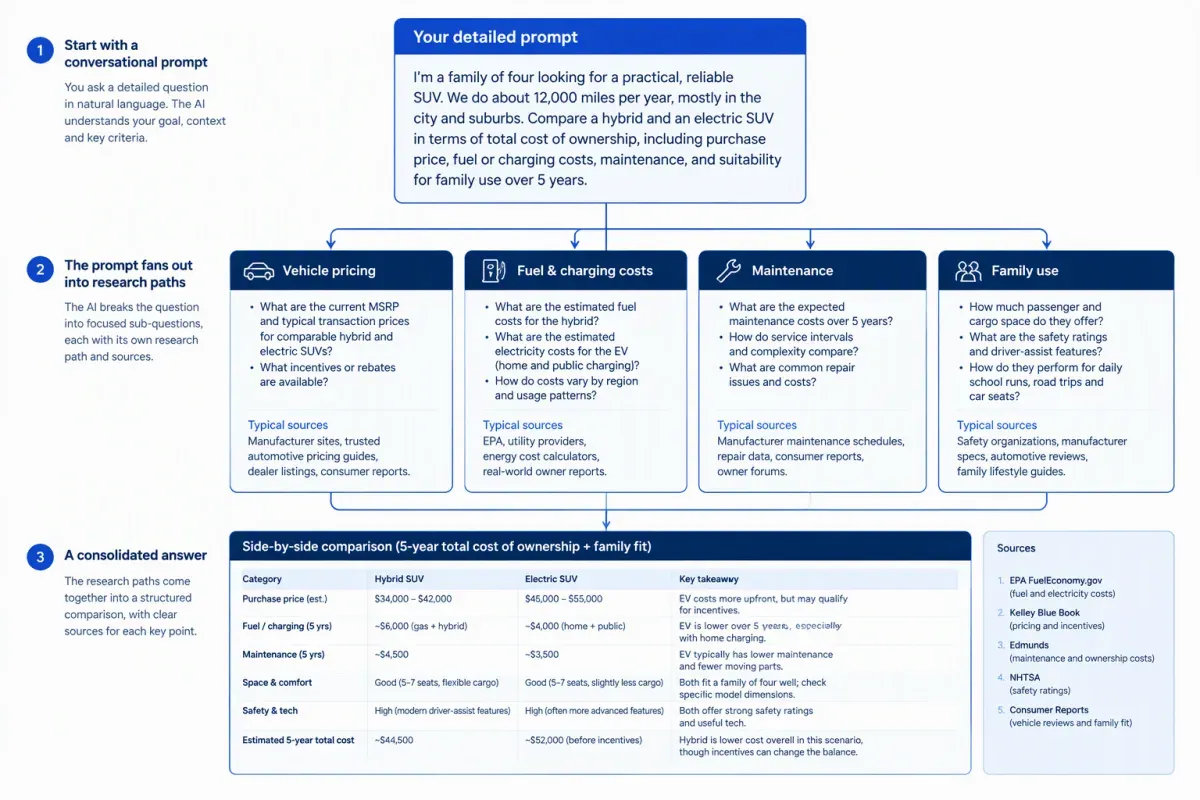
Conversational prompts give an AI system more decision context than a keyword string, and that changes which pages it can retrieve and combine into an answer.
A keyword search such as “electric car vs gas car cost” names a broad comparison. A conversational prompt might ask, “For a family that drives a lot, which costs less to own over five years: an electric car or a gas car? Put the comparison in a table.” The prompt names the audience and a usage pattern. It also sets a time frame and asks for a format. Those details shape the sub-questions the system has to answer.
| Input type | Example | What the search system learns |
|---|---|---|
| Keyword search | Electric car vs gas car cost | A general ownership-cost comparison |
| Conversational prompt | For a family that drives a lot, which costs less to own over five years: an electric car or a gas car? Put the comparison in a table. | Audience, driving pattern, time horizon, comparison need, and output format |
Multi-turn AI search prompts narrow the work further without a separate search. A user may add, “Only include models within our budget,” then ask, “Include maintenance costs too.” In AI search, each follow-up question targets a narrower part of the decision instead of restarting the comparison.
Query fan-out helps generative AI search handle prompts with several moving parts. Google describes it as issuing multiple related searches across subtopics and data sources to build a response. One cost table may cite different pages for vehicle pricing, charging or fuel costs, maintenance, and family-use considerations.
That matters for publishers. A page can answer one sub-question inside a larger prompt even when it would never rank for the full prompt as a keyword. A thorough page on electric-vehicle maintenance costs, for example, can support a broader ownership comparison. Pages built around one exact-match phrase give an engine less to retrieve than pages that address a defined need with clear conditions, entities and complete explanations.
Search intent still guides content planning, though conversational prompts often combine several intents:
- Informational: The searcher wants to learn what affects vehicle ownership costs.
- Navigational: The searcher wants to reach a known brand, product or destination.
- Commercial: The searcher is weighing options before a possible purchase.
- Transactional: The searcher intends to act, such as locating a dealer or configuring a vehicle.
- Generative: The searcher wants the AI system to create an output, such as a five-year cost table.
One prompt can carry Commercial, Transactional and Generative intent at the same time. Plan content around the individual questions behind the larger decision, not only the headline query.
What Changes in the Click Path?
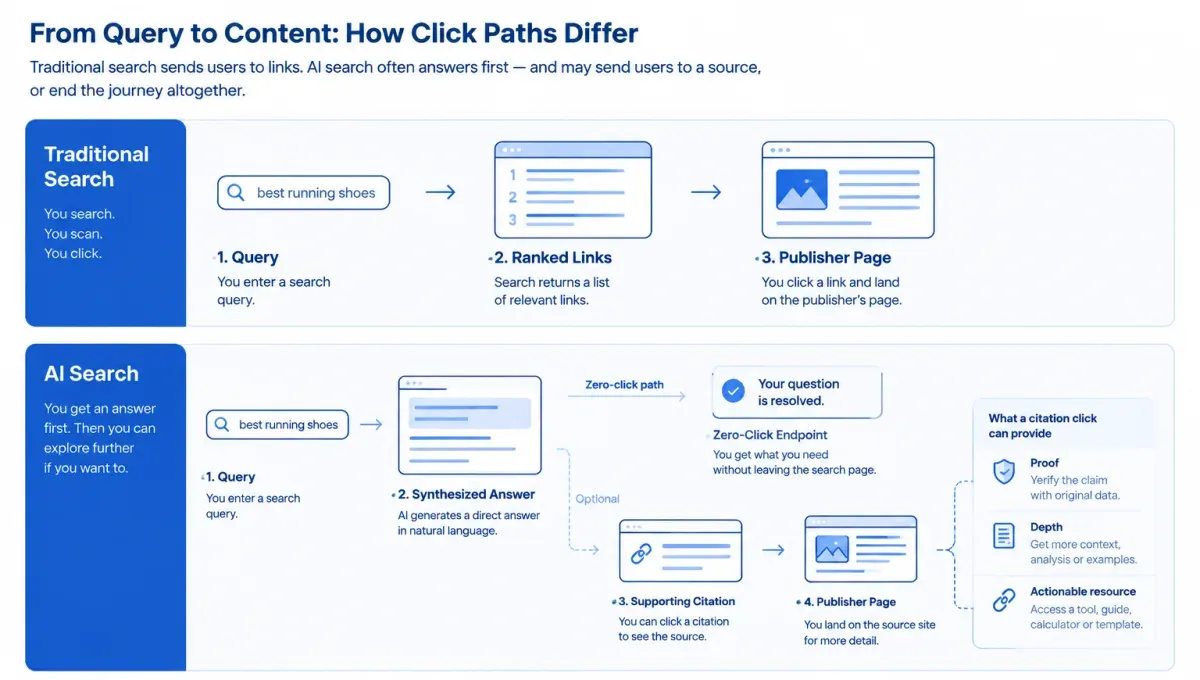
AI search can settle a question before anyone visits a site. In traditional search, the click comes first. Ads and organic results appear as separate options. Ranked links show which domains compete, and searchers scan titles and snippets before picking one. The publisher’s page gets the first real chance to answer.
AI search changes that order. An AI-generated search response puts synthesized text first and supporting links second. A simple need can end right there as a zero-click search.
A citation click often serves a different purpose than a traditional search click. Readers who open a cited source have usually seen the basic explanation already. They want something the summary couldn’t give them:
- Proof: Evidence behind a claim, such as methodology, original reporting or a source document.
- Depth: Nuance, exceptions, comparisons, and the detail needed to decide with confidence.
- Action: A calculator, template, product page, workflow, or a specific next step.
That doesn’t make AI search traffic better or worse than traffic from traditional search. Review engagement and conversions in your own analytics by entry page and query intent. A cited guide may attract someone verifying a claim, while a ranked product page may reach someone comparing options. Each visit has a different job, so judge performance in that context.
Visibility can also happen without a visit. An AI answer may name your brand without a link, or cite a page the reader never opens. That exposure can build awareness, but site analytics won’t record it.
Your pages still need to answer questions directly. The new click path favors material that goes beyond a summary, so give readers a concrete reason to visit: original data, worked examples, decision detail, useful tools, or reusable templates.
What Earns Visibility: Ranking vs. Retrieval and Citation
Traditional search rewards a page with a position in a ranked list. AI search visibility depends on whether an engine retrieves a passage, uses it in an answer, cites its source, or names your brand.
In a traditional SERP, one URL competes for one visible slot. Higher organic results appear first, and ads stay labeled apart from organic listings. AI-generated answers put synthesized text first, sometimes with source links that get less visual weight. Searchers get a quick synthesis, and fewer of them may need to visit the publishers behind it.
| Search experience | Unit of competition | What the searcher sees |
|---|---|---|
| Traditional search | A page competing for rank | A list of links, with higher positions seen first |
| AI search | Retrieved passages and source candidates | A synthesized answer that may cite several pages, name brands or do neither |
AI search engines can retrieve several pages or passages for one response. An answer may draw on one source while linking to another, and some contributing sources get no visible citation. Engines don’t publish complete citation rules, so treat these as observed behaviors, not a formula.
Two forms of visibility need separate measurement:
- Mention: The answer names your brand, product or organization without linking to a page.
- Citation: The answer links to one of your pages as a supporting source.
A brand can be mentioned without earning AI search citations, and a page can be cited without a prominent brand mention. Keeping the two apart shows whether an engine recognizes your brand, relies on a specific page or does both.
Ranking still matters. Google says SEO best practices still apply to its AI features, but a top position doesn’t guarantee a citation.
SEO for AI search visibility, often called AI search optimization, builds on traditional SEO instead of replacing it. Build topical coverage around the specific sub-questions your audience asks, so your site holds clear passages worth retrieving while each page stays strong enough to compete in the standard SERP.
How Does Measurement Change?
Measurement adds a layer instead of starting over. Rankings, impressions, clicks, and CTR in Search Console still show how your pages perform in ranked results. Google reports AI Overviews and AI Mode traffic inside the Performance report’s Web search type, mixed with regular results, and Search Console can’t show a brand mention that came without a link.
AI search visibility adds three answer-level signals: brand mentions, AI citations and AI search share of voice. Share of voice is how often you appear compared with competitors across the same set of queries.
These signals won’t always line up with rankings or sessions, because a zero-click answer can name your brand without producing a visit. Report them next to organic performance instead of blending everything into one score.
What Stays the Same for Discoverability?
Both systems still depend on pages they can reach, read and interpret. Crawlable pages, indexable content, accurate facts, descriptive internal links, helpful content, and clear topical coverage give either one reliable material to surface. That’s the same technical SEO and content work you already do.
Google says so directly. Its Search Central guidance states there are no additional technical requirements to appear in AI Overviews or AI Mode, and no special schema.org structured data to add. That doesn’t make structured data pointless. Other search engines and AI systems can read schema.org markup, and in classic results it can still support eligible SERP features when it matches the visible page.
So you don’t need two content strategies. Start with real audience questions and answer each one early, then back it with evidence, examples and depth that a short summary can’t replace. A thin page states a conclusion. A useful page shows why it holds, where it changes and what the reader can do next. Direct section openings, definitions, comparison tables, and sourced claims make passages easier to extract. In competitive topics, depth still doesn’t replace links, reputation and other trust signals.
Searchers haven’t abandoned ranked results either. Many use both: an AI answer for orientation, then ranked results to reach an official page, a local listing, the original study, or several independent perspectives before they act. A page still has to work as a ranked destination and as a source worth citing.
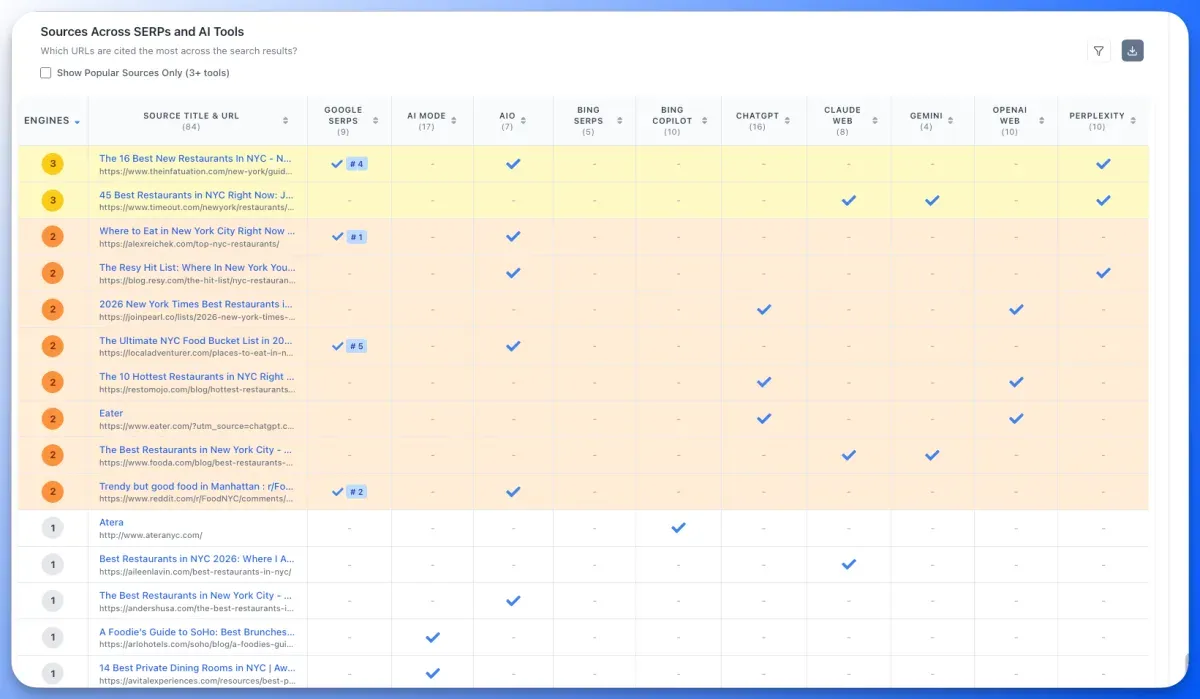
To see the difference on a real query, pick a priority query from your plan and run it through AIRS Analyzer. It’s an on-demand, per-query analysis across 11 surfaces: nine AI engines plus Google and Bing SERPs. The report keeps brands that are named apart from pages that are cited, and its Source Comparison view lists AI citations separately from organic rankings.
AI Search vs. Traditional Search FAQs
These questions cover where AI Overviews fit, how far to trust AI answers, local searches, and how current AI search results are.
1. Is an AI Overview AI Search or Traditional Search?
Both. A Google AI Overview is an AI-generated summary shown on Google’s regular results page, with links to supporting pages and ranked results alongside it. For publishers, one query can earn a ranking, an AI Overview citation, both, or neither, so check both placements on the same results page.
Google AI Mode is different. It’s a separate mode in Google Search built for exploration, follow-up questions and complex comparisons.
2. Is AI Search Less Reliable Than Traditional Search?
Not inherently, but it works best as a synthesis layer, not a substitute for checking sources. AI search accuracy depends on what the engine retrieves. Generated answers can still drop qualifiers, misread content or state an inaccurate fact with confidence.
Use AI search to orient yourself, then open the cited pages before you act on a consequential claim. Original publishers, primary data, official documentation, and expert sources let you judge accuracy, scope and recency.
3. Which Search Works Better for Local Results?
Traditional search is the better starting point for Navigational local needs: a business’s official site, address, hours, phone number, directions, and current listings. Ranked results also link straight to independent local sources.
AI search can pull options together for broader Commercial questions, like comparing nearby services against several requirements. Treat its answer as a shortlist, then confirm availability, hours and location on the business’s own page or a current listing.
4. Does AI Search Use Current Web Information?
Often, yes. Many AI search engines retrieve live web pages before they answer, but the synthesized answer can still miss the newest or most complete reporting. Google AI Overviews and AI Mode show supporting links, and those citations are a starting point for verification. Open each cited page, check its publish or update date and confirm it supports the exact claim. For fast-changing or consequential topics, use traditional search to find the original or newer sources.
About the author

Yoyao Hsueh
Yoyao Hsueh is the founder and CEO of Floyi, the topical authority platform, and the founder of Main Heading, an SEO and AI search agency. He is an expert in topical authority and topical mapping. He created Topical Maps Unlocked, a course studied by thousands of SEOs, content strategists and digital marketers, founded TopicalMap.com, a done-for-you topical mapping service for agencies and enterprise teams, and publishes the weekly Digital Surfer newsletter on SEO, content strategy and AI search.
About Floyi
Floyi is a closed loop system for strategic content. It connects brand foundations, audience insights, topical research, maps, briefs, and publishing so every new article builds real topical authority.
See the Floyi workflow