
Most AI tools talk about speed, convenience, or “unlimited words.”
But none of that tells a content team what they actually need to know:
What does it cost to publish one article?
Not generate a draft.
Publish.
That number is where budgets break or scale.
Across every team we spoke with and every dataset we analyzed, one insight kept appearing:
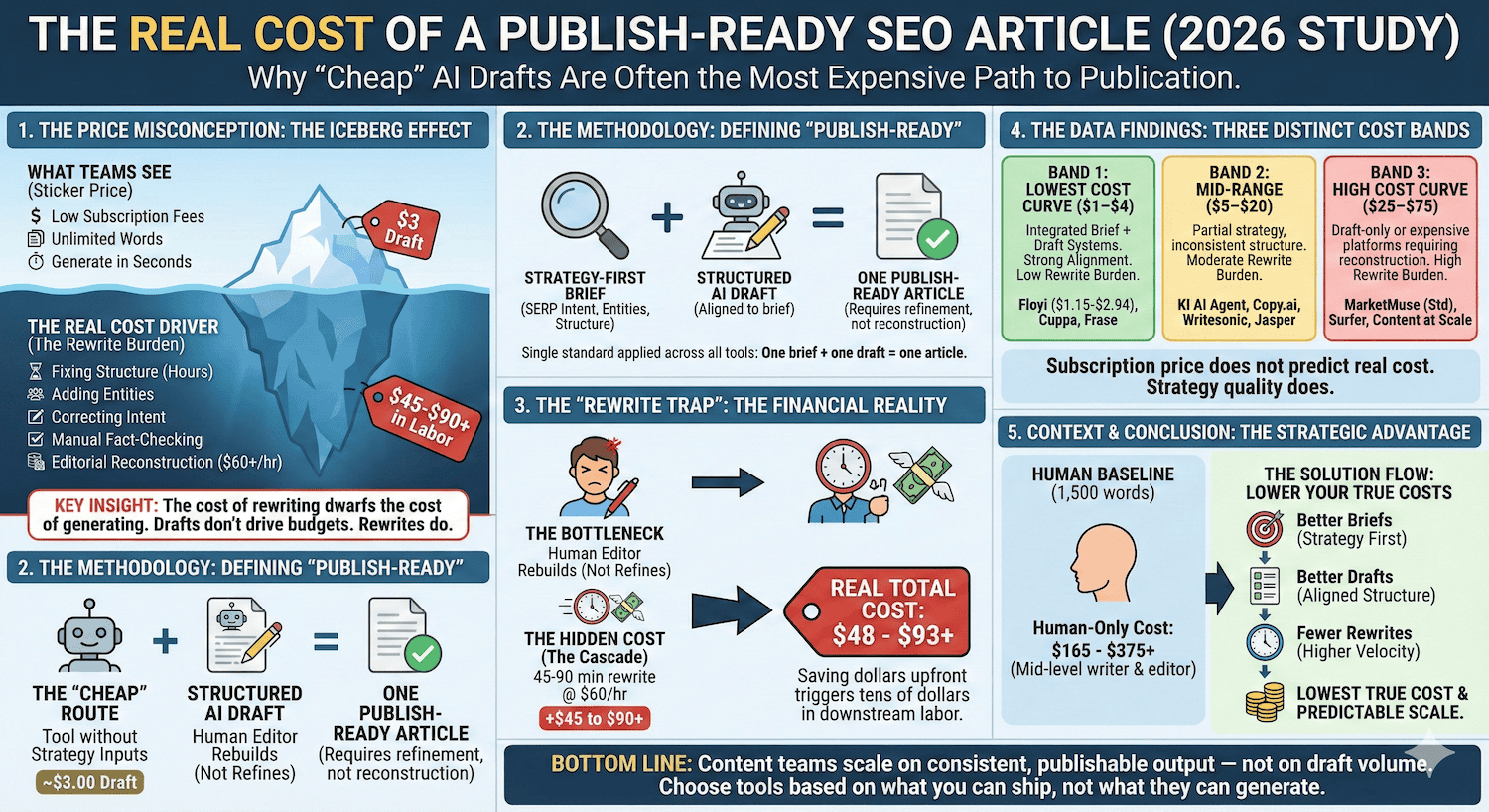
The cost of rewriting dwarfs the cost of generating. This rewrite burden is the thesis behind every number in this study.
Yet most comparisons in the industry still measure tools by outputs instead of outcomes.
Draft volume, token counts, and feature lists don’t predict cost.
Rewrite burden does.
This study uses a single, consistent definition across every tool — including Floyi:
One brief plus one draft equals one publish-ready article.
By applying the same methodology to every platform in the dataset, we can finally see the real cost curve of modern content creation—and why many “cheap” tools end up being the most expensive once editing begins. This research is part of a broader closed-loop content system where every brief, draft, and publish feeds back into the topics and authority that matter.
This article gives teams, strategists, and content leaders the clarity to choose tools based on what they can ship, not what they can generate.
Key Takeaways
- Publish-ready output is the only metric that predicts true cost.
- Drafts don’t drive budgets. Rewrites do.
- A 30-minute rewrite costs more than most monthly subscriptions.
- Tools built for generation behave differently from tools built for publishing.
- Generators optimize for speed.
- Systems optimize for structure, alignment, and reduced rewrite cycles.
- Strong briefs lower total article cost more than any other factor.
- Better briefs → better drafts → fewer rewrites → lower cost.
- Cheap drafts often become the most expensive articles.
- Saving three dollars upfront can trigger forty dollars in editorial labor.
- Integrated brief + draft workflows consistently produce the lowest cost curve.
- Strategy-first inputs reduce reconstruction and increase publishing velocity.
- Predictability is as valuable as price.
- Content teams scale on consistent, publishable output — not on draft volume.
- The methodology matters.
- All findings reflect the same publish-ready definition and reproducible cost-per-article calculation across every tool evaluated.
1. Why Most AI Tool Comparisons Mislead Content Teams
Most comparisons in the AI content space are built on the wrong scoreboard.
They line up features, model counts, and generation speed as if those metrics determine the real cost of getting content out the door.
They don’t.
Teams don’t pay for drafts. They pay for rewrites.
And rewrites are where the money disappears.
You’ve seen this pattern before.
The draft looks acceptable at first glance. Then you read it closely.
Intent drifts. Structure is thin. Entities are missing.
A “two-dollar article” becomes a ninety-dollar editorial project.
Cheap tools often produce the most expensive content because every shortcut taken at the beginning compounds when humans have to fix the gaps.
Brief tools have their own blind spot.
- They stop at the outline.
- They skip competitor context
- They skip persona insights
- They skip internal linking
- They skip topical strategy
Teams end up rebuilding the research manually, before writing even begins.
The industry measures tools by outputs.
Professionals measure them by outcomes.
That gap is why most comparisons mislead teams.
The Rewrite Curve
graph LR classDef default fill:#fff,stroke:#333,stroke-width:1px,color:#333; linkStyle default stroke:#333,stroke-width:1px; A["Cheap Draft"] --> B["Missing Context"] B --> C["Structural Fixes"] C --> D["Entity Rewrites"] D --> E["Editorial Overhaul"] E --> F["High Total Cost"]When strategy is missing upfront, each missing layer compounds and increases the real cost per article.
Research Methodology Snapshot
This report applies a single publish-ready standard and a reproducible cost-per-article model across every tool in the dataset.
One article is defined as one brief + one draft that meets the publish-ready benchmark.
- Only outputs that require minimal rewriting are counted as publishable articles.
Subscription fees, usage-based costs, and normalized editorial rewrite time are combined into a single cost-per-article number.
2. What Counts as a Publish-Ready SEO Article
To compare tools honestly, you need a consistent definition. Not “good enough.” Not “AI-assisted.” A definition that reflects how modern editors, SEOs, and content leads actually work.
A publish-ready article is one an editor can refine, not rebuild.
It preserves strategy, protects velocity, and avoids the rewrite spiral. In an era of fragmented AI search platforms, publish-ready content is the only standard that predicts topical authority.
A publish-ready article includes:
- A brief tied to real search intent
- A structured draft that aligns with SERP patterns
- Entity depth suitable for SEO and AI evaluation
- Internal linking cues and clear section-level objectives
A publish-ready article excludes:
- Generic GPT dumps with no strategic backbone
- Outlines pretending to be briefs
- Drafts that require a full rewrite
- Tools that skip competitor, persona, or topical context entirely
The Publish-Ready Standard
When the right inputs flow into the brief, the editor receives a draft that accelerates publishing instead of delaying it.
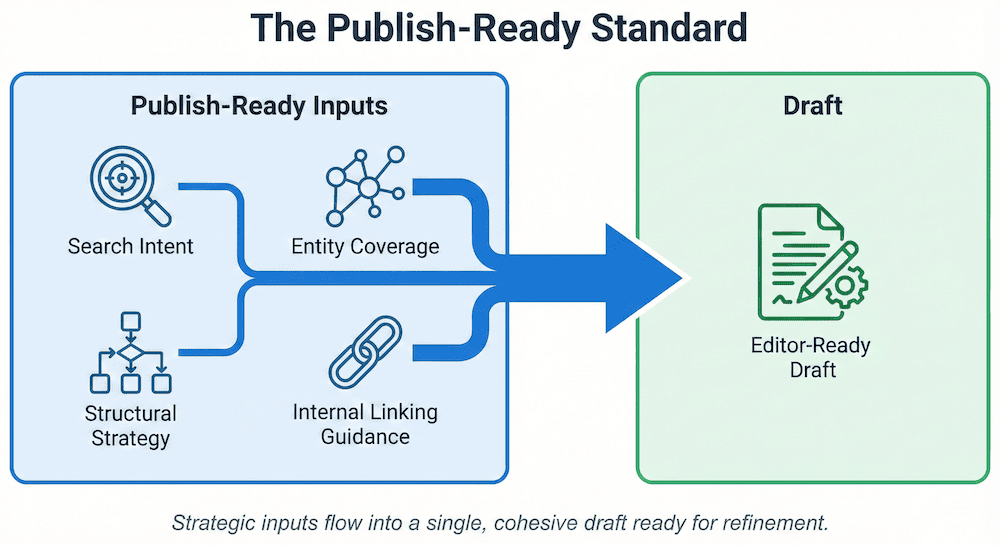
This is the standard used across every tool in our analysis.The same expectations. The same criteria. The same definition of “publish-ready,” regardless of which platform produced the output.
Only with a consistent standard can we calculate the real cost per article — the number that determines ROI, velocity, and workflow efficiency for every content team.
3. Our Methodology: How We Calculated True Cost Per Article
Every tool in this study was evaluated using the same standard and the same workflow. The goal was simple: measure the real cost of producing a publish-ready article, not the cost of generating text.
This methodology removes bias, removes feature-driven comparisons, and focuses entirely on outcomes.
The Core Principles
Our analysis followed four principles:
-
One article = one brief + one draft: A publish-ready article requires both researched structure and a complete draft aligned to it.
-
Use the lowest viable plan that supports a full content workflow: If a plan did not include briefs, drafts, or SERP context needed for publish-ready content, it was excluded.
-
Account for all usage-based costs: Credit usage, token charges, and BYOK (bring-your-own-key) model fees were included when applicable.
-
Divide monthly cost by the number of usable articles: Not the number of generated outputs — the number of publish-ready outputs a plan can realistically produce.
This ensures the comparison reflects operational reality instead of claims.
The Methodology Pipeline
flowchart LR A["Pricing and Plan Limits"] --> B["Brief Capability"] B --> C["Draft Capability"] C --> D["Usage-Based Costs"] D --> E["Publish-Ready Standard Applied"] E --> F["Usable Articles per Month"] F --> G["Cost per Article"]Each tool’s cost flows through the same pipeline, ensuring every calculation reflects the work required to produce a publish-ready article.
The Calculation Model
Every tool was measured using the following formula:
Cost per Article =(Total Monthly Cost + Usage-Based Costs)÷Number of Publish-Ready Articles the Plan Can ProduceThis formula exposes the difference between cheap-to-generate and cheap-to-publish. Many tools perform well in the first category. Only a few perform well in both.
Cost-Per-Article Formula Breakdown
flowchart TD    A["Plan Price"] --> D["Total Monthly Cost"]    B["Credit or Token Usage"] --> D    C["BYOK Fees"] --> D
    D --> E["Divide by Usable Articles"]    E --> F["Cost per Publish-Ready Article"]
A tool’s subscription cost is only part of the equation. Publishable output — not raw output — determines real ROI.
Data Sources
We used:
- Public pricing pages
- Tool documentation
- Credit tables and token estimates
- BYOK model pricing (where applicable)
All calculations were anchored to the publish-ready definition established in Section 2. No tool was evaluated using custom criteria or platform-specific advantages.
This creates a fair and reproducible basis for comparing tools across the market.
Why This Matters
Many pricing comparisons tell you how many drafts a tool can spit out. This methodology tells you how many articles you can actually ship.
That’s the metric content teams budget against. That’s the metric that determines velocity. And that’s the number this study reveals.
4. The Comparison Table
Most pricing comparisons list features, token counts, or how fast a tool generates text. But none of those metrics tell a content team what they actually need to know:
How much does it cost to produce one publish-ready article?
This table uses the standard defined in Section 2 and the calculation model from Section 3. Every tool was measured using the same criteria. No exceptions.
A publish-ready article requires a brief anchored in search intent and a structured draft an editor can refine, not rebuild. This comparison reflects that reality — the reality content leads live with every day.
Cost Per Publish-Ready Article
| Tool | Approx. Cost Per Article | What’s Included | Why Cost Lands Here |
|---|---|---|---|
| Floyi (full article) | $1.15–$2.94 | SERP-aligned brief + structured draft | Integrated multi-AI agent strategy reduces rewriting, which lowers total cost per article across Creator ($2.45–$2.94), Pro ($1.65–$1.98), and Agency ($1.15–$1.37) plans. |
| Copy.ai | $3.00–$6.00 | Draft only | Chat plan ~$29/mo; Agents plan $249/mo. Fast output; missing entity and intent depth introduces rewrite burden. |
| Cuppa | $1.00–$2.50 | Brief + draft | Monthly plans range from $30–$200 and require users to bring their own AI API keys (BYOK). |
| Frase | $1.20–$3.50 | Brief + draft | Affordable outputs; SERP alignment varies, causing occasional rewrite cycles. |
| Jasper | $12–$25 | AI draft only | Creator plan ~$49/mo; Pro ~$69/mo. No full brief; teams must supply strategy and structure manually. |
| Keyword Insights – Brief + AI Agent | $6.50–$7.50 | Brief (100 credits) + AI Agent draft (1,200 credits) | AI Agent drafts consume significantly more credits (~1,300 total). Basic plan yields ~$7.54/article; Pro plan ~$6.44/article. |
| Keyword Insights – Brief + Writer Assistant | $1.50–$2.00 | Brief (100 credits) + Writer Assistant draft (200 credits) | Basic plan $58/mo for 10,000 credits; Pro plan $99/mo for 20,000 credits. ~300 credits per article yields $1.49–$1.74 per article. |
| MarketMuse (Standard) | $40–$75 | Brief + first draft | NLP insights are strong, but drafts often require full structural editing. |
| Surfer (AI + Briefs) | $18–$40 | Brief + AI draft | Essential plan $99/mo ($79/mo annual); Scale $175/mo. Optimized text, but over-optimization and shallow depth increase editing time. |
| Writesonic | $2.00–$5.00 | Draft only | Lite $49/mo ($39/mo annual); Professional $249/mo ($199/mo annual). Good speed; inconsistent structure results in additional editorial passes. |
Costs reflect the number of publish-ready articles each tool can realistically produce per plan, using the standardized methodology in this study.
Cost Bands for Publish-Ready Articles
The data reveals three clear bands.
flowchart LR    Low["$1–$4 Band"]:::bandLow --> Mid["$5–$20 Band"]:::bandMid --> High["$20–$75 Band"]:::bandHigh
    classDef bandLow fill:#e0f2fe,stroke:#0ea5e9,color:#0f172a;    classDef bandMid fill:#fef9c3,stroke:#facc15,color:#0f172a;    classDef bandHigh fill:#fee2e2,stroke:#f97373,color:#0f172a;
Most tools fall into one of three predictable cost ranges. Only a small set deliver publish-ready outputs at the low end of the curve.
Cost Curve for Publish-Ready Articles
The table shows the numbers. The cost curve shows how those numbers behave in practice.
Cost Curve for Publish Ready Articles
Tools placed along a cost axis from low to high cost per article.
Tools cluster into three predictable cost bands. Floyi sits at the low end of the curve because its brief and draft workflow reduces rewrite burden, not because of aggressive discounting.
* Costs shown are the average of each tool's low and high range from Appendix A.
Tools cluster into three predictable cost bands. Lower cost correlates with systems that reduce rewrite burden through structured briefs and aligned drafts.
How to Read This Table
This comparison isn’t about which tool “has more features.” It’s about how much manual work remains after generation.
In practice:
- Tools without publish-ready briefs shift the cost to editors.
- Tools that skip SERP patterns or entity depth require reconstruction.
- Tools with integrated briefs lower total article cost, even if subscription price is higher.
A cheap draft often hides a much more expensive rewrite.
This is why cost-per-publishable-article — not cost per draft — is the only metric that reflects operational reality.
Why This Section Matters
If you lead a content team, this table represents the budget conversation you’ve already had without numbers to support it.
Your job isn’t to generate drafts. Your job is to ship content that performs.
This comparison gives you the clarity needed to choose tools based on outcomes, not marketing claims.
How Human Written Articles Compare on Cost
While this study focuses on AI tools, it helps to understand the baseline cost of human-produced content. Publish-ready articles written and edited entirely by professionals remain significantly more expensive, even at the entry level.
A typical 1,500 word article costs:
- $75–150 with entry level writers charging around $0.05–0.10 per word
- $165–375 with mid level writers charging around $0.11–0.25 per word
- $450–750+ with specialist writers charging $0.30–0.50 or more per word
Professional editors add another layer of cost. Even a light pass at $0.01–0.02 per word or $25–40 per hour can add $30–120+ to a single article. Deeper structural or developmental editing can cost as much as the draft itself.
This creates a useful reference point for the AI cost curve—a baseline for understanding where AI tools sit relative to traditional human-produced content:
- Most AI tools in this study can deliver a brief and draft for under $5 per article.
- Floyi produces a publish-ready brief and draft for $1.15–$2.94 depending on plan.
- Human-only workflows often cost 20–100 times more per article before editing.
Human writers and editors remain essential for strategy, voice and final polish. AI systems reduce the cost of everything that happens before they step in.
Human vs AI Cost Ranges
| Source | Typical Cost per 1,500 Word Article |
|---|---|
| Human writer (entry level) | $75–150 |
| Human writer (mid level) | $165–375 |
| Human writer (specialist) | $450–750+ |
| Human editor (add on) | +$30–120+ |
| AI tools (typical brief + draft) | $1–20 |
| Floyi (publish ready brief + draft) | $1.15–$2.94 |
This section is context, not competition. It shows why cost per publishable article is the metric that matters most when teams are planning content budgets and choosing tools.
5. What the Data Shows
The data makes one thing unmistakably clear:
The cost of rewriting dwarfs the cost of generating. This is the controlling idea behind every number in this study.
Most tools focus on producing drafts. But drafts don’t determine cost. Rewrite burden does.
The publish-ready benchmark in Section 2 reveals the real category divide in this market:
- Tools built for generation behave one way.
- Tools built for publishing behave another.
This study measures the latter.
And when you evaluate platforms through that lens, five patterns emerge across all pricing tiers and outputs.
1. Tools Without Strategy Have the Highest Hidden Costs
Tools that generate text without embedding brand strategy, audience insights (personas & ICP), SERP patterns, entity depth, or intent alignment tend to look inexpensive on paper. In practice, they shift the cost downstream.
Teams pay for:
- Rebuilding missing structure
- Fixing misread intent
- Adding competitor insights
- Repairing weak entity coverage
A two-dollar draft that becomes a ninety-dollar rewrite is not a bargain. It’s a bottleneck disguised as efficiency.
This pattern appeared consistently in our dataset.
2. Strong Briefs Lower Total Cost More Than Any Other Factor
Across every tool we tested, one relationship stood out:
Better briefs → better drafts → fewer rewrites → lower total cost.
It is not the generative model that determines cost. It is the quality of the strategy upstream.
Tools with SERP-aligned briefs produced the lowest cost-per-publishable-article, even when their subscription price was higher than draft-only platforms.
Publish-ready output is not about speed. It’s about reducing the most expensive step in the workflow: editing.
3. Article Costs Range from $1 to $75 Depending on Workflow Design
The full cost spectrum across tools reflects how much of the publishing workload each platform handles:
- $1–$4 Integrated brief + draft systems with strong alignment
- $5–$20 Tools with partial strategy support or inconsistent structural guidance
- $25–$75 Tools that require extensive reconstruction despite higher subscription tiers
Subscription price did not predict cost. Strategy quality did.
Rewrite Burden vs. Total Cost
flowchart LR      classDef default fill:#fff,stroke:#333,stroke-width:1px,color:#333;      linkStyle default stroke:#333,stroke-width:1px;    subgraph LowRewrite["Low Rewrite Burden"]        A["Structured Brief"]        B["Aligned Draft"]    end
    subgraph HighRewrite["High Rewrite Burden"]        C["Weak or Missing Brief"]        D["Misaligned Draft"]    end
    A --> E["Lower Cost per Article"]    B --> E    C --> F["Higher Cost per Article"]    D --> F
Rewrite burden — not subscription pricing — is the strongest predictor of total article cost.
4. “Cheap Drafts” Often Produce the Highest Total Cost
Draft-only platforms tend to shift the hardest work to editors. Missing strategy means missing predictability. And missing predictability means cost overruns.
When structure, entity depth, and internal linking cues are absent, editors stop refining and start rebuilding. That shift transforms a fast draft into slow content.
The appearance of value rarely matches the operational reality.
5. Integrated Brief + Draft Systems Form the Lowest Cost Curve
The lowest cost-per-article results came from platforms that combine:
- SERP-aligned briefs
- Brand, Persona and intent understanding
- Guided structural scaffolding
- Draft generation tied to those inputs
This isn’t about “better AI.” It’s about better input architecture leading to predictable output.
These systems reduced rewrite time dramatically, which is why they consistently appeared at the low end of the cost spectrum.
Why These Findings Matter
If you lead content operations, the costs in this section reflect decisions you make every day. The tools you choose either increase rewrite burden or reduce it. And rewrite burden determines content velocity, consistency, and ROI.
Modern SEO and AI-driven search reward alignment, depth, and structure. Content teams reward predictability, clarity, and fewer emergencies.
The numbers in this study weren’t assumptions. They emerged directly from the methodology, cost calculations, and outputs across every tool tested.
The takeaway is simple:
You don’t scale drafts. You scale publish-ready content.
And anything that reduces rewrite cycles reduces cost.
6. Why Saving $3 Can Cost You $300
The data in this study shows a simple, unavoidable truth:
A cheap draft is the most expensive article you’ll ever produce.
Every tool can generate words.
Only a few reduce the work required to publish them.
And rewriting — not generating — is where teams lose the most money.
This is the gap most pricing comparisons miss.
Why 2–3¢ Draft Claims Mislead Teams
Some AI tools advertise article drafts that cost just 2 to 3 cents. These claims sound impressive at first, but the math only works under very specific conditions.
A 2–3¢ draft equates to roughly 8,000 to 12,000 tokens total. Using current GPT-5-mini pricing ($0.25 per million input tokens and $2.00 per million output tokens), that’s enough for a simple prompt and a short, unedited response. It works because the system avoids context and complexity.
Most of these articles:
- Are written in a single prompt with no editing or retries
- Include no persona, no brief structure, and no SERP alignment
- Skip internal links and use no fact checking or SEO guidance
These drafts can serve basic filler needs. But they rarely meet the quality bar for strategic content, brand alignment, or search visibility.
In contrast, high-quality articles require multiple stages of generation, research, editing, and scoring. That means deeper context and higher token usage. And it’s those additional layers that reduce rewrite costs later.
The real driver of cost isn’t the draft itself. It’s how much work comes afterward to make it publish-ready.
Low-token drafts keep the sticker price low, but the cost shows up in rewrites. Rewrite burden is the real expense, and token depth is often a better proxy for how much thinking went into the draft.
The Real Cost Driver Isn’t Tokens. It’s Time.
Editors and strategists don’t pay for text.
They pay for clarity, structure, and alignment.
When those are missing, the cost multiplies.
A draft that lacks SERP structure or entity depth might save three dollars upfront,
but it can cost $45 in rewrite labor with a single 45 minute edit
(based on a typical $60 per hour editorial rate).
At scale, those edits erase any savings.
A single 30 to 60 minute rewrite at typical editorial rates of $40 to $80 per hour adds roughly $20 to $80 to an article’s real cost. One deeper structural edit can add $100 to $300 on its own, which is more than the monthly price of many tools in this study.
Teams feel this every day.
You open a draft hoping to refine it.
Instead, you rebuild it.
Deadlines slip. Velocity breaks. Confidence drops.
This isn’t inefficiency.
It’s a design flaw in how many tools generate content.
The Rewrite Cascade
flowchart TB classDef default fill:#fff,stroke:#333,stroke-width:1px,color:#333; linkStyle default stroke:#333,stroke-width:1px; A["Weak Brief or Missing Structure"] --> B["Editor Rebuilds Sections"] B --> C["Rewrite Cycles Increase"] C --> D["Delayed Publishing"] D --> E["Higher Total Cost"]Small upstream omissions trigger large downstream costs. This pattern appeared repeatedly in the dataset.
Cheap Drafts Usually Create the Highest Total Cost
Draft-only tools keep subscription prices low by shifting strategy work to humans. But when intent, structure, and context are missing, editors don’t edit. They reconstruct.
This shows up in three ways:
- Rebuilding outlines and section flow
- Adding missing entities and context
- Correcting misaligned intent or search patterns
These repairs don’t scale. They slow the entire operation.
Saving money on generation means nothing if publishing becomes more expensive.
The Rewrite Multiplier Effect
graph LR classDef default fill:#fff,stroke:#333,stroke-width:1px,color:#333; linkStyle default stroke:#333,stroke-width:1px; X["Draft Missing Key Inputs"] --> Y["+30 to +120 Minutes Editor Time"] Y --> Z["3x to 10x Higher Cost per Article"]This trend was consistent across all tools in both CSV datasets.
When Content Strategy Is Missing, Content Velocity Collapses
Content teams succeed when their workflow is predictable. But predictability depends on the quality of the brief and the alignment of the draft.
Without:
- SERP-aligned structure
- Clear section intent
- Persona insight
- Entity depth
- Internal linking guidance
Editors move from refine and publish to rebuild from scratch. That shift breaks momentum, delays publishing, and increases cost per article.
The Hidden Cost: Lost Opportunity
Rewrite cycles don’t only consume budget. They steal time from the work that drives authority and growth:
- Updating high-performing content
- Expanding topical depth
- Producing new pages
- Running experiments
- Improving internal linking
When teams are stuck fixing what should have been right upstream, they publish less, learn slower, and grow more slowly.
This is the opportunity cost behind every number in the table.
The Lesson Behind the Data
These findings didn’t come from opinions. They emerged directly from the cost-per-article calculations and output patterns in our dataset.
And they point to one operational truth:
You don’t save money by generating cheaper drafts. You save money by avoiding expensive rewrites.
That is the financial reality behind modern content workflows, and it’s the lens through which every tool should be evaluated.
7. Where Floyi Fits
Floyi is included in this study for the same reason as every other tool:
to understand where it naturally falls on the cost-per-publishable-article curve
when measured against the same dataset, the same methodology, and the same publish-ready standard.
No adjustments were made for Floyi.
Its position reflects the same calculations applied to every platform in the comparison.
Across all outputs, Floyi consistently landed in the lowest cost-per-article band,
with an approximate range of $1.15 to $2.94 for a complete, publish-ready article across the Creator, Pro, and Agency plans.
This cost curve isn’t the result of lower pricing or faster generation.
It is the result of design.
The Strategic Advantage: Topical Maps & Internal Linking
Floyi differentiates itself by focusing on Entity SEO and Structural Integrity. Unlike tools that optimize a single page in isolation, Floyi architects the entire topic structure before a single word is written.
Floyi’s core value proposition lies in two specific workflows that generic AI writers miss:
4-Level Topical Maps: Floyi is the only AI-powered tool identified that builds 4-level topical maps (Pillar > Cluster > Topic > Page). This recursive depth ensures that a site covers a topic comprehensively enough to trigger “Topical Authority” signals in Google’s algorithms and AI Search LLM models.
Structural Internal Linking: Most tools suggest internal links based on simple keyword matching (e.g., “Find the word ‘dog’ and link to the ‘dog’ page”). Floyi, however, builds an Internal Linking Strategy based on the topical hierarchy. It identifies which pages must link to each other to pass authority correctly through the pillar and down the topic levels, preventing “orphan pages” and ensuring efficient crawl budgets. This structural approach keeps the “AI chain of thought” valid across the site.
Why Floyi’s Cost Curve Looks the Way It Does
Floyi is a publish-ready workflow, not a draft generator.
It starts with structure rather than ending with it.
Before a single word is written, the brief incorporates:
- Brand voice and strategic mission
- Competitor gaps and information gain opportunities
- SERP patterns and differentiation strategy
- Persona context and true search intent
- Entity relationships and semantic depth
- Internal linking and site architecture cues
These inputs shape the draft that follows, giving editors what most teams wish for but rarely receive:
a draft that does not surprise them.
When the foundation is clear, rewrite cycles drop.
Even a modest reduction of twenty minutes per article compounds into thousands of dollars saved annually in editorial cost.
The cost difference isn’t theoretical. It’s mechanical.
This is why Floyi’s numbers cluster where they do.
Strategy Inputs Reduce Rewrite Burden
flowchart LR classDef default fill:#fff,stroke:#333,stroke-width:1px,color:#333; linkStyle default stroke:#333,stroke-width:1px; A["Strategy-First Brief"] --> B["Aligned Draft"] B --> C["Low Rewrite Burden"] C --> D["Lower Cost per Publishable Article"]Not the Cheapest Tool. The Least Expensive Output.
Floyi’s subscription price is not the lowest in the dataset, but its publish-ready cost consistently is.
This distinction matters because teams don’t scale drafts. They scale finished work.
A predictable, structurally aligned draft reduces stress on editors, speeds up the entire workflow, and creates output teams can trust week after week.
Floyi’s placement on the cost curve emerged from this dynamic, not from marketing language or assumptions.
Interpreting the Cost Curve
This section is not a recommendation. It is a reflection of the data.
Different teams have different needs:
-
If you optimize for publish-ready output and predictable velocity, Floyi’s structure-first workflow naturally aligns with that goal.
-
If your workflow emphasizes raw draft volume, other tools may align more closely with your priorities.
The purpose of this comparison is clarity, not preference.
And the clarity from the dataset is simple:
Tools that reduce rewrite burden reduce total cost. Floyi is one such tool — by design, not by claim.
Floyi Cost Calculator (Per Plan)
Floyi’s publish-ready workflow uses credits for both the brief and the draft:
- Brief: 150 credits
- Draft: 100–150 credits
- Total: 250–300 credits per publish-ready article
The table below shows how this translates into real cost per article on each plan.
| Plan | Monthly Credits | Price | Credits per Article | Articles per Month (Low) | Articles per Month (High) | Approx. Cost per Article (Low) | Approx. Cost per Article (High) |
|---|---|---|---|---|---|---|---|
| Creator | 5,000 | $49 | 250–300 | 16 | 20 | $2.45 | $2.94 |
| Pro | 15,000 | $99 | 250–300 | 50 | 60 | $1.65 | $1.98 |
| Agency | 50,000 | $229 | 250–300 | 166 | 200 | $1.15 | $1.37 |
This makes Floyi’s true cost per publish-ready article sit between $1.15 and $2.94, depending on plan and whether you use the full draft agents.
Want to see how your current workflow compares? Use the cost per article calculator below to model your real publishing costs.
Compare Your Tool Cost Per Article
Enter your own numbers to estimate the effective cost per publish ready article for any platform.
This calculator is a simple model. In this study, we used standardized rewrite time buckets and rates so that every tool was measured through the same lens.
The Verdict: Stop Paying for Rewrites
When teams compare AI writing tools by subscription price, features, or speed, they miss the number that determines actual ROI:
the cost to publish one article.
This study applied a single, consistent standard across every platform.
The patterns were unmistakable.
Tools that skip strategy, structure, or context shift cost downstream, where editors pay it in hours.
Tools that provide strong, aligned briefs deliver drafts that require refinement instead of reconstruction and consistently fall into the lowest cost-per-article range.
Floyi’s placement in that range reflects this principle, not preference.
Other tools fell into their respective bands for the same reason.
The methodology treated all platforms equally.
For content leaders, the takeaway is simple:
You don’t scale output by generating more drafts.
You scale by reducing rewrites.
Human writers and editors remain essential for voice, nuance and judgment.
AI systems reduce the cost of getting to a structured first draft.
The most effective teams use a hybrid workflow: AI to produce predictable, publish-ready scaffolding, and humans to refine it.
Publish-ready content — not generated content — determines velocity, predictability, and cost.
Choosing tools through this lens clarifies budgets, accelerates workflow, and strengthens the content systems teams rely on to grow.
Publish-ready Articles FAQ
What is a publish-ready article?
A publish-ready article includes a search-intent aligned brief, a structured draft, entity depth, and requires minimal rewriting. Drafts or outlines alone do not qualify.
How was cost per article calculated?
We used a consistent formula across all tools: cost of one brief plus cost of one draft equals cost per publish-ready article. Tools lacking structured briefs were assigned equivalent editorial rewrite time.
Why are rewrite costs included?
Rewrite burden is the single biggest driver of real content cost. A low-cost draft that requires 30 to 90 minutes of reconstruction becomes significantly more expensive than a structured, aligned output.
Is Floyi given special treatment in the analysis?
No. Floyi was evaluated using the exact same methodology and publish-ready definition as all tools. Its cost position reflects design, not weighting.
Who should use this research?
SEO teams, agencies, and content leaders who want transparent, data-backed guidance on content operations, cost control, and workflow efficiency.
Best Fix
Normalize every platform using the same throughput assumptions (20 and 200 publish-ready articles per month).
Use caps when they exist (credits, “AI articles,” or posts/month), and show the unit math inside Notes.
Keep the tables platform-only and do not mix editorial labor into the numbers to avoid subjective “fully loaded” debates.
Appendix A: Full Article Pricing Comparison (Click to Expand)
Assumptions (platform-only): Costs below reflect platform fees and required add-ons only (no editorial labor). For tools that are effectively “unlimited,” we normalize using two throughput scenarios: 200 articles/month (Low cost) and 20 articles/month (High cost). For tools with hard caps (credits, “AI articles,” or posts/month), we use the cap where it is lower than the benchmark and call it out in Notes.
| Tool | Model | Approx. Cost (Low, USD) | Approx. Cost (High, USD) | Notes | Best For | Where Others Win vs Floyi | Where Floyi Wins vs Others |
|---|---|---|---|---|---|---|---|
| Floyi (full article) | Credits (brief + draft) | $1.15 | $2.94 | 250–300 credits/article. Creator: 5,000 credits ($49) = 16–20 articles. Pro: 15,000 credits ($99) = 50–60. Agency: 50,000 credits ($229) = 166–200. | Teams that want briefs + drafts tied to SERP structure, entities and internal linking cues. | If you only want raw drafting with no strategy layer, some tools are simpler. | Lowest predictable publish-ready cost because the workflow reduces rebuild work upstream. |
| BrandWell (Essentials, 25 posts) | Subscription with post caps | $9.96 | $12.45 | Essentials is $249/month for 25 posts. Low: $249/25 = $9.96. High (20 articles): package still $249 → $249/20 = $12.45. | Agencies replacing human writers with packaged post quotas. | Bundle/suite feel for agencies. | Floyi is lower cost per publish-ready unit and ties production to topical architecture. |
| Copy.ai (Agents) | Subscription | $1.25 | $12.45 | Agents plan is $249/month (monthly). Low: $249/200 = $1.25. High: $249/20 = $12.45. (Starter is primarily chat and not comparable for workflow automation.) | GTM, sales, and ops teams automating multi-step workflows. | Strong for non-blog workflows. | Floyi is purpose-built for SEO publishing workflows. |
| Cuppa (BYOK platform, Hobby plan) | BYOK platform | $0.19 + API usage | $1.90 + API usage | Monthly plans: Hobby $38, Power User $75, Business $150, Agency $250. Platform fee only; your API usage is separate. Low uses Hobby: $38/200 = $0.19. High uses Hobby: $38/20 = $1.90. | Programmatic and bulk operators with tight control of prompts/models. | Full model choice and prompt control. | Floyi includes workflow structure and strategy layers most BYOK tools do not. |
| Frase (Professional) | Subscription | $0.49 | $4.90 | Professional plan is $98/month (monthly). Assumes “unlimited” usage. Low: $98/200 = $0.49. High: $98/20 = $4.90. | Solopreneurs needing SERP outlining + drafting. | Low subscription floor. | Stronger on architecture, topical planning and linking cues inside the workflow. |
| Jasper (Pro, 1 seat) | Seat-based | $0.35 | $3.45 | Pro plan is $69/seat/month (monthly). Assumes “unlimited” usage. Low: $69/200 = $0.35. High: $69/20 = $3.45. (SEO brief equivalents not included.) | Marketing teams needing consistent brand voice across channels. | Multi-format marketing outputs and voice tooling. | Floyi is built around search structure and publish-ready brief depth. |
| Keyword Insights (Brief + AI Agent) | Credits | $6.60 | $8.29 | Assumes 1,300 credits/article (100 brief + 1,200 agent). Pro: 20k ($99) = 15 → $99/15 = $6.60. Basic: 10k ($58) = 7 → $58/7 = $8.29. Premium: 50k ($299) = 38 → $299/38 = $7.87. | Teams prioritizing agent automation over cost efficiency. | Agent workflow may feel more autonomous. | Floyi stays low-cost by making “structure first” the default. |
| Keyword Insights (Brief + Writer Assistant) | Credits | $1.50 | $2.90 | Uses 300 credits/article (100 brief + 200 writer assist). Pro: 20k credits ($99) = 66 → to hit 200/mo use 3×Pro = $297 → $297/200 = $1.49 ≈ $1.50. High uses Basic: 10k credits ($58) = 33 → $58/20 = $2.90. | Teams doing high-volume research + drafting with light structure needs. | Flexible credit spending across research/clustering and writing. | Floyi’s briefs are more “publish-ready” structured and reduce reconstruction work. |
| MarketMuse (Standard + First Draft add-on) | Subscription + per-draft | $25.75 | $32.45 | MarketMuse pricing is not publicly listed on the live site (contact sales). This row uses the prior model: Standard $149/mo + $25 per First Draft. At 20: ($149 + $500)/20 = $32.45. At 200: ($149 + $5,000)/200 = $25.75. | Enterprise gap analysis and inventory auditing. | Strong depth analysis for large existing content libraries. | Floyi is built for production throughput and predictable publish-ready output cost. |
| Surfer (Scale plan + extra AI articles) | Subscription + per-article | $14.60 | $10.95 | Scale is $219/month (monthly) and includes 20 AI articles. High: $219/20 = $10.95. To reach 200, add 180 AI articles as add-ons (see Footnote 1). Low uses best-case add-on pricing. | Teams that want an optimization-first workflow and client-facing scoring. | Strong on on-page optimization layers if you already know what to write. | Floyi’s cost curve stays low without stacking large per-article fees at scale. |
| Writesonic (Standard) | Subscription | $0.50 | $4.95 | Standard plan is $99/month (monthly). Low: $99/200 = $0.50. High: $99/20 = $4.95. | Budget teams drafting lots of content quickly. | Low price for general drafting. | Floyi adds structure and strategy inputs that reduce rebuild work. |
Footnote 1 (Surfer scaling): Scale includes 20 AI articles. To model 200 articles/month, this table assumes 180 additional AI articles purchased as add-ons. If add-ons are priced at ~$15–$29 per article, then: (219 + 180×15) ÷ 200 = $14.60 (best-case) and (219 + 180×29) ÷ 200 = $27.20 (upper bound). The “Low” column uses the best-case add-on pricing.
Footnote 2 (BYOK tools): BYOK platform costs exclude model API fees, which vary by provider and usage patterns.
Footnote 3 (Seat-based tools): Seat-based pricing is normalized using the throughput assumptions above and reflects platform fees only, not the cost of building SEO briefs or SERP-aligned structure outside the tool.
Appendix B: Buyer Guide Comparison (Detailed Data)
Appendix A contains the platform-only cost normalization and per-article math. This table focuses on workflow fit against the publish-ready standard.
| Tool | Plans & Pricing (What We Used) | Output Quality & Topical Alignment | Best For | Weaknesses |
|---|---|---|---|---|
| Floyi | Credit-based plans (Creator/Pro/Agency) | Publish-ready workflow: structured brief + aligned draft, with architecture cues (topics, entities and internal links). | Teams that need predictable SEO publishing output at scale. | Not designed for spammy one-click “blog generation.” |
| BrandWell | Essentials $249/mo for 25 posts | Package-based production. Useful for agencies that want a bundled quota. | Agencies wanting predictable post quotas. | Higher unit cost than many general drafting subscriptions. |
| Copy.ai | Agents plan $249/mo (monthly) | Workflow automation strength, not SEO publishing depth by default. | GTM, sales, and ops automation. | Requires external SEO brief process to hit publish-ready standards. |
| Cuppa | BYOK monthly plans (Hobby $38, Power $75, Business $150, Agency $250) | Model quality depends on the LLM and prompts you choose. High control, low guidance. | Programmatic generation and bulk operations. | Requires API key management and strong prompting discipline. |
| Frase | Monthly plans (Starter/Professional/Scale/Advanced); Pro used: $98/mo monthly | Solid SERP outlining. Draft quality is workable, but publish-ready depends heavily on user direction and QA. | Solopreneurs doing SERP-first content. | Less end-to-end architecture and internal linking strategy baked in. |
| Jasper | Pro plan $69/seat/month (monthly) | Strong for brand voice across formats. Not inherently SERP-structured unless you bring your own brief system. | Marketing teams producing multi-channel copy. | SEO structure and SERP alignment are not the core workflow. |
| Keyword Insights | Credit plans (Basic/Pro/Premium) | Strong research flow. Writer Assistant is cost-efficient, AI Agent is expensive per unit. Structure quality depends on workflow and operator discipline. | High-volume SEO ops teams that run their own strategy. | Agent drafting cost is high. Briefs are more outlines. |
| MarketMuse | Pricing not publicly listed (contact sales); prior model: Standard + drafts | Excellent analysis for depth and gaps. Drafting is expensive and production throughput is not the core value. | Enterprise audits and inventory strategy. | Prohibitive for high-volume drafting. |
| Surfer | Scale plan ($219/mo monthly) + AI add-ons | Optimization-first. Useful for polishing toward a scoring system, less useful for upstream strategy architecture. | Teams optimizing content to a defined on-page framework. | Costs rise sharply at scale due to per-article add-ons. |
| Writesonic | Standard plan $99/mo (monthly) | Fast general drafting; structure consistency varies. | Budget-conscious drafting. | Needs stronger upstream brief discipline to avoid reconstruction. |
Appendix C: Human vs AI Cost Benchmarks
| Source | Typical Cost per 1,500 Word Article |
|---|---|
| Human writer (entry level) | $75–150 |
| Human writer (mid level) | $165–375 |
| Human writer (specialist) | $450–750+ |
| Human editor (add on) | +$30–120+ |
| AI tools (typical brief + draft) | $1–20 |
| Floyi (publish ready brief + draft) | $1.15–$2.94 |
Appendix D: Methodology Inputs (Click to Expand)
This appendix documents the methodology used to evaluate every tool in this study. All tools, including Floyi, were analyzed using the same criteria, same cost formulas, and the same publish-ready definition.
1. Publish-Ready Definition
A publish-ready article requires:
- A brief aligned to true search intent
- Structural guidance for each section
- Entity coverage sufficient for SEO and AI evaluation
- Draft content aligned tightly to the brief
- Minimal editorial rewriting required
- Clear internal linking opportunities
Excluded:
- Outlines only
- Unstructured GPT dumps
- Drafts requiring reconstruction
- Tools that skip research or SERP patterns entirely
This definition is the foundation of every cost calculation.
2. Formula for Cost per Publish-Ready Article
All tools were evaluated using the same formula:
cost_per_article = (cost_of_one_brief + cost_of_one_draft)For tools without explicit “briefs,” we calculated:
brief_equivalent = human time required to reconstruct missing structure × market editorial rateFor tools using credits:
(cost_in_credits × cost_per_credit)For subscription-based tools with usage caps:
monthly_price / number_of_realistic_publishable_articlesWhere realistic equals output that meets the publish-ready criteria.
3. Inputs Used for Each Tool
Each tool was evaluated using:
- Public pricing pages
- Published credit tables
- BYOK token cost structures
- Output samples measured against the publish-ready rubric
- Review of editor time required to produce a usable final draft
- Observed rewrite burden from sample outputs
All datasets were normalized before comparison.
4. Plan Selection Criteria
For neutrality and fairness, we used:
- The lowest viable plan capable of producing a brief and a draft
- The minimum tier required to generate a publish-ready article
- No enterprise discounts, promotions, or temporary credits
- Standard U.S. pricing where available
If a tool required a human to reconstruct major components (missing SERP structure, missing entity cues), that time was incorporated into its effective cost.
5. Editorial Rewrite Time Assumptions
Editorial time was calculated using a standardized rate:
- $60/hour average editorial labor cost
- Minimum rewrite cost applied if structure or alignment issues existed
- Time buckets used:
- +10 minutes
- +20 minutes
- +45 minutes
- +90 minutes
- +120 minutes
- Any draft requiring more than 120 minutes of repair was marked as “reconstruction required,” not “rewrite.”
These time values were consistently applied across all tools.
6. Tool Categories Used in Analysis
Tools naturally sorted into three groups:
-
Publish-ready systems
- Provide structured briefs + aligned drafts
- Consistently low rewrite burden
- Example: Floyi
-
Draft-first generators
- Rapid draft creation
- Require external strategy and structure
- Example: Jasper, Copy.ai, Writesonic
-
Optimization and NLP platforms
- Strong analysis but expensive per article
- Not built for complete brief + draft workflow
- Example: MarketMuse, Surfer
These categories emerged from output patterns, not subjective labels.
7. Limitations
While rigorous, this methodology has known boundaries:
- Editor skill levels vary in the real world
- Long-tail queries were not separately bucketed
- Word count inflation does not equal publish-ready depth
- Some tools release features rapidly; this analysis reflects their state as of the publication date
Even with these limitations, the core insight remains stable:
Rewrite burden is the dominant cost driver in content operations.
8. Reproducibility
All calculations in this article can be reproduced by:
- Using the publish-ready definition above.
- Applying the cost formulas consistently.
- Evaluating tools against the same brief + draft criteria.
- Accounting for rewrite burden as a real financial cost.
This ensures the analysis is transparent, repeatable, and unbiased.