
Floyi vs Topical Map AI
Depth vs Quick Sketches
Floyi creates brand-led four-level maps, briefs, and AI benchmarks for lasting authority. Topical Map AI creates quick maps that still need a system around them.
Quick overview
Topical Map AI can generate a large topical map in seconds, which is helpful when you are staring at a blank page. Floyi goes further: it builds deeper, brand-led maps and then turns them into briefs, drafts, and authority metrics so you can actually execute and improve over time.
When Floyi is the better fit
- You want a living topical map that drives planning, briefs, and drafts—not a static export.
- You care about brand voice, personas, and internal linking as part of your map.
- You are building long-term topical authority and need coverage, rankings, and AI visibility tracked.
- You’re trying to reduce a Franken stack of separate mapping, brief, and reporting tools.
When Topical Map AI is the better fit
- You mostly need a quick topical map to spark ideas or validate existing thinking.
- You already have other tools and processes for briefs, drafts, and performance tracking.
- You are comfortable manually vetting topics for brand fit and prioritizing them in spreadsheets.
- You prefer to plug a simple mapping tool into an existing, more manual workflow.
Floyi vs Topical Map AI at a glance
Floyi is a strategic OS for topical authority. Topical Map AI is a fast mapping tool. Both can play a role—but only Floyi is designed to carry strategy from the first map through to briefs, drafts, and measurable authority gains.
| Feature | Floyi – outcome | Topical Map AI – outcome |
|---|---|---|
| Topical research | Runs query-anchored research with live SERP analysis and multi-level topic generation, grounded in your Brand Foundation and competitor data. | Creates AI-generated maps from a single seed keyword in about a minute. Fast output, but no built-in brand or competitor context. |
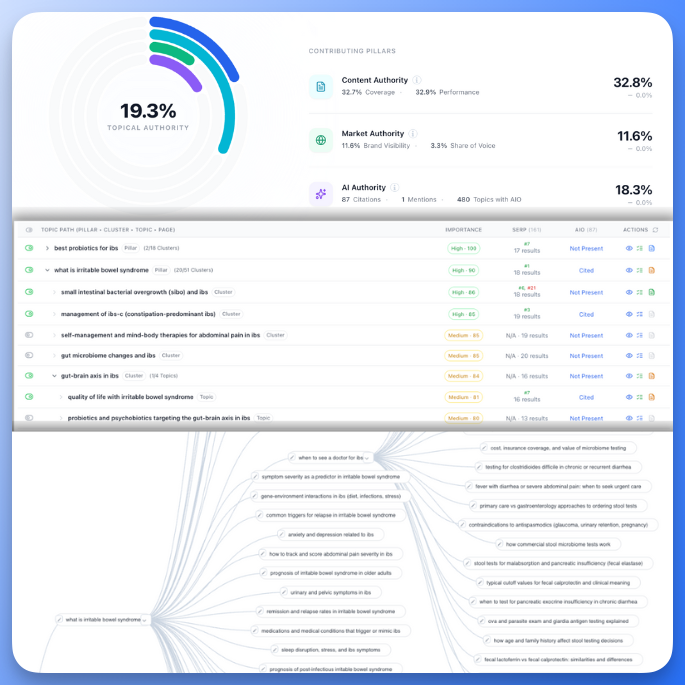
| Clustering depth | Builds hierarchical clustering up to four levels deep (pillar → cluster → topic → page), mirroring how your expertise is structured for humans and AI. | Produces flat or shallow (1–2 level) clusters. Helpful as a starting list of topics and subtopics, but not a full knowledge architecture. |
| Brand integration | Treats brand strategy as a first-class input. Mission, positioning, and voice are codified and carried into maps, briefs, and drafts. | Has no concept of brand voice or differentiation. Users with the same seed keyword see similar generic maps regardless of positioning. |
| Audience & personas | Uses buyer personas to shape topics and angles. Briefs can be targeted at specific personas so content reflects real customer needs. | Produces one-size-fits-all topic lists. Persona perspectives must be added manually later, outside the tool. |
| Content briefs | Includes an integrated brief builder that pulls in competitor outlines, link opportunities, and strategy cues to create rich briefs per topic. | Does not natively generate briefs. Maps must be exported to external AI tools or written manually to create outlines. |
| Execution workflow | Provides a closed-loop pipeline where the map feeds the Planner, briefs, drafts, and Authority Score—tracking what is published and how it performs. | Acts as a fire-and-forget generator. Once you export the map, execution happens elsewhere and the tool has no awareness of what shipped. |
| Optimization & authority | Embeds optimization into briefs and drafts, then measures Content, Market, and AI Authority so you know which topics truly move the needle. | Suggests titles and basic structures for topics, but has no integrated optimization or authority model. Ranking and AI impact depend on external tools. |
| Role in the stack | Designed as a strategic OS that replaces a patchwork of mapping, briefing, and tracking tools with one coherent system. | Designed as a point tool for quick topical maps. It adds another piece to your stack rather than consolidating it. |
Why teams choose Floyi instead of a Franken stack around Topical Map AI
Topical Map AI gives you a quick sketch of what to write about. Floyi turns that idea into a deep, brand-led map plus the briefs, drafts, and feedback loop to actually build authority.
Brand-led mapping
Floyi embeds your Brand Foundation and personas into topic generation so maps reflect how you want to be known, not just what a seed keyword suggests.
Four-level topical depth
Floyi’s maps go multiple levels deep, making it easier to see pillars, clusters, support articles, and how internal links should connect them.
Execution built in
Every topic in Floyi can become a brief and draft, and every published piece feeds back into your Authority Score—no separate project trackers required.
AI-era authority
Floyi tracks Content, Market, and AI Authority so you can see which mapped topics actually move rankings and AI visibility, not just which ones exist on a chart.
Unified workflows
Plan, brief, draft, and measure inside Floyi instead of bouncing between a mapping tool, spreadsheets, docs, and analytics platforms.
Scalable consistency
Floyi’s closed loop keeps structure, tone, and internal links consistent as you scale, something hard to achieve when your map lives in a CSV.
How Floyi and Topical Map AI can work together
Already used Topical Map AI? You can treat it as a rough draft and let Floyi become the living map that drives your ongoing content program.
Use quick maps as input, not the whole plan
If you’ve already built maps in Topical Map AI, you don’t have to start over. You can review the strongest sections of those maps and rebuild or refine them inside Floyi, layering on your Brand Foundation, personas, and authority goals.
From there, Floyi turns topics into briefs and drafts and tracks performance, so the map is no longer a static export—it becomes a living, evolving structure that reflects what you have actually shipped and how it performs in search and AI answers.
Over time, many teams find they rely on Floyi’s deeper, brand-led maps and closed-loop workflow as their primary system, with quick-mapping tools like Topical Map AI used only for occasional exploration.
Floyi vs Topical Map AI: common questions
Deciding between a quick mapping tool and a strategic OS? These answers help clarify where each one fits.
Is Floyi a replacement for Topical Map AI?
Floyi subsumes what Topical Map AI does—and extends it. Topical Map AI generates a quick map based on a seed keyword. Floyi generates deeper, four-level maps tied to your brand and audience, then turns them into briefs, drafts, and authority metrics. Many teams who start with Topical Map AI later move to Floyi when they need more than a one-off map and want strategy, execution, and measurement in one place.
Who is Floyi best suited for compared to Topical Map AI?
Floyi is built for teams that treat topical authority as an ongoing program—not a one-time mapping exercise. If you need to plan, publish, and measure across dozens or hundreds of topics, Floyi gives you the structure and feedback loop to do it. Topical Map AI is best when you simply need a quick topical map as a reference and are comfortable doing the planning, briefing, and measuring elsewhere.
Can I use Floyi and Topical Map AI together?
Yes. Some teams generate a fast map in Topical Map AI to explore ideas, then recreate or refine those topics inside Floyi’s Brand Foundation and Planner. Over time, as Floyi becomes the primary source of truth for maps, briefs, and drafts, Topical Map AI is often used less, reserved for exploratory sessions or sanity checks.
How does Floyi change the value of a point tool like Topical Map AI?
Topical Map AI solves the “blank page” problem for topic discovery, but it stops at the map. Floyi solves the entire lifecycle: discovery, mapping, briefs, drafts, internal linking, and authority tracking. That means the map you generate in Floyi isn’t an artifact you export and forget—it becomes a living structure that guides every brief and draft and reflects actual performance over time.
Ready to turn quick topical sketches into a deep, strategic map?
Topical Map AI can jumpstart ideas. Floyi gives you the connected system to turn those ideas into briefs, drafts, and measurable authority across search and AI.