
Floyi vs Surfer SEO
Strategy vs Article Edits
Floyi builds brand-led maps, briefs, and AI-benchmarked drafts so content is pre-optimized. Surfer SEO analyzes and fixes drafts after—or while—they’re written.
Quick overview
Surfer SEO shines at scoring and improving individual articles against the live SERP. Floyi shines at preventing unoptimized drafts in the first place—by encoding strategy, SERP signals, and authority goals into your briefs and drafts from day one.
When Floyi is the better fit
- You want a system that starts at brand and personas, not at the draft stage.
- You are building or defending topical authority across an entire domain.
- You want AI search visibility and SERP performance to drive what you publish next.
- You are ready to move beyond a Franken stack of separate planners, optimizers, and editors.
When Surfer SEO is the better fit
- You mainly need to optimize or generate individual SEO articles based on live SERPs.
- Your content strategy, briefs, and workflows are already handled in other tools.
- You prefer working inside a content editor with a visible content score and NLP term list.
- You are comfortable stitching Surfer into a stack of research, planning, and reporting tools.
Floyi vs Surfer SEO at a glance
Floyi is a pre-optimized content system. Surfer SEO is a post-draft optimizer and AI writer. Both can be useful—the question is whether you want to fix drafts or prevent misaligned drafts from being created at all.
| Feature | Floyi – outcome | Surfer SEO – outcome |
|---|---|---|
| Core role | Acts as a strategic operating system that replaces the Franken stack - brand, audience, topical map, briefs, drafts, and authority tracking all live in one closed loop. | Acts as a content optimizer and AI writing tool that analyzes current SERP winners and helps you improve or generate individual SEO articles. |
| Strategy layer | Codifies your brand, personas, and positioning so every topic, brief, and draft inherits the same strategic context automatically. | Is SERP- and page-driven. Strategy, brand voice, and personas remain in separate docs and processes outside Surfer. |
| Topical planning | Builds a hierarchical topical map tied to a Planner and Scorecard, including AI visibility impact, so you know which topics to tackle and in what order. | Surfer’s topical and keyword tools cluster terms and show coverage gaps based on SERP and GSC data, but connecting those clusters to a broader brand-led map is manual. |
| Content briefs | Generates strategy-anchored briefs with competitor headings, NLP terms, entities, questions, search intent, and internal links so drafts are pre-optimized. | Content Editor suggests headings, keywords, and NLP terms based on SERP analysis, but it typically comes into play after a draft exists or while writing inside Surfer. |
| AI writing & drafts | Writer and Editor agents generate drafts directly from Floyi briefs, so the first version already reflects the structure and signals a tool like Surfer would ask you to add later. | Surfer AI generates drafts based on SERP data, then relies on the Content Score and Editor recommendations to refine and complete the piece. |
| Optimization model | Pre-optimized content system—optimization is embedded in the brief and drafting process, so there is no separate “paste into optimizer and fix” step. | Post-draft optimizer—content is adjusted after or during writing to raise the Content Score and match SERP/NLP expectations. |
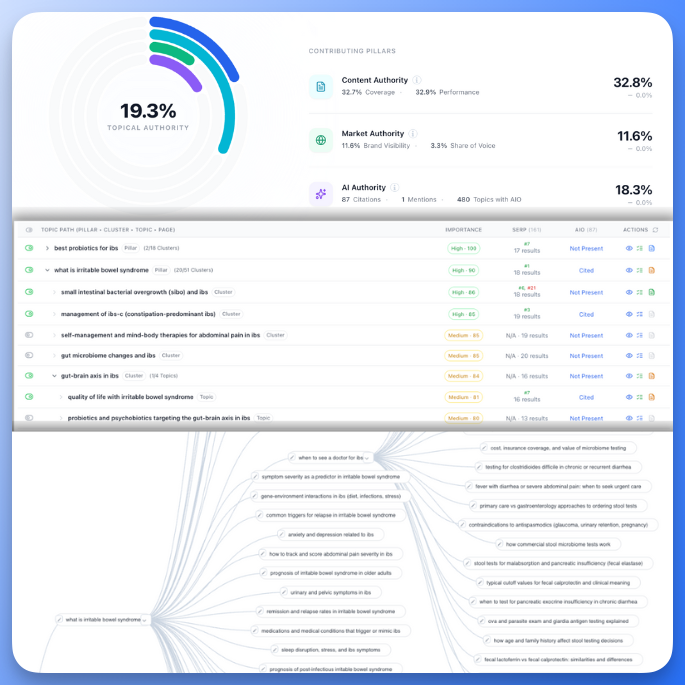
| Authority & AI visibility | Tracks Content, Market, and AI Authority together in a Scorecard and uses an Authority Planner so every published piece updates your roadmap. | Focuses on page-level content scores, audits, and keyword movement; authority modeling and AI citation tracking require additional tools. |
| Workflow model | One closed loop: plan → brief → draft → publish → authority update → next steps, all inside the same system. | One layer in a larger stack—best used alongside other tools for strategy, planning, and project management. |
Why teams choose Floyi instead of a Franken stack around Surfer SEO
Surfer SEO helps you fix and enhance drafts. Floyi gives you a strategy-first, closed-loop system so most of your content is born optimized instead of patched later.
Strategy-first planning
Floyi begins with your Brand Foundation and personas, turning them into topical maps and briefs so drafts carry your narrative and differentiation, not just keywords.
Pre-optimized briefs and drafts
Floyi’s briefs embed SERP and entity signals upfront, so first drafts already satisfy many of the requirements Surfer would point out in a later optimization pass.
AI-era authority
Floyi measures Content, Market, and AI Authority together, helping you choose topics and angles that build durable authority, not just improve a page score.
Unified workflows
Plan, brief, draft, and measure inside one environment instead of bouncing between planners, Surfer, docs, and CMS with manual copy-paste between each step.
Team alignment
Your strategists and writers share a single source of truth for what to create and why—reducing the risk that optimization tools pull content off-strategy.
Scalable consistency
Floyi’s closed loop makes it easier to apply consistent structure, tone, and internal linking across a large content program than ad-hoc optimization alone.
How Floyi and Surfer SEO can work together
You can keep Surfer SEO as a familiar optimization tool for select pages while letting Floyi run the strategy, mapping, and first-draft creation.
Use Surfer to polish, Floyi to prevent rework
If your team already relies on Surfer, you do not need to abandon it. Floyi can own the upstream work—turning brand and audience insight into topical maps, briefs, and AI drafts. Surfer can then be used as a final pass on mission-critical pages where you want an extra layer of SERP-aligned fine-tuning.
This pairing lets you move away from a reactive, “fix it in Surfer” mindset toward a proactive, strategy-led workflow. Surfer remains a valuable specialist, but Floyi ensures that most of your content already meets a high bar before you ever open an optimizer.
Over time, that shift means fewer last-minute rewrites, less Franken stack overhead, and a content operation that consistently advances your authority in both traditional search and AI answers.
Floyi vs Surfer SEO: common questions
Deciding between a content optimizer and a strategy engine? These answers highlight when each one fits best.
Is Floyi a replacement for Surfer SEO?
Floyi and Surfer SEO tackle different parts of the content workflow. Surfer is a powerful optimizer and AI writing tool for individual pages. Floyi is a closed-loop strategy and execution system that decides what to publish, generates briefs and drafts, and tracks authority. Many teams use Floyi as the primary system and keep Surfer as an optional optimizer for specific pages or legacy workflows.
Who is Floyi best suited for compared to Surfer SEO?
Floyi is ideal for content leaders and teams who need to run an entire program from brand and personas through topical maps, briefs, drafts, and authority metrics. Surfer SEO is best when your main need is to optimize or generate individual articles against current SERPs while your strategy, planning, and reporting live elsewhere.
Can I use Floyi and Surfer SEO together?
Yes. A common pattern is to use Floyi for strategy, mapping, briefs, and initial drafts, then, when needed, bring those drafts into Surfer for additional tweaking and Content Score checks. In that setup, Floyi ensures every piece fits your roadmap, and Surfer acts as a final optimization layer for select pages.
How does Floyi change the need for a tool like Surfer?
Surfer exists largely to fix drafts that were created without enough SERP or entity context. Floyi’s briefs and AI drafts already incorporate the competitive extraction and topical signals a tool like Surfer would highlight later. That means fewer emergency optimization passes and more time spent publishing content that is born aligned with both your strategy and the SERP.
Ready to move from post-draft fixes to pre-optimized content?
Surfer SEO is great at scoring and refining drafts. Floyi gives you the closed-loop system to create content that’s aligned with both your brand and the SERP from the start.