Floyi vs Semrush
Clarity vs Dashboards
Semrush gives you reports and tools. Floyi delivers a clear roadmap with maps, briefs, and AI benchmarking to scale authority across search and AI.
Quick overview
Semrush is a versatile SEO and marketing platform with dozens of tools and dashboards. Floyi is a focused, closed-loop system that decides what to publish next and keeps every map, brief, and draft connected to your authority goals.
When Floyi is the better fit
- You want a single roadmap that links brand, personas, topics, briefs, and drafts.
- You are focused on building topical authority across an entire niche, not just isolated keywords.
- You care about AI search visibility and need it integrated into planning, not just reporting.
- You’re ready to simplify a patchwork of content planning, briefing, and tracking tools.
When Semrush is the better fit
- You primarily need comprehensive SEO data, rank tracking, and competitive analysis.
- You already have internal systems for strategy, content planning, and production workflows.
- You prefer to keep content creation in existing editors or CMSs while using Semrush for guidance.
- You manage multiple channels (SEO, PPC, social) and want consolidated marketing reports.
Floyi vs Semrush at a glance
Floyi is a strategic OS. Semrush is a broad SEO and marketing toolkit. They can work together—but only Floyi is designed to keep brand, audience, topics, and execution in a single closed loop.
| Feature | Floyi – outcome | Semrush – outcome |
|---|---|---|
| Strategy integration | Unifies brand, audience, and topic strategy in one system. Every brief and page is guided by your mission, voice, and personas by default. | Provides deep SEO and market data (keywords, competitors, trends), but strategy modeling and persona integration live outside the platform. |
| Content planning | Builds hierarchical topical maps from your core topics and brand context, highlighting high-impact gaps and sequencing what to publish next. | Offers powerful tools like Keyword Magic and Topic Research to surface many ideas, but prioritization and structuring into a roadmap require manual effort. |
| AI search optimization | Tracks AI Authority—how often you are cited in AI answers—and bakes it into your Topical Authority Score so AI visibility is part of every planning decision. | Introduces AI Overview visibility tracking for generative search results, giving you data on AI presence but leaving optimization steps to your existing workflows. |
| Content creation | Generates briefs and full drafts with AI agents that follow your brand voice and topical map, including internal links and entity guidance by design. | Includes SEO Writing Assistant and content templates that recommend keywords and improvements, but writers still assemble and polish content in their own editors. |
| Workflow & execution | Acts as a closed-loop system: publishing content updates coverage and Topical Authority automatically and reprioritizes the roadmap from inside the same workspace. | Consolidates many SEO and marketing tools under one login, but execution still means exporting data, working in external docs or CMSs, and manually connecting the dots. |
| Consistency & control | Brand guidelines, personas, and internal linking patterns are encoded into briefs and drafts so content stays on-message and structurally coherent as you scale. | Helps you monitor performance and spot opportunities, but consistency of voice, narrative, and structure depends on separate processes and team discipline. |
| Role in the stack | Designed to replace a fragmented content stack by handling planning, briefs, drafts, and authority tracking in one closed loop. | Designed as a comprehensive SEO and marketing toolkit that plugs into your existing content and planning systems rather than replacing them. |
Why teams choose Floyi instead of a Franken stack around Semrush
Semrush gives you an impressive set of SEO and marketing dashboards. Floyi turns strategy, maps, briefs, and drafts into one connected system so nothing gets lost between tools.
Brand-led planning
Floyi starts with your Brand Foundation and personas so topic ideas, briefs, and drafts all reinforce your positioning and messaging instead of just following search volume.
Closed-loop authority model
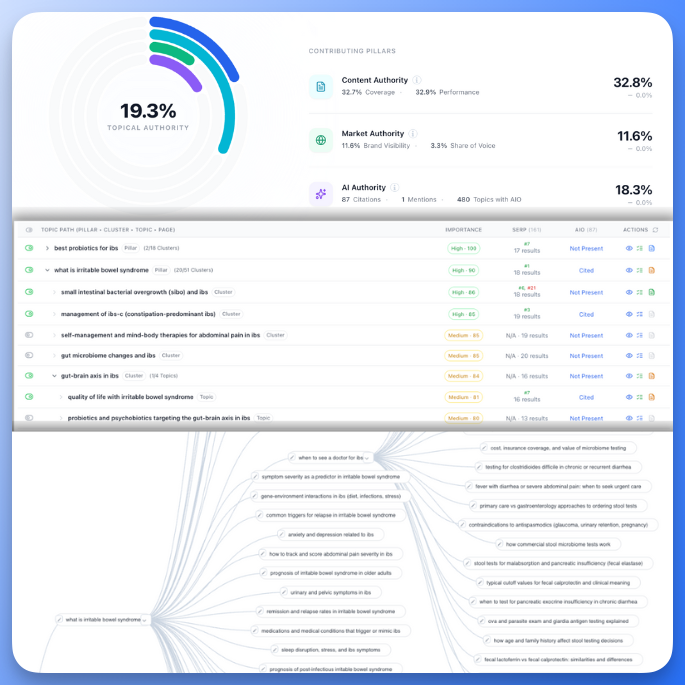
Topical maps, coverage, rankings, and AI Authority feed a single Scorecard and Planner that update as you publish, telling you exactly where to focus next.
Embedded AI visibility
Floyi treats AI visibility as a core metric from the start, helping you design content that earns citations in AI answers—not just on traditional SERPs.
Unified workflows
Plan topics, generate briefs, create drafts, and monitor impact in one environment instead of stitching together exports, docs, optimizers, and dashboards.
Team alignment
Strategists, writers, and leadership see the same roadmap and authority metrics, reducing misalignment between what gets researched and what actually ships.
Scalable consistency
Floyi makes it easier to maintain consistent structure, tone, and internal linking across hundreds of pieces, something that’s hard to enforce with disconnected tools alone.
How Floyi and Semrush can work together
You do not have to abandon Semrush to benefit from Floyi. Many teams keep Semrush as a data powerhouse and let Floyi run the content engine.
Use Semrush for data, Floyi for execution
Semrush remains one of the best sources of SEO and competitive intelligence. Floyi doesn’t try to replace that; it focuses on what happens before and after the analysis—turning insights into a coherent roadmap and executing that roadmap consistently.
In practice, teams often pull high-value topics, gaps, and competitive intel from Semrush, then use Floyi to organize those ideas into a topical map, generate briefs, and create AI-assisted drafts that follow their brand and audience context. Floyi’s authority metrics and AI visibility tracking then guide what to publish next.
Over time, Floyi becomes the operating system for strategy and execution, while Semrush remains an invaluable data source. You get the best of both: fewer Franken stack headaches and more clarity on what to do next.
Floyi vs Semrush: common questions
Still deciding how each platform should fit into your stack? Start with whether you need better data, a better system, or both.
Is Floyi a replacement for Semrush?
Floyi and Semrush play different roles. Semrush is an industry-standard SEO and marketing toolkit that excels at data and diagnostics—keywords, backlinks, competitors, and more. Floyi is a closed-loop content OS that uses strategy, topical maps, briefs, and drafts to execute a plan. Many teams keep Semrush for specialized data while relying on Floyi to own the roadmap and day-to-day execution.
Who is Floyi best suited for compared to Semrush?
Floyi is built for content and marketing leaders who need a single system that turns brand and audience insights into an executable content roadmap—deciding what to publish, when, and how it moves authority. Semrush is ideal when your primary need is broad SEO and competitive data and you already have strong internal systems for strategy, briefs, and production.
Can I use Floyi and Semrush together?
Yes. Many teams use Semrush for backlink audits, keyword and competitor research, and PPC insights while leaning on Floyi to turn those insights into topical maps, briefs, AI drafts, and authority tracking. In this setup, Semrush remains your SEO data hub; Floyi becomes the operating system that orchestrates content planning and execution.
How does Floyi handle AI search differently from Semrush?
Semrush’s AI Overview and related reports help you see where you appear in generative results. Floyi goes a step further by treating AI Authority as part of a unified Topical Authority Score and Authority Planner. Instead of AI visibility being a separate report, Floyi turns gaps in AI answers into prioritized topics and briefs inside your ongoing roadmap.
Ready to turn Semrush data into a connected roadmap?
Semrush can surface powerful SEO insights. Floyi gives you the closed-loop system that turns those insights into a living, AI-ready content strategy.