
Floyi vs MarketMuse
Strategy vs Topic Suggestions
Floyi builds maps, briefs, and AI-era benchmarks that are tied to your brand and audience. MarketMuse helps you plan and optimize individual topics and pages.
Quick overview
MarketMuse is a seasoned content optimization platform that helps you find topics, build briefs, and improve drafts. Floyi is a closed-loop strategy engine that decides what to publish, how it connects, and how it performs across both search and AI answers.
When Floyi is the better fit
- You want one system for brand, personas, topics, briefs, drafts, and authority metrics.
- You are mapping and defending an entire topical domain, not just optimizing isolated pages.
- You need AI search visibility and SERP performance tied into a single Scorecard.
- You are ready to reduce a Franken stack of planning, writing, and reporting tools.
When MarketMuse is the better fit
- You already have a strategy, personas, and workflows defined elsewhere.
- You mainly need to analyze existing content, find topic gaps, and guide writers with deep briefs.
- You prefer human-led drafting with AI assist inside a familiar optimization editor.
- You are comfortable managing planning, production, and reporting across multiple tools.
Floyi vs MarketMuse at a glance
Floyi is a strategic OS. MarketMuse is a content optimization platform. Both can improve your content; the key question is whether you need an engine that runs your whole program or a specialist that helps tune individual pieces. For data on how these approaches affect real publishing costs, see our content cost curve research.
| Feature | Floyi – outcome | MarketMuse – outcome |
|---|---|---|
| Content strategy layer | Acts as a closed-loop strategy engine that integrates brand mission, personas, and a hierarchical topical map to drive planning, briefs, drafts, and authority tracking. | Focuses on AI-driven content planning around topics and existing inventory. Strong at finding topics and gaps from your current site, but brand and persona strategy live outside the tool. |
| Brief generation | Generates strategy-coded briefs that inherit topic context, brand guidelines, internal link targets, and AI search considerations—all inside one planner. | Builds detailed content briefs that outline intent, questions, headings, related topics, and link suggestions, but ordering and brand alignment still require manual tweaking. |
| Content creation & drafting | AI agents create first drafts directly from Floyi briefs, with multiple writing intents to match your audience and AI visibility goals. Drafts are born aligned to your plan. | Supports human-first writing with AI assistance inside its editor. It intentionally avoids full one-click drafts; your team (or another writer) produces content and MarketMuse helps refine it. |
| Optimization model | Embeds optimization into briefs and drafts so there is no separate “paste into optimizer and tweak” phase. The same insights a scoring tool would surface are built into the initial draft. | Uses post-draft optimization via its Optimize editor and content scores. You write first, then adjust content to close gaps and raise scores based on MarketMuse’s recommendations. |
| Internal linking & structure | Built-in link intelligence suggests internal links and anchors during planning and briefing, helping your topical map and internal link graph stay coherent as you publish. | Provides link recommendations and a Connect view that surfaces internal link opportunities, but inserting and maintaining those links across your CMS remains a manual step. |
| Brand integration | Turns brand positioning, tone, and messaging into a living system that shapes every brief and draft. Personas can be selected to tailor angles and examples for specific segments. | Optimizes for topical coverage and quality, not brand identity. It does not ingest your brand guidelines; ensuring voice and narrative consistency is up to writers and editors. |
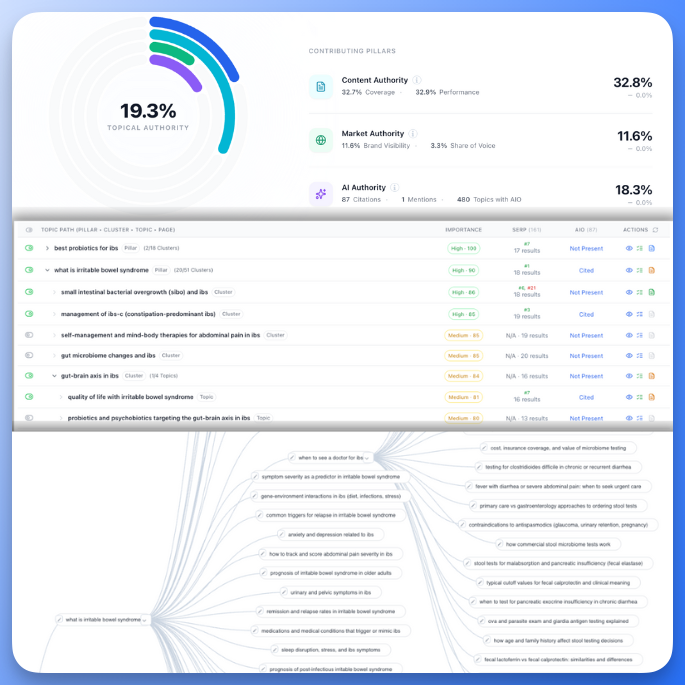
| AI search & authority | Tracks AI Authority—how often you are cited in AI answers—alongside content and market authority, feeding into a Topical Authority Score and Authority Planner that reprioritize your roadmap. | Reports SEO-centric metrics such as content scores and ranking coverage. It does not natively monitor AI search mentions, so AI-era authority requires additional tools. |
| Workflow & tool stack | Replaces a multi-tool Franken stack with one system where plan → brief → draft → authority metrics all live together, keeping execution tied tightly to strategy. | Improves planning and optimization, but still relies on external tools for brand, drafting, project management, and AI visibility, so you continue orchestrating a broader stack. |
Why teams choose Floyi instead of a Franken stack around MarketMuse
MarketMuse is excellent at topic suggestions and optimization. Floyi takes that idea further by turning brand, audience, and authority into a closed-loop content system.
Brand-led strategy
Floyi starts from your Brand Foundation and personas, ensuring every topic, brief, and draft reinforces your positioning instead of just chasing keywords.
Strategy-coded briefs
Briefs are generated from your topical map, SERP analysis, and AI visibility goals—complete with internal link targets and persona context baked in.
AI-era visibility
Floyi measures AI Authority alongside traditional rankings, helping you see whether you are the go-to source in both search results and AI-generated answers.
Unified workflows
Plan topics, generate briefs, create drafts, and monitor authority from one place instead of juggling planners, optimizers, writers, and spreadsheets.
Team alignment
Strategists, writers, and stakeholders all work from the same live roadmap and Scorecard, reducing misalignment between “what we planned” and “what we shipped.”
Scalable consistency
Floyi makes it easier to apply the same standards across hundreds of pieces, from internal linking to topic coverage, without relying on manual audits alone.
How Floyi and MarketMuse can work together
You do not have to choose on day one. Many teams let Floyi run the strategy, while MarketMuse remains a specialist optimizer where it makes the most sense.
Use MarketMuse to tune pages, Floyi to run the program
If your team already uses MarketMuse, Floyi can sit above it as the operating system. You define your Brand Foundation and personas in Floyi, build topical maps, and generate briefs and AI drafts there—then selectively bring important drafts into MarketMuse for extra scoring and refinement if needed.
This lets MarketMuse do what it does best—deep optimization and topic suggestions—while Floyi keeps the bigger picture intact: which topics to prioritize, how pieces connect, and how they impact your Topical Authority Score and AI Search Visibility over time.
Over time, many teams find that Floyi’s closed-loop workflow reduces how often they need separate optimization passes, freeing MarketMuse to be a targeted tool rather than the center of the stack.
Floyi vs MarketMuse: common questions
Still deciding where each platform fits? These answers summarize the biggest differences.
Is Floyi a replacement for MarketMuse?
Floyi replaces the strategic and operational layers many teams build around MarketMuse: mapping a niche, sequencing topics, generating brand-led briefs, drafting content, and tracking authority across search and AI. MarketMuse remains a strong content optimization and planning platform, but it is not designed to run your entire content operation. Many organizations find Floyi can become the operating system, while MarketMuse serves as an optional optimization companion during transition.
Who is Floyi best suited for compared to MarketMuse?
Floyi is ideal for SEOs, CMOs, and agencies who need a single system that connects brand, audience, topics, briefs, drafts, and authority metrics in one closed loop. MarketMuse is a great fit when you primarily want to improve how individual pages perform—discovering content gaps, building in-depth briefs, and optimizing drafts—while relying on separate tools for strategy and workflow.
Can I use Floyi and MarketMuse together?
Yes. Many teams use Floyi to define their Brand Foundation, build topical maps, and generate briefs and AI drafts, then bring those drafts into MarketMuse for additional scoring and refinement. In this setup, Floyi owns the roadmap and authority model; MarketMuse acts as a specialized optimizer for certain high-stakes pages or clients.
How does Floyi handle AI search differently from MarketMuse?
MarketMuse focuses on traditional SEO and content coverage metrics. Floyi goes further by tracking AI Search Visibility—how often your brand appears in AI-generated answers—and weaving that into your Topical Authority Score and Authority Planner. That means AI-era visibility is not just analyzed; it actively influences which topics and pages you prioritize next.
Ready to move from topic suggestions to a full strategy engine?
MarketMuse helps you refine and expand individual pages. Floyi gives you the system to decide what to publish, how it all connects, and how it performs across search and AI.