Floyi vs Keyword Insights
Roadmap vs Clusters
Floyi creates a brand-led roadmap of topics, briefs, drafts, and authority metrics. Keyword Insights gives you powerful clustering and outlines for individual pieces.
Quick overview
Keyword Insights helps you organize keywords into clusters and draft content faster. Floyi uses that same kind of SERP intelligence inside a broader strategy engine—one that connects brand, audience, topics, briefs, drafts, and authority tracking into a single roadmap.
When Floyi is the better fit
- You want one roadmap that links brand, personas, topics, briefs, and drafts.
- You are building or defending authority across an entire niche or category.
- You need AI search visibility and traditional rankings tied into one Scorecard.
- You are ready to reduce a patchwork of planning, briefing, and reporting tools.
When Keyword Insights is the better fit
- You mainly need SERP-based clustering and quick outlines from keyword lists.
- Your brand, personas, and workflows are already handled elsewhere.
- You are comfortable orchestrating briefs, drafting, and analysis across several tools.
- You want a focused topical SEO tool to plug into an existing stack.
Floyi vs Keyword Insights at a glance
Floyi is a closed-loop strategy OS. Keyword Insights is a topical SEO tool. Both can help you find what to write, but only Floyi is designed to keep your entire content operation synced to a brand-led roadmap. For a transparent look at how these workflows affect real costs, see our publish-ready cost comparison.
| Feature | Floyi - outcome | Keyword Insights - outcome |
|---|---|---|
| Brand & audience integration | Codifies your mission, voice, positioning, and buyer personas so every topic, brief, and draft is aligned to a real audience and a clear narrative. | Centers on keyword and SERP data. It does not ingest your brand foundation or personas, so brand voice and buyer nuance must be layered on manually. |
| Keyword & topic planning | Generates a hierarchical topical map (pillar → cluster → topic) that blends your brand inputs with SERP reality, so plans reflect both opportunity and strategy. | Excels at SERP-based clustering and topical grouping. Quickly shows which keywords belong together and surfaces gaps—but clusters are driven mainly by search data, not business priorities. |
| Content brief generation | Builds strategy-anchored briefs that inherit topic context, internal link targets, and persona insights. Outlines stay tied to your wider map and authority goals. | Auto-generates content briefs with headings, questions, and competitor insights that cover SEO fundamentals, but internal linking and brand tone need additional work outside the tool. |
| AI content generation | AI writing agents draft on-brand content directly from Floyi briefs, following your topic structure and brand guidelines by default. | Provides AI drafting inside its editor geared around your clusters. Drafts can be fast to produce but require manual checks to ensure brand and persona fit. |
| AI search & authority | Tracks Content, Market, and AI Authority in one Scorecard, so AI citations and SERP performance directly influence what you publish next. | Focuses on ranking and clustering metrics. Helpful for identifying which pages to create, but AI-era authority and feedback loops rely on additional tools and manual analysis. |
| Workflow & tool stack | Acts as a closed-loop OS where topics feed briefs, briefs feed drafts, and every publish updates coverage and authority—reducing the need for a 5-7 tool Franken stack. | Plays a strong role in research and outlining, but still expects you to manage briefs, drafting, and reporting across separate systems like docs, CMS, and analytics. |
Why teams choose Floyi instead of a Franken stack around Keyword Insights
Keyword Insights is excellent at clustering and outlines. Floyi uses that same idea inside a system that also encodes brand, audience, AI visibility, and authority into your daily workflow.
Brand-led planning
Floyi starts with your Brand Foundation and personas, then turns that strategy into maps, briefs, and drafts. Your narrative guides every decision—not just search volume.
Deeper topical mapping
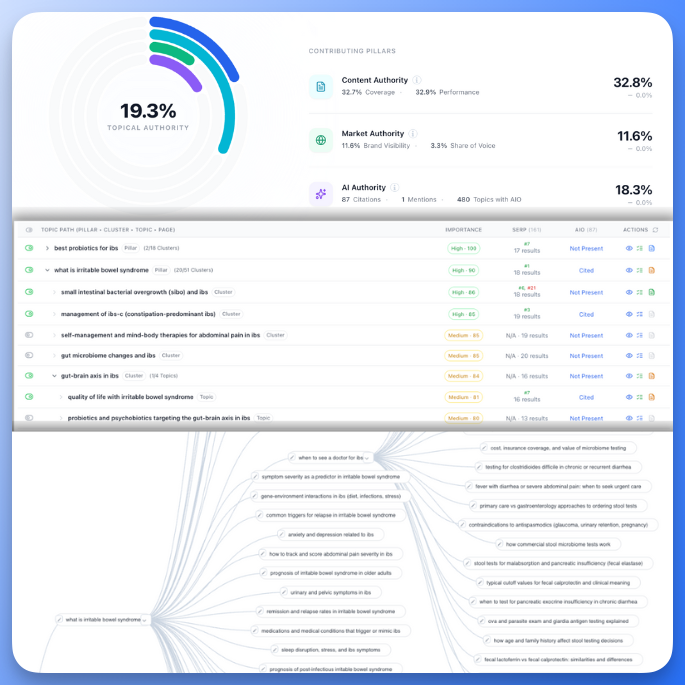
Move beyond flat keyword clusters into four-level maps that reflect how humans and AI understand your domain, so coverage and internal links stay coherent.
AI-era authority
Floyi measures Content, Market, and AI Authority together, helping you see where to publish next to grow both rankings and AI citations.
Unified workflows
Replace multiple disconnected tools with one environment for topic planning, briefs, drafts, and authority reporting, reducing copy-paste and context switching.
Team alignment
Strategists, writers, and leaders collaborate in one shared roadmap, not across scattered spreadsheets and documents tied loosely to a clustering tool.
Scalable consistency
Floyi makes it easier to maintain consistent structure, tone, and internal linking across hundreds of pages than a manual process built around exported clusters.
How Floyi and Keyword Insights can work together
If you already rely on Keyword Insights for clustering, Floyi can become the system that turns those clusters into a living, brand-led roadmap.
Use clusters as inputs, not the whole plan
Many teams begin with Keyword Insights to generate SERP-based clusters. Floyi can ingest those insights and place them in a larger context—your Brand Foundation, personas, and long-term authority goals—so clusters become part of a structured topical map instead of a standalone spreadsheet.
From there, Floyi generates briefs and AI drafts directly from that map, automatically updating coverage and authority metrics as you publish. Keyword Insights can remain in the mix for experimentation and advanced clustering work, but it no longer has to carry the burden of planning, briefing, and measurement on its own.
Over time, many teams find that Floyi’s closed-loop workflow reduces reliance on external spreadsheets and stitching multiple tools together—while still benefiting from any Keyword Insights projects they want to keep.
Floyi vs Keyword Insights: common questions
A quick FAQ for deciding whether you need a clustering tool, a content OS, or both.
Is Floyi a replacement for Keyword Insights?
Floyi replaces the strategy, planning, and execution layers that many teams try to build around Keyword Insights—topical mapping, brand-anchored briefs, AI drafting, and authority tracking. Keyword Insights remains a powerful clustering tool, but it does not run your entire content operation. Many organizations find Floyi can take over the “operating system” role, with Keyword Insights becoming an optional, specialized research add-on.
Who is Floyi best suited for compared to Keyword Insights?
Floyi is built for teams that need to own a topic category end-to-end: CMOs, SEOs, and agencies who want one system to align brand, audience, topics, and execution. Keyword Insights is best when your primary need is to cluster large keyword lists, identify content gaps, and spin up outlines quickly—within a broader stack that handles brand, workflow, and reporting.
Can I use Floyi and Keyword Insights together?
Yes. Some teams use Keyword Insights to explore SERP-based clusters or validate keyword targeting, then feed those learnings into Floyi’s Brand Foundation, topical maps, and briefs. Over time, Floyi’s own mapping and clustering can take on more of that workload, but if you already have workflows built around Keyword Insights, the two can coexist while Floyi centralizes strategy and execution.
How does Floyi help with AI search compared to Keyword Insights?
Keyword Insights focuses on SERP-derived structure and content opportunities. Floyi goes further by measuring AI Authority—how often you appear in AI-generated answers—and tying that into your topical map and Authority Planner. Instead of simply identifying clusters, Floyi helps you prioritize the pieces that will move your overall authority and AI visibility the most.
Ready to move from clusters to a complete roadmap?
Keyword Insights helps you find groups of keywords. Floyi turns that insight—plus your brand and audience context—into a system that plans, executes, and measures content at scale.