Floyi vs Frase
Blueprint vs Briefs
Floyi builds the full blueprint—maps, briefs, and AI-era benchmarks. Frase focuses on AI-assisted briefs and optimization scores for individual articles.
Quick overview
Floyi and Frase both help you create content that can win in search and AI answers—but they sit at different layers of your stack. Frase shines at drafting and optimizing individual articles. Floyi is the strategy engine that decides what to publish, in what order, and how it all connects into a coherent authority play.
When Floyi is the better fit
- You want a single blueprint that ties brand, personas, topics, briefs, and drafts together.
- You are mapping and managing an entire topic category or multi-site content program.
- You care about AI search visibility and need it connected directly to your roadmap.
- You are ready to reduce a Franken stack of separate research, brief, and reporting tools.
When Frase is the better fit
- You already have a separate strategy and topic map in place.
- You mainly need to research and optimize individual articles for SEO and GEO.
- Your team is small and prefers working inside a familiar editor with live scores.
- You are comfortable stitching together multiple tools for planning and reporting.
Floyi vs Frase at a glance
At a high level, Floyi is the blueprint and Frase is the brief. Floyi connects brand, audience, topics, briefs, drafts, and authority metrics into a single loop. Frase focuses on making each piece you write stronger inside its editor. Both can be valuable—the key is knowing which layer you actually need to fix. For a data-backed look at how these approaches affect content economics, see our independent cost analysis.
| Feature | Floyi – outcome | Frase – outcome |
|---|---|---|
| Overall strategy & role | Acts as a strategy-first content operating system. Brand, audience, topics, and authority tracking all live in one closed loop from plan to publication. | Primarily a content optimization and brief tool. Helps you research and refine individual pieces, but long-term strategy and planning live in other tools. |
| Briefs & research process | Generates research-heavy briefs by scraping competitors, integrating persona insights, and suggesting outlines that inherit your strategic context. | Creates AI-driven briefs from SERP data that highlight keywords, competitor headings, and questions, but you must manually add brand and persona context. |
| Content creation experience | AI agents draft articles directly from Floyi briefs, following your brand voice and topic structure so first drafts align with SEO and strategy by design. | Provides an editor with AI assistance and real-time scoring. Writers or AI generate sections and then refine them while watching SEO and GEO scores climb. |
| Optimization model | Embeds SEO and AI-ranking signals into briefs and drafts up front, often removing the need for a separate post-draft optimization pass. | Follows a “write first, optimize second” model where you adjust drafts after writing to improve content and GEO scores based on Frase recommendations. |
| Brand & audience integration | Every brief and draft is driven by your Brand Foundation and Audience Insights, keeping tone and messaging aligned to real buyer personas. | Offers light brand settings and tone controls, but optimization is primarily keyword and SERP-driven, with limited built-in governance for deeper brand strategy. |
| AI search visibility | Treats AI visibility as a core success metric. Floyi tracks AI Authority—how often you are cited in AI answers—and ties that directly to your content roadmap. | Includes SEO + GEO scoring and AI search tracking that reveal which pages get cited by AI systems, but turning those insights into a long-term plan is still manual. |
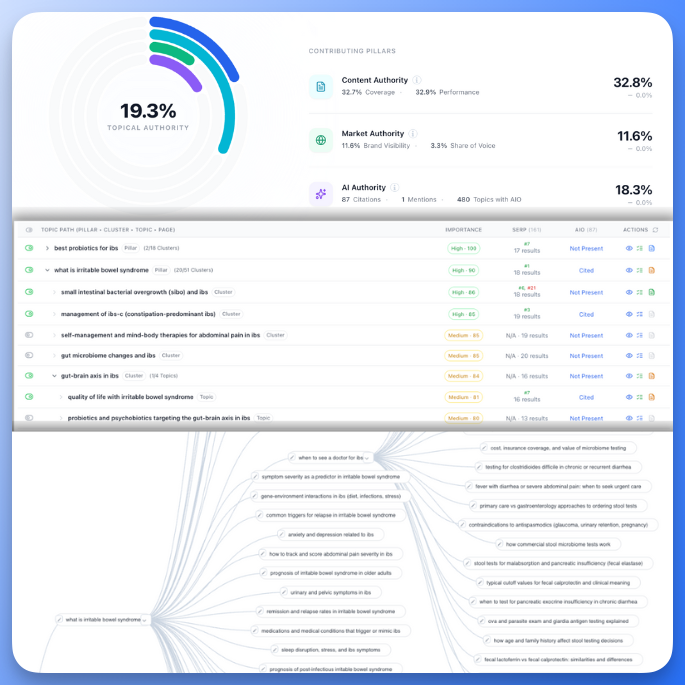
| Authority tracking & feedback loop | Provides an Authority Scorecard and planner that roll Content, Market, and AI Authority into a Topical Authority Score and reprioritize your roadmap as you publish. | Offers useful snapshots and alerts around rankings and AI citations, but lacks a unified authority model or closed-loop planner—teams still rely on external analytics. |
| Workflow & tool stack | Replaces a multi-tool Franken stack with an integrated workflow where topics feed briefs, briefs feed drafts, and every publish updates your strategy automatically. | Improves how writers create and optimize drafts, but remains one step in a broader stack. You still manage what happens before and after Frase with other tools. |
Why teams choose Floyi instead of a Franken stack around Frase
Floyi reimagines the entire content ops stack as one closed-loop system. Frase is a powerful brief and optimization tool, but it was never meant to be your strategy engine.
Strategy-first planning
Floyi starts from your Brand Foundation and Audience Insights. Topic ideas, briefs, and drafts all inherit that strategic DNA, so you scale without losing your voice.
Embedded optimization
The same signals a tool like Frase would ask you to add later are baked into Floyi briefs and first drafts, reducing rework and speeding up time to publish.
AI-era visibility
Floyi tracks Content, Market, and AI Authority, turning AI search visibility into a measurable, improvable metric—not just a one-off report.
Unified workflows
Replace multiple disconnected tools with one workspace that handles topic mapping, briefs, drafts, and authority reporting. Fewer logins, fewer leaks.
Team alignment
Strategists, writers, and stakeholders all operate from the same live roadmap and Scorecard, instead of juggling separate docs and dashboards.
Scalable consistency
Floyi makes it easier to enforce consistent structure and quality across dozens or hundreds of pieces, something hard to maintain with ad-hoc tools alone.
How Floyi and Frase can work together
You don’t have to rip out existing tools on day one. Many teams start by letting Floyi own the blueprint while Frase remains a familiar optimization layer.
Use Frase to tune drafts, Floyi to run the system
If your team already uses Frase, you do not need to abandon it to benefit from Floyi. Many organizations use Floyi to define their Brand Foundation, build topical maps, and generate briefs and AI drafts—then optionally send those drafts into Frase for additional scoring or on-page tweaks.
In this model, Floyi keeps the strategic backbone intact: what to publish, which personas it serves, how it fits into your map, and how it affects Content, Market, and AI Authority. Frase remains a specialized editor that helps polish individual pages, not the place where strategy lives or dies.
Over time, as teams grow more comfortable with Floyi’s closed-loop workflow, many find they can simplify their stack—relying on Floyi for more of the process and reserving Frase only for specific use cases or clients that require its scoring model.
Floyi vs Frase: common questions
Still deciding where each platform fits? These answers summarize the biggest differences.
Is Floyi a replacement for Frase?
Floyi replaces the strategic and operational layers that surround tools like Frase: topical mapping, planning, integrated briefs, AI drafting, and authority tracking. Many teams who use Frase today still need spreadsheets and extra tools to keep strategy connected—Floyi is designed to be that missing operating system. Some teams keep Frase for legacy workflows, but lean on Floyi for the blueprint and closed-loop execution.
Who is Floyi best suited for compared to Frase?
Floyi is ideal for content teams, agencies, and marketing leaders who need to run an entire content program against a clear strategy—mapping a niche, sequencing topics, and measuring authority across search and AI. Frase is a strong fit when your main need is to write and optimize individual articles faster inside an existing strategy and reporting stack.
Can I use Floyi and Frase together?
Yes. Some teams use Frase as an optimization layer on top of drafts that originate in Floyi. Floyi handles brand, personas, topic maps, briefs, and AI drafts; Frase can then be used for additional on-page scoring or GEO tweaks if your team already knows and likes that workflow. Over time, many teams find they can simplify by consolidating more of the process into Floyi.
How does Floyi handle AI search compared to Frase?
Frase’s GEO and AI-search tracking help you see which pages get cited by AI models and how to make those pages more “AI-friendly.” Floyi goes further by treating AI Authority as part of a unified Scorecard and Authority Planner. Instead of just reporting where you are mentioned, Floyi turns AI visibility gaps into prioritized topics and briefs, so improving AI citations becomes part of your ongoing roadmap—not a separate audit.
Ready to move from briefs to a full blueprint?
Frase helps you optimize individual pieces. Floyi gives you the system to decide what to create, how it all connects, and how it performs across search and AI.