
Floyi vs Ahrefs
Roadmap vs Raw Data
Floyi turns strategy into a closed-loop content system. Ahrefs gives you world-class SEO data. See how they compare—and where each one fits.
Quick overview
Both Floyi and Ahrefs help you win organic visibility—but they solve different parts of the problem. Ahrefs specializes in SEO datasets and diagnostics. Floyi is a closed-loop strategy and execution system that turns those kinds of insights into a connected map of topics, briefs, and drafts.
When Floyi is the better fit
- You want one system that connects brand, audience, topics, briefs, and drafts.
- You need topical maps, briefs, and AI drafts that all pull from the same strategy.
- Your team is tired of copy-pasting between tools and maintaining manual content plans.
- You care about AI search visibility and want it tied directly to your content roadmap.
When Ahrefs is the better fit
- You primarily need keyword, backlink, and competitive SEO data.
- Your strategy, briefs, and workflows are already handled in other internal systems.
- You have in-house analysts who enjoy stitching data across tools into a plan.
- You want a deep, standalone SEO toolbox rather than an end-to-end content system.
Floyi vs Ahrefs at a glance
The biggest difference is where each platform starts. Floyi begins with brand, audience, and topics and carries that context all the way through to briefs, drafts, and authority tracking. Ahrefs begins with SEO data—keywords, links, and rankings—and expects you to layer strategy and workflows on top.
| Feature | Floyi – outcome | Ahrefs – outcome |
|---|---|---|
| Brand & strategy integration | Codifies your mission, voice, and personas into a Brand Foundation that every map, brief, and draft inherits automatically. | No native brand or persona layer in planning or writing. A Brand Kit can guide its AI writer, but strategy lives mostly outside the tool. |
| Topic planning & mapping | Generates hierarchical topical maps from a core idea, grounded in SERPs and buyer intent, so you get a clear roadmap instead of scattered keywords. | Excels at keyword data via Keywords Explorer, but returns lists—not a structured content map—so clustering and planning happen in spreadsheets. |
| Briefs & content generation | Creates data-backed briefs from your topical map and SERP analysis, then feeds AI “writers” that draft content directly from those briefs. | AI Content Helper improves drafts in-app but behaves like a standalone editor, not part of a closed-loop system that updates a master plan. |
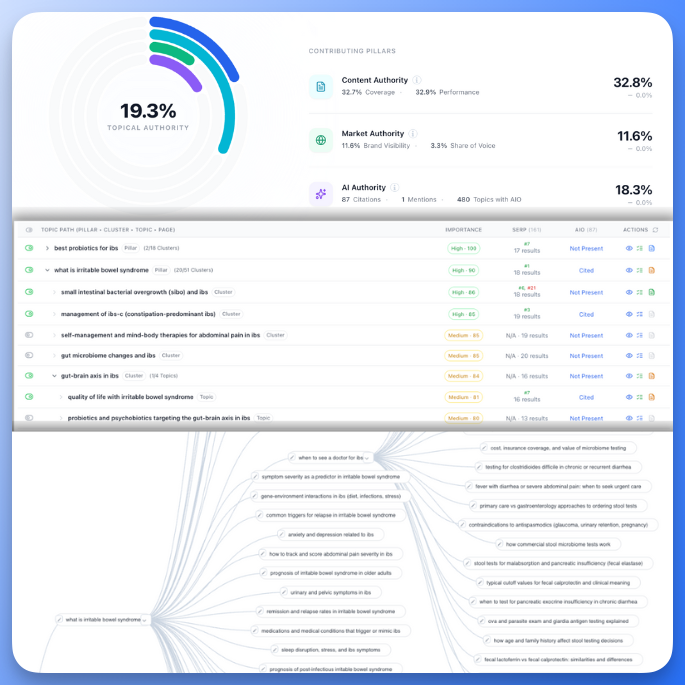
| AI search visibility | Tracks AI Authority—how often you appear in AI answers—alongside organic rankings. A Scorecard and Authority Planner point you to gaps to close. | Brand Radar shows where you and competitors are mentioned in AI answers, but turning those insights into a content plan is still manual work. |
| Performance & authority tracking | Blends coverage, market share, and AI visibility into a Topical Authority Score, updating automatically as you publish and helping prioritize next moves. | Offers powerful but siloed metrics (traffic, rankings, links). Connecting them back to a unified content strategy requires extra tools and analysis. |
| Workflow & execution | Replaces a 5–7 tool Franken stack with one system where the output of each stage is the input for the next—reducing context leaks and re-work. | Remains one tool in a larger stack (docs, CMS, project tools). Hand‑offs between apps increase the chance of narrative drift and slower execution. |
Why teams choose Floyi instead of a Franken stack around Ahrefs
Floyi is a closed-loop system that keeps strategy, research, and execution tightly connected. Ahrefs can power parts of that system, but it doesn’t run it for you.
Strategy-first planning
Floyi starts with your Brand Foundation and Audience Insights. Topic ideas, briefs, and drafts all inherit that context automatically, so you scale content without losing your voice.
Closed-loop execution
The output of one stage becomes the input for the next—topics feed briefs, briefs feed drafts, and published pages feed your authority metrics and future priorities.
AI-era visibility
Floyi tracks your presence in AI answers alongside traditional rankings. Authority gaps become concrete content opportunities instead of vague concerns.
Unified workflows
Replace multiple disconnected tools with one workspace that handles mapping, briefs, AI drafts, and performance tracking. Less copy-paste, fewer handoffs.
Team alignment
Everyone—from strategists to writers to editors—works from the same live plan. No more conflicting spreadsheets, ad-hoc briefs, or outdated docs.
Faster planning, fewer tools
Floyi customers often see planning time shrink dramatically because the system handles mapping, prioritization, and status updates behind the scenes.
How Floyi and Ahrefs can work together
You don’t have to choose on day one. Many teams pair Ahrefs’ deep SEO data with Floyi’s closed-loop strategy engine.
Use Ahrefs for diagnostics, Floyi for execution
Ahrefs remains one of the best sources for backlink data, keyword difficulty, and competitive SEO insights. Floyi doesn’t try to replicate that data layer—it focuses on what happens before and after the analysis: turning insights into a coherent plan, then executing that plan consistently.
In practice, many teams pull high-value topics and competitive gaps out of Ahrefs and then use Floyi to build topical maps, generate briefs, and draft content that carries their brand and audience context throughout. Once those pages are live, Floyi’s authority metrics and AI visibility tracking help decide what to publish next.
Over time, Floyi becomes the operating system for content strategy and execution. Ahrefs can stay in the mix as a specialized data source—but it no longer has to carry the full weight of planning, workflow, and consistency on its own.
Floyi vs Ahrefs: common questions
A quick FAQ to help you decide how each platform fits into your stack.
Is Floyi a replacement for Ahrefs?
Floyi replaces the strategic and execution layers that many teams try to cobble together around Ahrefs—planning, topical mapping, briefs, and AI-assisted drafting. Many customers begin by using Floyi alongside Ahrefs for backlink and keyword data, then gradually rely on Floyi as the primary system for planning and execution.
Who is Floyi best suited for compared to Ahrefs?
Floyi is designed for content teams, agencies, and marketing leaders who need a closed-loop system that turns brand, audience, and search insights into an executable roadmap. Ahrefs remains a strong fit when you primarily need deep SEO diagnostics, backlink analysis, and raw keyword datasets that plug into an existing internal strategy engine.
Can I use Floyi and Ahrefs together?
Yes. Many teams use Ahrefs for historical SEO data and competitive research while leaning on Floyi to turn those insights into topical maps, briefs, content drafts, and authority tracking. Floyi becomes the operating system that orchestrates execution, while Ahrefs acts as a specialized data source.
How does Floyi help with AI search compared to Ahrefs?
Ahrefs Brand Radar surfaces where brands are mentioned in AI answers, which is valuable visibility. Floyi goes a step further by tying AI Authority metrics into your content map and Authority Planner, so gaps in AI answers automatically translate into prioritized content opportunities instead of a static report.
Turn scattered SEO research into a connected content system
Keep Ahrefs for deep SEO data if you need it—use Floyi to turn that data, plus your brand and audience insights, into a roadmap your whole team can execute.