
| SEO | 19 min read
The 15-Minute Topical Authority Audit
Most Topical Authority SEO audits start in the wrong place. This three-pillar model diagnoses whether your real weakness is in content foundation, competitive position, or AI visibility — in about 15 minutes.
Most teams start their SEO audits in the wrong place.
They pull rankings. Check backlinks. Run a technical crawl. Flag missing meta descriptions. Generate a list of fixes and call it a strategy.
Those things matter. But they create false confidence.
You feel productive because you found broken links and thin content. You build a spreadsheet of issues. You report progress to stakeholders. And you still cannot answer the one question that actually matters: Are we building authority in this topic space, or just publishing pages?
I have seen this pattern repeat across dozens of sites. Teams spend six months optimizing, fixing, and reporting. Rankings improve slightly. Traffic inches up. But when you look at the competitive landscape, nothing changed. They are still behind on coverage. They are still outranked on the topics that drive revenue. They are still invisible when someone asks ChatGPT about their category.
The audit gave them answers. They were just the wrong answers.
The problem is not that you are missing an SEO audit. The problem is that you are missing an authority audit.
What Topical Authority Actually Means
Topical authority gets thrown around a lot. Most of the time it is used as a fancy way to say “we publish a lot of content.”
That is not what it means. A strong AI-powered content strategy treats topical authority as a system, not a volume metric.
Topical authority is whether you own meaningful territory in a topic space, and whether that territory shows up in both search and AI answers. You can have 500 pages and still not own anything. You can have 50 pages and own the space if the structure is right. For a full breakdown of what topical authority is and how to build it, start with the fundamentals.
The instinct when authority feels weak is to publish more. That is usually the wrong move. More content into a broken structure just makes the structure harder to diagnose and fix.
Authority compounds when three things are true at the same time:
Content Authority — You have the right content foundation. Major topics are covered, structure is clear, pages reinforce each other, and the most commercially important topics are prioritized.
Market Authority — You hold real ground relative to competitors. Not just present in the space. Meaningful share of visibility on the topics that matter commercially, and content that is at least as strong as what competitors are publishing on the same ground.
AI Authority — Your content can be found, understood and cited by AI search. Pages answer clear questions directly, entities are named, and your brand appears in AI-generated answers. Not just mentioned, but cited as a source.
You can be strong in one pillar and weak in the others. I see this constantly.
Good Content Authority, weak Market Authority — The foundation is there, but competitors are winning the space. You are doing the work in the wrong places.
Strong Market Authority, weak AI Authority — You own traditional search. But when someone asks an AI assistant about your topic, you are invisible or someone else gets the citation.
Strong AI Authority, weak Market Authority — You are mentioned and cited by AI engines, but you barely show up in traditional search results. Your content is referenceable. It just is not winning the market.
Weak Content Authority, high output — You are publishing constantly. The structure is scattered. Nothing compounds. You are building a pile of pages, not a system.
The most important pattern is the uneven one.
Most sites are not weak across all three pillars. They are strong in one or two and weak in the third. That is where authority breaks. You can be excellent at two things and still lose to a competitor who is decent at all three.
Authority usually breaks at the weakest pillar, not the strongest, and teams naturally keep reinforcing what they are already good at, which means the weak pillar stays weak.
The audit’s job is to make that visible.
Why Most Audits Miss This
Standard SEO audits focus on the wrong first questions.
They ask: How are we ranking? What technical issues exist? Where is traffic dropping? What backlinks are we missing? These are useful questions, but they are lagging indicators. They tell you what already happened. They do not tell you whether your authority is compounding, stagnating, or quietly eroding while competitors eat your territory.
An authority audit asks different questions first:
- Do we have the right content foundation, or are we missing major topics and subtopic depth?
- Are we winning meaningful territory versus competitors, or just ranking in isolation while they build more ground?
- Are we building content that AI systems can actually cite, or are we invisible to the search layer that is growing fastest?
Those questions are harder to answer with a rankings report. They require a different model. And most teams never build that model. They keep auditing the same things, fixing the same issues, and wondering why the competitive picture does not change.
Before building that model, there is one prerequisite most teams skip.
Before You Audit: You Need a Topical Map
This audit assumes you have a real topical map to assess against. Not a flat keyword list. Not a spreadsheet of topic clusters. A topical map is a hierarchical view of the topics your site should own, organized from broad to specific:
- Level 1: A broad main topic your site should own (e.g., “Content Strategy”)
- Level 2: A subtopic group within that main topic (e.g., “Content Briefs”)
- Level 3: A more specific topic within that group (e.g., “How to Write a Content Brief”)
- Level 4: A supporting detail or long-tail topic (e.g., “Content Brief Templates for SaaS”)
A keyword list tells you what terms exist. A topical map tells you how topics relate to each other, what supports what, and where the gaps are. It gives you a clear picture of what “complete” looks like for your topic space. Without one, questions about coverage, depth, competitive gaps, and structure become guesswork.
If you do not have a topical map yet, building one should be your first step before auditing anything. For a deeper walkthrough on building topical authority with AI, start there.
The Three Pillars in Practice
Content Authority: Looking Inward
Is your content foundation actually strong?
This is not about word count or publishing cadence. It is about whether the right structure exists. The sites with real Content Authority tend to share a few traits:
- Major topic areas are covered, not just a few obvious pages
- Each major topic has supporting subtopics beneath it
- Structure feels like a plan, not a backlog of random posts
- Internal links connect related pages in a way that reinforces the topic hierarchy
- Pages feel complete enough that a reader would trust the source
- Important pages rank well for the topics they target
- Publishing effort is weighted toward important topics, not just what is easiest to write
A site can publish constantly and still have weak Content Authority. Coverage without structure does not build authority. It just creates more pages that do not connect to anything. Publishing more into that situation makes it harder to fix, not easier.
If this is your weak pillar, do not just publish more. Map what is missing. Look at your topic structure and find the gaps. Check internal linking. Are related pages actually connected, or does each page sit in isolation? Then prioritize. Fix the highest-value topics first. Do not spread effort evenly across a broken foundation.
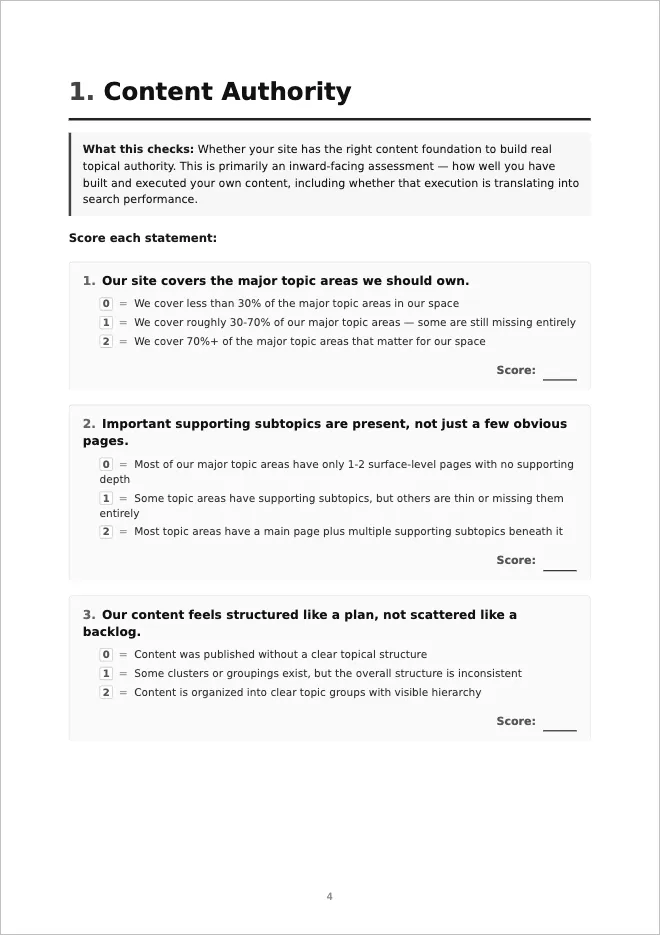
Floyi’s Authority Planner maps your topical structure with topic importance weighted, so you can see exactly where coverage is thin and where the highest-value gaps are, without building the comparison manually.
Market Authority: Looking Outward
How do you compare to the people you are actually competing with?
You might rank well. You might have good content. But if three competitors cover 40 more subtopics, outrank you on the most valuable searches, and produce stronger content on shared topics, your Market Authority is weaker than your Content Authority suggests.
This is where teams get blindsided. They look at their own metrics and feel good. They do not realize the competitive landscape shifted while they were optimizing meta descriptions.
Strong Market Authority tends to look like this:
- You know which competitors own the space and what they cover
- You can see where competitors are broader or deeper than you
- You have a clear view of which topical gaps are still open
- You hold meaningful share of search visibility across the topic space, not just isolated wins
- Your content quality matches or exceeds competitors on shared topics
- Publishing priorities are shaped by competitive gaps, not internal convenience
- Authority-building effort is tied to business value, not just gap-filling
A lot of teams audit in isolation. They look at their own performance without comparing it to competitive reality. Your rankings do not matter much if competitors rank higher on the topics that drive revenue, and your content quality does not matter much if competitors are producing more thorough, better-resourced content on the same ground.
If this is your weak pillar, stop auditing yourself in isolation. Identify the top 3-5 competitors for your topic space. Compare coverage. Where are they broader, where are they deeper? On topics you share, is their content actually stronger than yours? Which gaps are commercially valuable and which are noise? Your publishing priorities should reflect where you can win ground, not just where you have ideas.
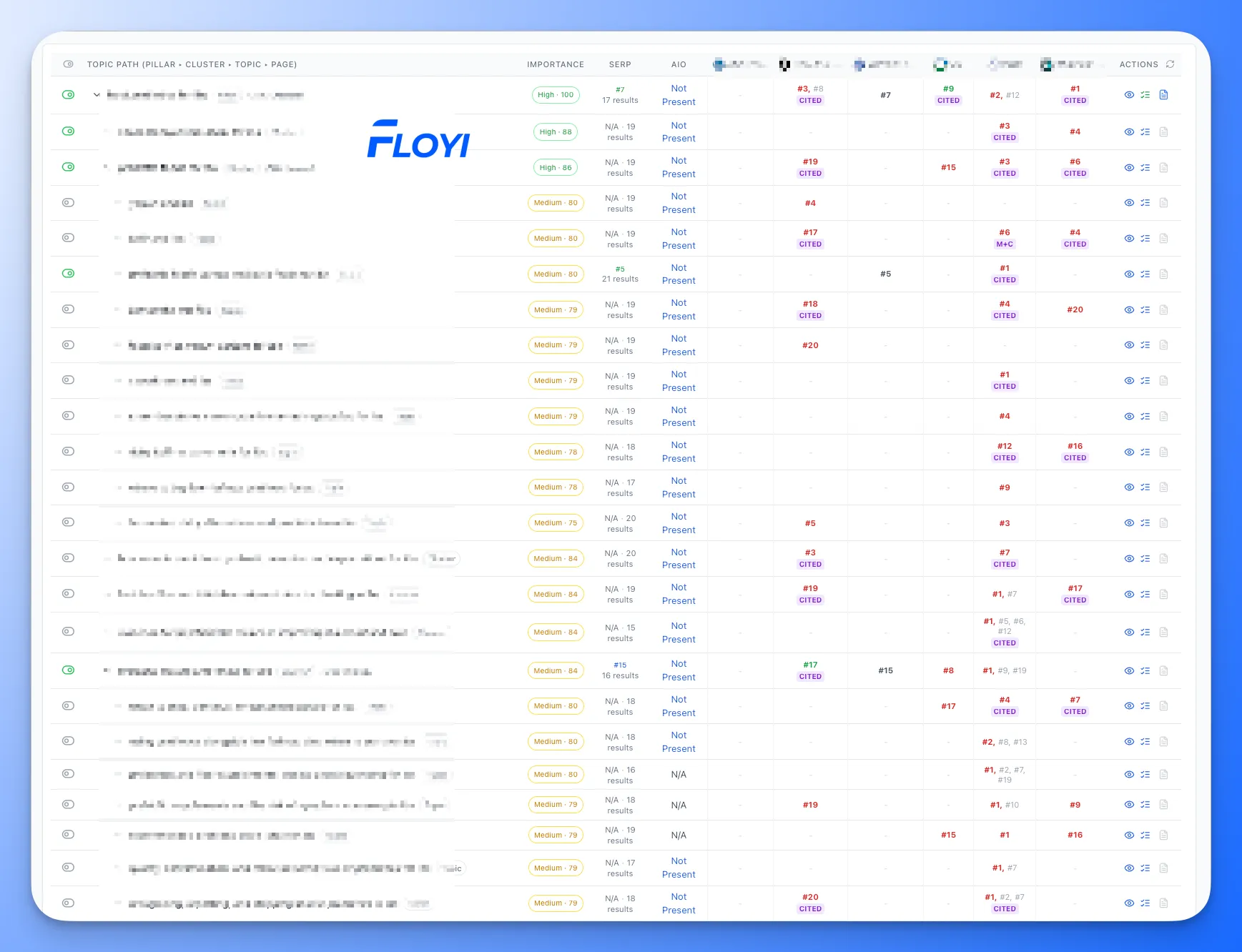
Floyi’s Competitor Matrix shows where your top competitors are ranking, mentioned, and cited across your topical map, side by side with your own position. You can see which topic clusters you are winning, where they are ahead, and where the open territory is. Start by strengthening the areas where you are already showing up. Then close the gaps that matter most.
AI Authority: Looking Forward
Can AI systems find, understand, and cite your content?
Before you assess this pillar, confirm the basics. If your content is blocked by robots.txt, requires JavaScript to render, or is not indexed by Google and Bing, AI search engines cannot retrieve it regardless of quality. Fix access issues first. Nothing else in this pillar matters if AI systems cannot reach your pages.
Ranking is not the question here. The question is whether your content is referenceable. AI search does not just return links. It synthesizes answers and cites sources it can extract from cleanly. A page can rank on page one and never get cited by an AI system because it buries the answer, uses vague language, or adds nothing beyond what fifty other pages already say.
Sites with strong AI Authority tend to share these traits:
- Pages answer clear questions directly, without burying the point
- Concepts, entities, and relationships are named explicitly and consistently
- Structure is clean enough to extract from, with headings, lists, and tables
- Content adds information gain beyond generic summaries — something only this source can say
- Pages look trustworthy and referenceable, not just publishable
- The brand appears in AI-generated answers for the topics it should own
- The brand is cited as a source, not just mentioned in passing
If this is your weak pillar, test your pages in AI search. Ask ChatGPT about your topic. Check Google AI Overviews. Check other AI search platforms. Does your brand appear? Are you cited as a source, or is someone else getting the mention? Review structure. Are answers buried, are entities explicit? Then add information gain. If your page says the same thing as thirty other pages, AI systems have no reason to cite you. Make it say something only you can say.
Then review structure. Pages with clear headings, concise definitions, short lists, and well-labeled tables are easier to extract from. That is what AI systems are doing when they decide what to cite: finding information that is easy to pull cleanly.
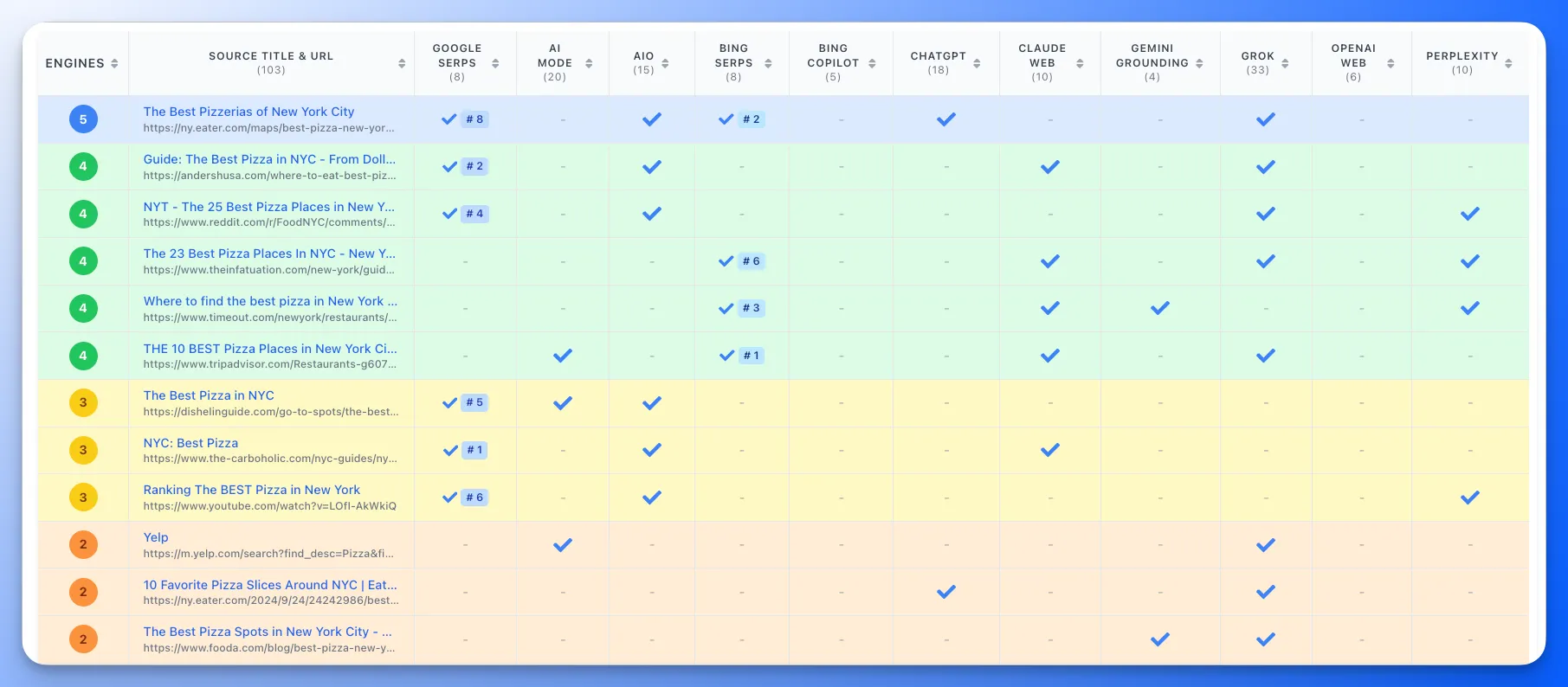
Floyi’s AIRS Analyzer fetches responses across 9 AI search platforms and shows you where your brand is mentioned, cited, or absent, by topic. Instead of manually checking each platform for every topic you care about, you get the full picture in one place.
What 15 Minutes Actually Gets You
Here is what makes this audit different from a standard SEO report, and why 15 minutes is enough to get directional clarity.
The scorecard is structured around the three-pillar model above. It has 21 specific questions across the three sections (7 questions per pillar) each scored 0, 1, or 2. You do not need tools. You do not need a data export. You need your topical map, an honest read of your own site, and maybe a competitor tab open.
Each question has clear scoring criteria so you do not have to guess whether something qualifies. A few examples of what the questions look like:
- Important supporting subtopics are present, not just a few obvious pages. Score 0 if most major topic areas have only 1-2 surface-level pages with no supporting depth. Score 2 if most topic areas have a main page plus multiple supporting subtopics beneath it.
- When we compare search results across our topic space, we hold a meaningful share of visibility, not just a few isolated wins. Score 0 if competitors consistently dominate search results across most of your topic space. Score 2 if your search presence is comparable to or stronger than your top competitors across most topic areas.
- Our brand is cited as a source in AI-generated answers, not just mentioned in passing. Score 0 if AI answers never link to or reference your content as a source. Score 2 if AI answers regularly cite your content as a source or reference.
At the end of each section, you get a total out of 14 that tells you whether that pillar is weak, mixed, or strong. Because all three sections use the same scale, you can compare them directly. The lowest score tells you where your authority is breaking.
That is what 15 minutes gets you: not a perfect audit, but a clear answer to the question most teams never ask, which pillar is actually the bottleneck? Once you know, you can track the right KPIs to measure whether authority is improving.
Here is what that picture looks like in practice:
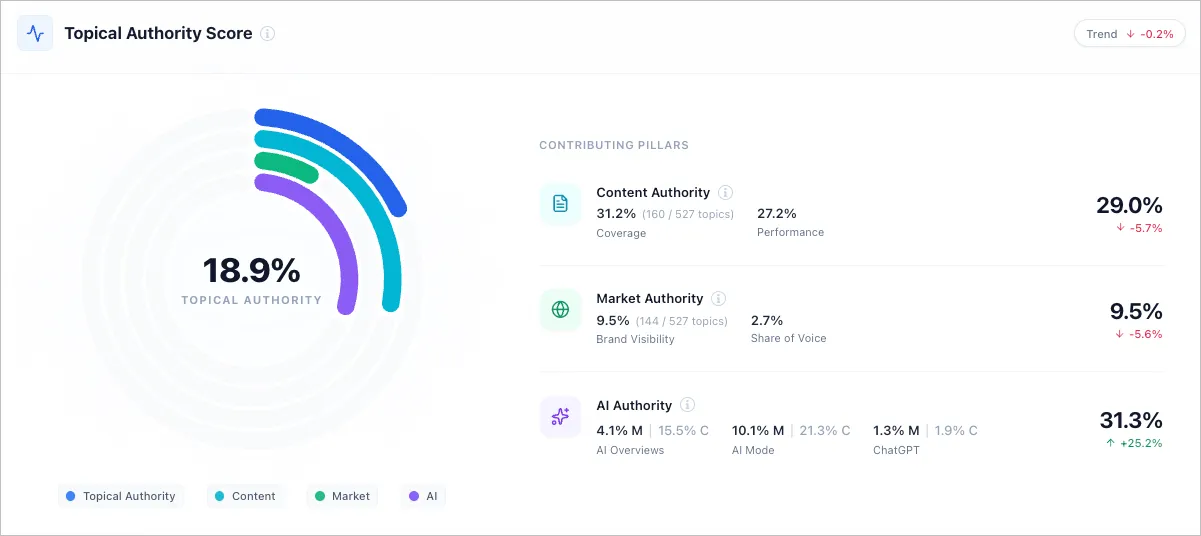
A site with a Content Authority score of 11, a Market Authority score of 4, and an AI Authority score of 9 does not have a publishing problem. It has a competitive visibility problem. The foundation is there. The AI-readiness is reasonable. But competitors are winning the space. That is a different fix than publishing more content, and without that picture, most teams would never see it clearly enough to act on it.
That clarity is what makes the next decision easier.
What Weak Scores Usually Reveal
Each weak pillar points to a different kind of problem:
- Weak Content Authority — the foundation needs work. Coverage is thin, structure is scattered, important subtopics are missing, or publishing effort is not weighted toward what matters. Publishing more will not help if the structure is wrong. It just adds to the pile.
- Weak Market Authority — you are losing ground to competitors. They are broader, deeper, ranking higher, or producing stronger content on shared topics. Your metrics might look fine in isolation. They look very different when you compare them against the people actually winning the space.
- Weak AI Authority — your content is not referenceable. It might rank. It might be well-written. But AI systems cannot extract from it cleanly, or they do not see it as worth citing. As AI search takes more share from traditional results, this gap compounds.
The most revealing result is usually the uneven one: strong in two pillars, clearly weak in one. That is the pattern that explains stalled performance most often. The weak pillar is the bottleneck, but because the other two look fine, teams keep working on the wrong thing.
What to Do When You Find a Weak Pillar
The audit tells you where to look. Here is how to start addressing what you find.
Fixing Weak Content Authority
The first move is not to publish more. It is to understand the shape of what is missing.
Take your topical map and compare it against what you have published. Where are the major topic areas with no coverage? Where do you have a main pillar page but no supporting subtopics? Where does the hierarchy break down? Look for pages that exist but sit in isolation, not connected to related content above or below them.
From there, prioritize by commercial value. Not all missing topics matter equally. The highest-value gaps are the ones closest to what your audience is searching for when they are ready to act, not just broadly interested. Fix those first. Do not spread effort evenly across a broken foundation; that just makes the foundation bigger without making it stronger.
Internal linking is the most overlooked fix. If related pages do not link to each other in a way that reflects the topic hierarchy (parent pages linking down to subtopics, subtopics linking back up) search engines and readers cannot follow the structure you intended. Connecting the existing pages properly is often faster than publishing new ones and delivers more authority signal immediately.
Floyi’s Authority Planner shows your topical map against what you have published, so you can see missing coverage, thin subtopics, and broken hierarchy in one view. Once you identify the gaps, topic importance weighting helps you decide which ones to fix first.
Fixing Weak Market Authority
The first move is to stop looking only at your own data and start mapping the competitive landscape properly.
Identify the top 3-5 sites that currently rank for the topics you care about. For each one, assess two things: how much of the topic space do they cover that you do not, and how strong is their content on the topics you share. Coverage breadth shows you where they have territory you are missing. Content quality on shared topics shows you whether you are losing on depth and execution, not just volume.
From there, build a gap list prioritized by commercial value. Not every gap is worth closing. Focus on territory where competitors are present but not dominant, or where your content could clearly be stronger. That is where you win ground fastest.
Realign your publishing priorities around that gap list. If your content calendar was built from internal ideas rather than competitive analysis, it is optimized for convenience, not for closing the right gaps. The test for every new piece: does this help win meaningful ground on a commercially important topic? If not, it should move down the list.
Floyi’s Competitor Matrix shows you exactly where competitors are broader and deeper, side by side with your own coverage, so you are not building a gap list from memory or guesswork. Filter by commercial value to see which gaps are worth closing and which are noise.
Fixing Weak AI Authority
Start by testing where you actually stand. Open ChatGPT, AI Mode and Google AI Overviews and search for the topics your most important pages cover. Does your brand appear in the answer? Are you cited as a source, or just mentioned in passing, or absent entirely? That is your baseline before you fix anything.
The most common reason for weak AI Authority is not technical. It is structural. AI systems extract from content that answers questions directly and names concepts clearly. If your pages bury the main point after several paragraphs of preamble, restructure them to lead with the answer. If key concepts, entities, and relationships are implied rather than named, name them. AI systems cite what is clearly written, not what can be inferred.
The second most common reason is information gain. If your page says the same thing as thirty other pages, AI systems have no reason to prefer yours. Add something genuinely distinct: original data, a specific point of view, a clearer framework, an example no one else has used. Generic summaries do not get cited. Content that says something only this source can say does.
Then review structure. Pages with clear headings, concise definitions, short lists, and well-labeled tables are easier to extract from. That is what AI systems are doing when they decide what to cite: finding information that is easy to pull cleanly.
Floyi’s Authority Planner tracks AI mentions and citations from AI Overviews, AI Mode, and ChatGPT against your topical map on an ongoing basis. As you restructure and improve pages, you can see whether those changes are translating into more citations, without re-checking platforms manually every time you update a page.
Download the Topical Authority Audit Scorecard
You now have a model for where to look. The scorecard gives you the 21 questions to find out exactly how weak each pillar is.
It takes about 15 minutes. No tools required. You score each question using the criteria provided, total each section, and compare the three scores directly. The interpretation guide tells you what your result means and what to investigate next.
If you have been wondering why your authority is not compounding the way it should, why rankings are okay but competitive position is not moving, or why traffic exists but AI search ignores you, this is where you find out which part of the system is actually breaking.
Download the Topical Authority Audit Scorecard →
The Real Risk
Most teams do not have a publishing problem. They have an authority visibility problem.
They cannot clearly answer whether their content foundation is strong, whether they are winning competitive ground, or whether they are visible in AI search. So they optimize what they can measure. They fix what shows up in the audit tools. They report on rankings and traffic and backlinks. And they spend months, sometimes years, working hard on the wrong problems.
The real risk is not weak authority. It is spending another quarter fixing the wrong thing because you never looked at the right picture.
A better audit model does not solve everything. But it makes the right problem visible, and that is where everything else starts. Because if you audit the wrong thing, you fix the wrong thing. And if you fix the wrong thing long enough, you wake up one day and realize the competitive landscape moved while you were optimizing meta tags.
About the author

Yoyao Hsueh
Yoyao Hsueh is the founder of Floyi and TopicalMap.com. He created Topical Maps Unlocked, a program thousands of SEOs and digital marketers have studied. He works with SEO teams and content leaders who want their sites to become the source traditional and AI search engines trust.
About Floyi
Floyi is a closed loop system for strategic content. It connects brand foundations, audience insights, topical research, maps, briefs, and publishing so every new article builds real topical authority.
See the Floyi workflow